
What investors should check before applying for an IPO?
An initial public offering gives investors an opportunity to apply for shares when a company offers its equity to the public. The excitement around a new listing can be high, particularly when an upcoming IPO receives strong media attention. However, an IPO application should be treated as an investment decision, not as a shortcut to listing gains.
Before applying, investors should understand the company, the offer structure, valuation, risks and the purpose for which the business is raising money. The offer documents provide much of this information. Spending time on these details can help investors separate a fundamentally understandable opportunity from market noise.
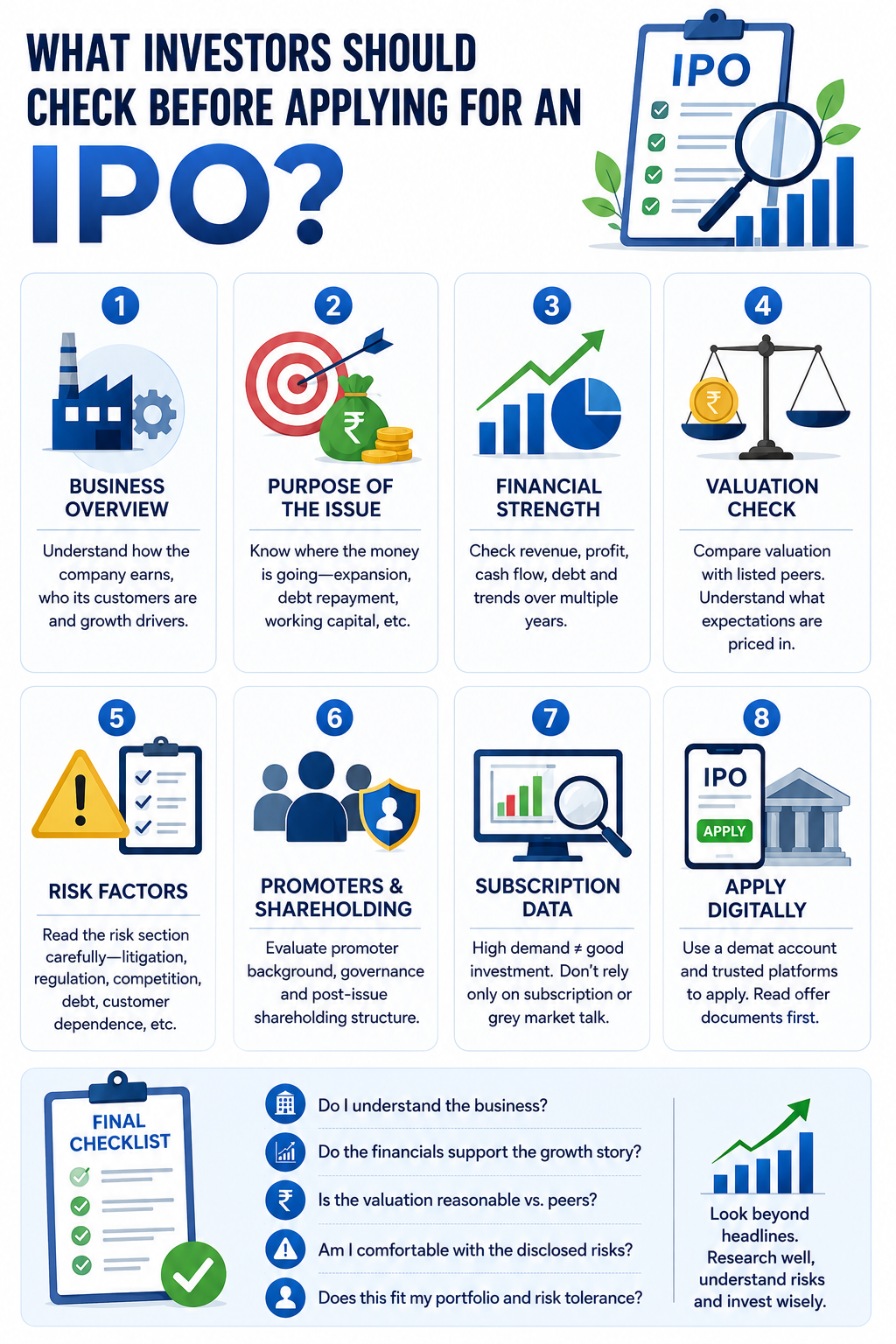
Check before Applying for an IPO? What does the company actually do?
Start with the business model. An investor should be able to explain in simple language how the company earns revenue, who its customers are and what can affect future demand.
A rapidly growing company is not automatically a strong investment. Look at whether revenue growth is translating into sustainable profitability or improving business economics. If the company is loss-making, understand why it is losing money and what management says about the path ahead.
Investors should also examine how dependent the business is on a particular product, customer, supplier or geography. Heavy dependence can increase risk if conditions change.
Track Live : IPO – Latest & Upcoming IPOs List 2026 | Check Live BSE NSE IPOs
Why is the company raising money?
The purpose of the issue can reveal a lot about management’s priorities. An IPO may raise fresh capital for expansion, debt repayment, working capital or other corporate requirements. It may also include an offer for sale, where existing shareholders sell part of their holdings.
These are not automatically positive or negative signals. The important step is to understand where the money is going. Fresh capital intended for capacity expansion, for example, serves a different purpose from an issue where a large proportion represents an exit by existing shareholders.
The offer documents explain the objectives of the issue and should be read before applying.
How strong are the financials?
Revenue, profit, cash flow and debt deserve attention before an upcoming IPO application. Do not judge the business from a single year’s numbers.
Look at trends across multiple reporting periods. Is revenue growing consistently? Are profit margins improving or shrinking? Is debt manageable relative to the size of the business? Does the company generate operating cash flow?
Investors should also distinguish accounting profit from actual cash generation. A company may report profits while still requiring substantial cash to fund operations or expansion.
Read More : Bankex Put Option Jumps 16,500% in Minutes — Traders Blame New Closing Auction
Is the valuation reasonable?
Even a good company can become an unattractive investment at an excessively high valuation. Investors can compare valuation measures with listed peers operating in similar businesses, while recognising that no two companies are exactly alike.
Common measures may include price-to-earnings, price-to-book or enterprise-value-based ratios, depending on the industry and financial profile. The goal is not to find the cheapest issue. It is to understand what expectations are already reflected in the offer price.
Investors should be cautious about assuming that strong demand automatically means the valuation is attractive.
What risks does the offer document highlight?
Risk factors are easy to skip because these sections can be lengthy, but they are among the most useful parts of an offer document. They may discuss litigation, regulatory dependence, customer concentration, competitive pressure, debt obligations, related-party transactions and industry-specific challenges.
Reading these risks helps investors understand what could go wrong. It can also reveal factors that are not obvious from promotional material or market discussions.
An IPO is still an equity investment. The share price can rise or fall after listing, and there is no assurance of a listing gain or future return.
Track Live : NSE Option Chain — Live
Who are the promoters and key shareholders?
Investors should understand who controls the company, how ownership may change after listing and whether promoters or existing shareholders are selling a substantial stake.
Reviewing management experience, promoter background and corporate governance disclosures can provide additional context. Past regulatory issues, major disputes or governance concerns should not be ignored simply because the issue is popular.
The post-issue shareholding structure also helps investors understand the level of promoter ownership and public participation after the listing.
Should subscription numbers influence your decision?
Subscription data can show market demand, but it should not replace fundamental research. A heavily subscribed issue can still list weakly, while an IPO with moderate demand can perform differently over the long term.
Grey market discussions should also be treated carefully because they are unofficial and do not guarantee listing performance. Investors should make decisions from regulated disclosures and their own assessment rather than informal price signals.
How can investors apply digitally?
Investors generally need a demat account and the required banking setup to apply for public issues through supported channels. Digital brokerage platforms can simplify access to issue information and the application process.
Bajaj Broking, for example, provides eligible investors with a digital route to participate in public issues through its platform. Before applying, investors should still read the relevant offer documents and independently evaluate suitability rather than relying only on platform availability.
What is the final checklist before applying?
Before submitting an IPO application, ask five questions. Do I understand the business? Do the financials support the growth story? Is the valuation reasonable compared with relevant peers? Am I comfortable with the disclosed risks? Does this investment fit my overall portfolio and risk tolerance?
If any of these answers is unclear, further research may be more valuable than rushing to apply.
An upcoming IPO can be interesting, but investor discipline matters more than excitement. Looking beyond headlines, reviewing offer documents and understanding both potential and risk can lead to a more informed application decision.