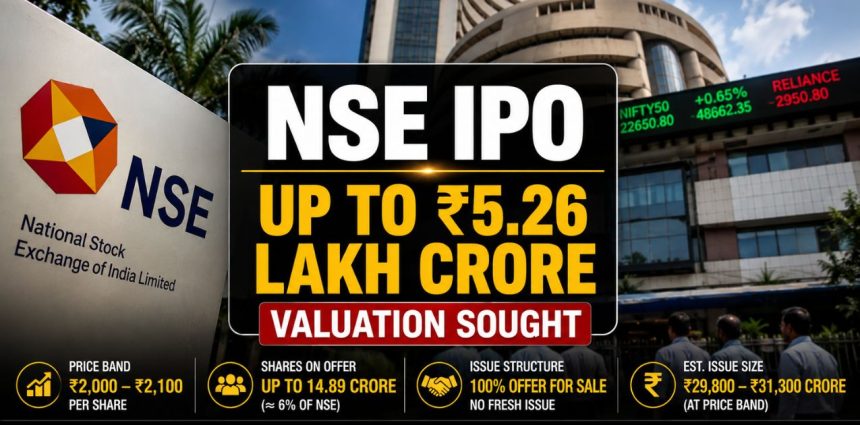
NSE has marketed shares to global investors at ₹2,000–₹2,100 apiece, SEBI’s approval has slipped roughly three weeks, and equity-options transaction revenue alone accounted for about 60% of operating revenue in FY26.
Quick Take
- NSE has marketed its IPO to global investors at ₹2,000–₹2,100 a share, implying a valuation of up to ₹5.26 lakh crore (~$55 billion), Bloomberg reported the exchange is seeking this valuation according to people familiar with the matter.
- The offer for sale consists of 14.89 crore shares without any fresh issue component — the exchange itself will not receive any IPO proceeds.
- SEBI’s observation letter, earlier expected by early-to-mid August, has been pushed back by around three weeks following changes to the list of selling shareholders, including the addition of SBI Capital Markets.
- NSE’s FY26 revenue fell 3% to ₹16,601 crore and profit declined 15% to ₹10,302 crore, even as Q1 FY27 revenue fell 8.2% sequentially to ₹4,560 crore while net profit rose 8.7% quarter-on-quarter to ₹3,120 crore.
- Per NSE’s own DRHP, transaction charges made up 78.65% of operating revenue in FY26, with options trading alone contributing 60.22% of revenue from operations.
NSE Seeks Record ₹5.26 Lakh Crore Valuation
National Stock Exchange of India Ltd., operator of the world’s largest derivatives exchange by trading volume, is seeking a valuation of up to ₹5.26 lakh crore ($55 billion) in its planned IPO, according to people familiar with the matter who asked not to be identified because the information is private. The exchange has been discussing a price band of ₹2,000–₹2,100 per share with prospective investors and has completed most of its international roadshow, with meetings in the Middle East still pending.
The report cautions that the numbers remain fluid, deliberations are ongoing, and the valuation, deal size and structure could still change before the offer is finalised. That matters for anyone reading ₹5.26 lakh crore as a settled number: it’s a marketing input, not a locked-in price.
Also Read: NSE IPO Likely to Get SEBI Approval in August; Rs.30,000 Crore Issue May Open in September
The Deal Math: Price Band, OFS Size and Structure
At the marketed range, the sale of up to 14.89 crore equity shares, roughly 6% of NSE, would raise close to ₹29,800–31,300 crore based on the price band alone. That could surpass Hyundai Motor India’s ₹27,870 crore IPO from 2024, currently the country’s largest, making NSE’s listing India’s biggest share sale on record.
The offering stays structured entirely as an Offer for Sale. Because the issue is entirely an OFS, NSE itself will not receive IPO proceeds; the money goes to the existing shareholders selling their stakes, led by State Bank of India. LIC, NSE’s single largest shareholder at 10.72%, is not participating and will retain its full stake through the listing.
The Earnings Picture: A Weak Year, a Strong Quarter
The valuation question sits on top of a genuinely mixed earnings picture. For the full year FY26, NSE’s revenue fell 3% to ₹16,601 crore from ₹17,141 crore, while net profit declined 15% to ₹10,302 crore from ₹12,188 crore in FY25 — a slowdown driven mainly by a decline in transaction-charge, clearing and settlement income amid cooling derivatives activity.
Q1 FY27 tells a different story. Consolidated revenue from operations fell 8.2% sequentially to ₹4,560 crore for the quarter ended June 30, down from ₹4,968 crore in the March quarter. Net profit, however, rose 8.7% quarter-on-quarter to ₹3,120 crore from ₹2,871 crore, while EBITDA margin expanded sharply to 77.9% from 73.1%, even as EBITDA itself was marginally lower.
That combination, lower sequential revenue alongside higher profit and margin, gives investors another number to examine before assigning a valuation to the exchange, on top of an annual print that was down double digits.
NSE IPO — Key Deal Metrics
| Metric | Detail |
|---|---|
| Valuation sought | Up to ₹5.26 lakh crore (~$55 billion) |
| Price band marketed | ₹2,000 – ₹2,100 per share |
| Shares on offer | Up to 14.89 crore (~6.02% of NSE) |
| Issue structure | 100% Offer for Sale; no fresh issue |
| Estimated issue size | ~₹29,800 – ₹31,300 crore |
| FY26 net profit | ₹10,302 crore (-15% YoY) |
| Q1 FY27 net profit | ₹3,120 crore (+8.7% QoQ) |
| DRHP filed | June 17, 2026 |
| Largest selling shareholder | State Bank of India (+ SBI Capital Markets, added Aug 10) |
| Non-participating shareholder | LIC (retains 10.72% stake) |
Check Live: IPO Dashboard 2026 (SME & Main Board at NSE/BSE)
Can NSE’s Earnings Justify a ₹5.26 Lakh Crore Valuation?
NSE wants to enter India’s public markets at up to ₹5.26 lakh crore against a year in which profit fell 15%. The exchange has the dominance to make the ask plausible: its DRHP puts cash-market turnover share at 92.99% and equity futures turnover share at 99.79%.
But a large share of NSE’s operating revenue is linked to transaction activity, with equity options alone accounting for about 60.22% of operating revenue in FY26, which is precisely why the FY26 dip and the Q1 FY27 rebound both trace back to the same lever: derivatives volumes.
The ₹5.26 Lakh Crore Question: How Much Depends on Options?
This is the part a valuation headline alone doesn’t answer. Per NSE’s DRHP, transaction charges accounted for 78.65% of operating revenue in FY26, with options trading alone contributing 60.22% of total revenue from operations. Equity futures added another 8.92%, putting the derivatives segment’s combined share of revenue from operations at roughly 69.14%.
NSE’s DRHP also shows that its top 10 trading members accounted for 46.78% of operating revenue in FY26, highlighting another concentration risk beyond product mix: a relatively small group of large brokerages drives a significant share of exchange activity, so any shift in their trading behaviour, market share or relationship with NSE could move the topline more than a diversified revenue base would allow.
SEBI has already tightened the derivatives framework since 2024–25, including curbs on weekly expiries and higher transaction costs; a further move to cool speculative options activity would land directly on NSE’s largest revenue line. Investors weighing the ₹5.26 lakh crore valuation are effectively making a long-term bet on the durability of India’s options-led trading boom.
NSE’s Revenue Concentration in Derivatives (FY26, per DRHP)
| Revenue Source | Share of Operating Revenue |
|---|---|
| Transaction charges (all segments) | 78.65% |
| Options trading alone | 60.22% |
| Equity futures | 8.92% |
| Derivatives segment combined | ~69.14% |
| Top 10 trading members | 46.78% of operating revenue |
Why SEBI’s Nod Has Slipped Past August
Merchant bankers had earlier pointed to an early-to-mid-August observation letter, clearing the way for a September listing. That timeline has slipped roughly three weeks, and the trigger looks procedural rather than substantive: an August 10 addendum split State Bank of India’s stake sale between the bank and its wholly owned subsidiary, SBI Capital Markets.
The change is understood to have triggered a fresh 21-day public-feedback period, according to people familiar with the process, pushing the expected observation letter closer to early or mid-September.
SBI Capital Markets will offload roughly 87.8 lakh shares it received as bonus shares in a November 2024 bonus issue, and its role as one of the offer’s book-running lead managers narrows once it becomes a seller, under SEBI’s merchant banker regulations.
The delay sits alongside a separate, older matter now largely resolved on the payment side. In its June quarter, SEBI, via an email dated July 30, gave in-principle acceptance of settlement terms and demanded ₹714.74 crore in addition to the ₹776.47 crore already deposited; NSE’s board approved the payment the same day.
The payment covers the ₹1,491.21-crore settlement amount disclosed by NSE for the decade-old co-location and dark-fibre case, although related Supreme Court proceedings remain pending.
Who’s Selling: Inside NSE’s Shareholder List
The core selling group is State Bank of India and SBI Capital Markets, alongside Canada Pension Plan Investment Board, Bank of Baroda, MS Strategic (Mauritius) and Aranda Investments (Mauritius), plus a cluster of public-sector insurers including General Insurance Corporation of India. LIC, which holds NSE’s largest single stake, is sitting this offer out entirely. The full seller list, with exact share counts, is in the DRHP.
Where NSE Would Rank Among Global Exchanges
At the top of its marketed band, NSE would sit among the larger listed exchange operators globally, though well behind the two biggest, CME Group, at roughly $97 billion, and Intercontinental Exchange, at about $86.9 billion.
At the reported valuation, NSE would rank around sixth among major listed exchange operators, in a cluster with London Stock Exchange Group and Nasdaq. Global exchange-operator market caps move every session, so this reflects NSE’s marketed valuation as of Bloomberg’s August 18 report, not a fixed ranking.
The Roadshow So Far
NSE has held investor meetings across Boston, New York, San Francisco, London, Singapore and Hong Kong, with around 120 large global investors participating, including BlackRock, Capital Group, GQG Partners, Janus Henderson Group and Allspring Global Investments. The Middle East leg is the last stop before marketing wraps.
What Happens Next
Once SEBI clears the DRHP, NSE will file a Red Herring Prospectus carrying a formal price band, at which point it can set bidding dates and open the issue to institutional, non-institutional and retail investors. The proposed listing is on BSE, according to the IPO documents and market reporting, exchange regulations are understood to bar a bourse from listing on the platform it operates. Given the OFS structure, allotment mechanics and lot sizes are expected to mirror any other large-cap mainboard listing.
NiftyTrader Desk View
NSE’s marketed valuation is a marketing input, not a settled price, the final figure locks in only once the RHP carries a formal band. The latest delay looks procedural, not a fresh regulatory objection, so the September target still looks live, though early-to-mid September is more probable than a month-end close.
The sharper question for traders is the earnings arc: FY26 profit down 15%, then Q1 FY27 revenue down 8.2% quarter-on-quarter but profit up 8.7%, two data points that pull in different directions, both driven by the same options-heavy revenue base. This is not investment advice; track the RHP filing, price band and any further SEBI action on derivatives before drawing conclusions on entry valuations.
Read Next: Paytm Block Deal: ₹2,949 Cr Done. Is Another ₹1,946 Cr Coming?
FAQs
Q1: What valuation is NSE seeking in its IPO?
NSE has marketed its shares at ₹2,000–₹2,100 apiece, implying a valuation of up to ₹5.26 lakh crore (~$55 billion), per Bloomberg’s August 18 report.
Q2: How did NSE perform in FY26 and Q1 FY27?
FY26 net profit fell 15% to ₹10,302 crore. Q1 FY27 (June quarter) reversed part of that: revenue fell 8.2% sequentially to ₹4,560 crore, but net profit rose 8.7% to ₹3,120 crore.
Q3: Why has SEBI’s approval been delayed?
An August 10 addendum added SBI Capital Markets as a selling shareholder alongside SBI. That change is understood to have triggered a fresh 21-day public-feedback period, pushing the observation letter past the original early-to-mid-August target.
Q4: How dependent is NSE on options trading?
Heavily. Per its DRHP, options trading alone generated 60.22% of NSE’s FY26 operating revenue, with the wider derivatives segment contributing roughly 69.14%.
Q5: When could the NSE IPO open for bidding?
Merchant bankers are targeting a September 2026 listing, subject to SEBI’s observation letter and the subsequent RHP and price-band filing.
Disclaimer: This article is for informational purposes only and does not constitute investment advice. NSE’s IPO terms remain provisional until the RHP is filed. Investors should consult a SEBI-registered investment adviser before making any investment decision.