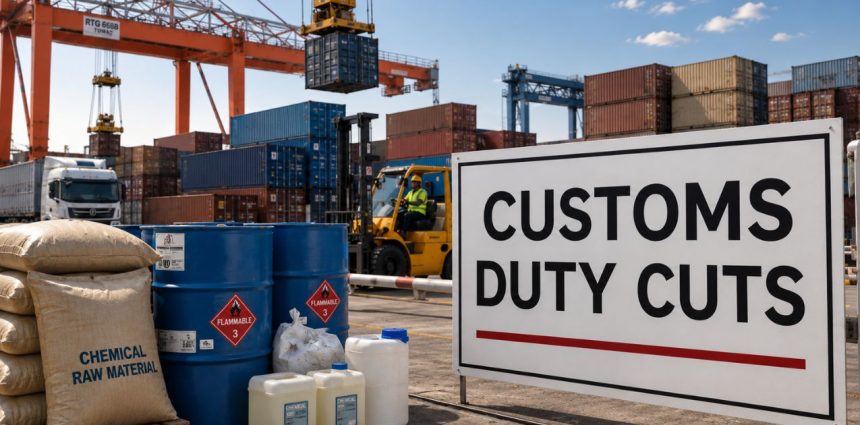
An inter-ministerial panel will meet next week to decide on extending India’s war-linked customs duty relief on critical raw material imports, with petrochemicals likely getting a September reprieve, fresh relief under discussion for pharma and steel, and new duties being considered on locally-made electronics.
Key Takeaways
- The customs duty exemption on 40 critical petrochemical products, set to expire June 30, is under active review, the panel is expected to discuss a possible extension to September 2026, though no decision has been confirmed.
- CBIC member Sanjay Mangal, during the April 2 inter-ministerial briefing, referred to government estimates suggesting that the three-month petrochemical duty exemption could cost nearly ₹1,800 crore in foregone customs revenue.
- The government is examining whether duty relief on petrochemicals used for plastics and pharmaceutical goods should continue beyond June 30, with a senior commerce ministry official confirming the review is underway as per Business Standard.
- The inter-ministerial panel will also take up duty cut requests from pharma, steel, ceramics, diamond polishing, polyester textiles, specialty chemicals, flexible packaging, and auto components.
- The same panel is considering imposing fresh import duties on select electronics where domestic manufacturing capacity already exists, a direct Make in India protection move.
Why June 30 Is the Date Every Manufacturer Is Watching
In a gazette notification issued on April 1, 2026, the Ministry of Finance granted a full customs duty exemption on 40 specified petrochemical feedstocks and polymers, effective from April 2 to June 30, 2026, describing it as a “temporary and targeted relief” to counter supply chain disruptions caused by the ongoing conflict in the Middle East.
That deadline expires in days. India is now considering extending customs duty exemptions on select petrochemical imports beyond June 30 as it assesses the needs of domestic industries that rely on such products as key inputs. The inter-ministerial panel, which has already held 20 meetings since the West Asia conflict began, will meet next week to settle the question.
What the April Exemption Covered
The Finance Ministry exempted a total of 40 goods from customs duty, including methanol, anhydrous ammonia, toluene, styrene, dichloromethane, and vinyl chloride monomer, among others. The exemption was expected to benefit sectors dependent on petrochemical feedstock and intermediates, plastics, packaging, textiles, pharmaceuticals, chemicals, and automotive components.
| Petrochemical Product | Primary Use | Normal Customs Duty | Duty Status |
|---|---|---|---|
| Polypropylene | Packaging, auto parts, textiles | 7.5% | Zero till June 30 |
| Polyvinyl Chloride (PVC) | Construction, pipes, packaging | 7.5% | Zero till June 30 |
| Anhydrous Ammonia | Fertiliser, pharma inputs | 5% | Zero till June 30 |
| Methanol | Chemicals, pharma, fuel blending | 5% | Zero till June 30 |
| Polycarbonates | Electronics, auto, medical | 7.5% | Zero till June 30 |
| Acetic Acid | Pharma, textiles, chemicals | 5% | Zero till June 30 |
| Toluene / Styrene | Chemicals, plastics, coatings | 2.5–5% | Zero till June 30 |
Source: Ministry of Finance Gazette Notification, April 1, 2026; CBIC
Three Items on the Panel’s Agenda
A senior government official told ET that the meeting will cover three specific areas, extension of existing relief, fresh relief on more industrial inputs, and new duties on electronics where India is self-reliant.
1. Extending petrochemical relief — probable but not confirmed
The petrochemical extension to September is the most consequential near-term decision. A senior commerce ministry official indicated the government is examining whether the relief should continue beyond the current deadline, telling Reuters that India will consider extending import tax exemptions on petrochemicals used for plastics and pharmaceutical goods beyond June 30 to help local industries. However, the panel review is still pending, and the outcome is subject to assessment of supply conditions and revenue impact.
2. Fresh duty relief for pharma, steel, and more
Beyond petrochemicals, industries formally requesting fresh duty cuts include ceramics and diamond polishing, polyester textiles, specialty chemicals, flexible packaging, and auto components. The Indian Drug Manufacturers’ Association (IDMA) welcomed the April exemption, with IDMA Executive Director Ashok K. Madan stating it helps the industry manage rising input costs and ensures stability in production, while also benefiting consumers by preventing sharp price increases in essential medicines.
The National President of the Indian Drug Manufacturers Association, Dr. Viranchi Shah, added that waiving import duties on key solvents and chemicals used in API and formulation manufacturing will help curb recent price escalation.
3. New import duties on self-reliant electronics
This is the new directional signal in the panel’s agenda. The government is considering levying fresh duties on select electronic items and parts where domestic manufacturing capacity is established. The rationale: electronics goods imports totalled $116.2 billion in FY26, surpassing gold imports for the first time, and with domestic capacity now available in several sub-segments, import protection becomes the logical next lever.
Track how FII-DII flows and sector positioning are shifting in response to India’s evolving trade policy. → View Live FII-DII Data on NiftyTrader
Sectors Seeking Relief: Who Needs What
| Sector | Relief Requested | Key Input at Risk | Why It Matters |
|---|---|---|---|
| Pharmaceuticals | Duty cut on API/drug inputs | Petrochemical intermediates | Input cost surge; drug price pressure on consumers |
| Steel | Duty cut on raw material inputs | Coking coal, ferroalloys | Global supply tightening post-Iran war |
| Ceramics | Duty waiver on raw inputs | Mineral intermediates | Energy cost pass-through accelerating |
| Diamond Polishing | Relief on rough diamond imports | Rough diamonds | Gulf shipping disruption |
| Polyester Textiles | Duty cut on fibre inputs | PTA, MEG (petrochemical-linked) | Margins under pressure from raw material spike |
| Specialty Chemicals | Broader exemption coverage | Chemical feedstocks | Strait of Hormuz closure still affecting supply |
| Flexible Packaging | Extend exemption | Polypropylene, PET | OEM and FMCG packaging cost blowout |
| Auto Components | Extend exemption | Plastics, rubber, polyurethane | Cascading cost pressure across OEM supply chains |
Source: Economic Times, Ministry of Finance inter-ministerial review — June 2026
Read More: Why BPCL, Asian Paints and Eternal Stocks Fell as Brent Crude Nears $100
Industry Voice: What Manufacturers Are Saying
Sudarshan Jain, Secretary-General of the Indian Pharmaceutical Alliance, noted that the crisis has had a deep impact on the supply chain, specifically affecting energy, freight, and delivery timelines.
Namit Joshi, Chairman of Pharmexil, said the exemption offers major relief to the pharmaceutical sector by stabilising prices and benefiting manufacturers, solvent suppliers, and consumers, describing it as a timely and forward-looking step to strengthen supply chains.
From the auto sector, CEO of the Federation of Automobile Dealers Associations, Saharsh Damani, called it a pre-emptive step by the government, noting that since many auto components rely on petrochemical inputs like plastics and polymers, the exemption may reduce disruption risks and contain cost pressures.
Nuclear Power: Retrospective Relief Granted
On June 11, the Finance Ministry issued an order granting retrospective customs duty exemption on all goods imported for nuclear power generation between April 1, 2019, and January 31, 2026, a seven-year lookback that clears outstanding tax liabilities for NPCIL and its equipment suppliers.
The move is expected to reduce project costs for nuclear power developers and equipment suppliers involved in nuclear power generation projects.
The Budget for FY2026-27, presented in February, had already extended fresh nuclear power import exemptions until 2035. The retrospective order fills the gap between those two windows.
Bottom Line
The inter-ministerial panel meeting next week is not a routine review; it is effectively a mid-year trade policy decision point that will set input cost conditions for eight major Indian industries through Q3 FY27.
For equity investors, sectors with the most direct exposure to the outcome are chemicals and petrochemicals (NOCIL, Aarti Industries, SRF); pharma (Sun Pharma, Cipla, Dr Reddy’s for API cost relief); auto components (Motherson, Minda, Sona BLW); and electronics (Dixon Technologies, Kaynes Technology stand to benefit from fresh import duties on competing products).
The nuclear duty waiver is a quiet but meaningful positive for NPCIL project economics and their equipment supplier ecosystem.
Disclaimer: This article is for informational and educational purposes only and does not constitute investment advice. Please consult a SEBI-registered financial advisor before making any investment decisions.