
Synopsis: Defence stocks rallied sharply on November 27, with BEML surging nearly 17% to a 52-week high of ₹2,378 and the Nifty India Defence index gaining nearly 4%. Higher defence spending expectations, ₹2.12 lakh crore in procurement proposals and upcoming programme decisions supported sentiment. However, Choice Institutional Equities highlighted a widening profitability gap between public and private defence companies.
Indian defence stocks staged a sharp recovery on Friday, November 27, 2026, as buying accelerated across public-sector manufacturers, aerospace companies and private defence technology firms.
BEML emerged as the standout performer, surging nearly 17% to touch a fresh 52-week high of ₹2,378 on the National Stock Exchange (NSE). Data Patterns, Solar Industries, Paras Defence and Garden Reach Shipbuilders also registered significant gains.
According to Moneycontrol’s 1:52 PM IST report, the Nifty India Defence index advanced nearly 4%, extending its gains to more than 5% over three consecutive trading sessions. Buying interest was reported across all 22 index constituents.
However, the rally comes amid contrasting corporate earnings. BEML’s latest quarterly profit declined approximately 31%, Solar Industries reported 80% profit growth, while Data Patterns recorded a profit decline exceeding 55%.
The divergence raises an important question for investors: can India’s expanding defence procurement pipeline translate into sustainable earnings growth?
Track Live: NiftyTrader: Live Options Analytics & F&O Trading Tools
Defence Stocks Today: BEML Leads Broad-Based Recovery
The rally gathered momentum throughout Friday’s trading session. BEML initially gained over 7% during opening trade, according to CNBC-TV18, before extending its gains as the session progressed.
| Defence stock | Reported intraday gain |
|---|---|
| BEML | Nearly 17% |
| ideaForge Technology | Around 7% |
| Solar Industries | Over 6% |
| Data Patterns India | Around 6% |
| Paras Defence | Around 6% |
| Garden Reach Shipbuilders | Around 6% |
| Unimech Aerospace | Around 6% |
| Bharat Dynamics | 4–6% |
| Mazagon Dock Shipbuilders | 4–5% |
| Hindustan Aeronautics | 4–5% |
| Dynamatic Technologies | 4–5% |
| Bharat Electronics | Nearly 2% |
Source: Moneycontrol and Business Standard. Figures represent approximate gains reported at different times during November 27 intraday trading, not closing prices.
The recovery follows a period of sector underperformance. Business Standard reported that the defence index had declined 5.6% over the preceding three months, compared with a 7% rise in the Nifty 50.
Friday’s advance therefore represents a recovery from recent weakness, alongside optimism surrounding future procurement and business opportunities.
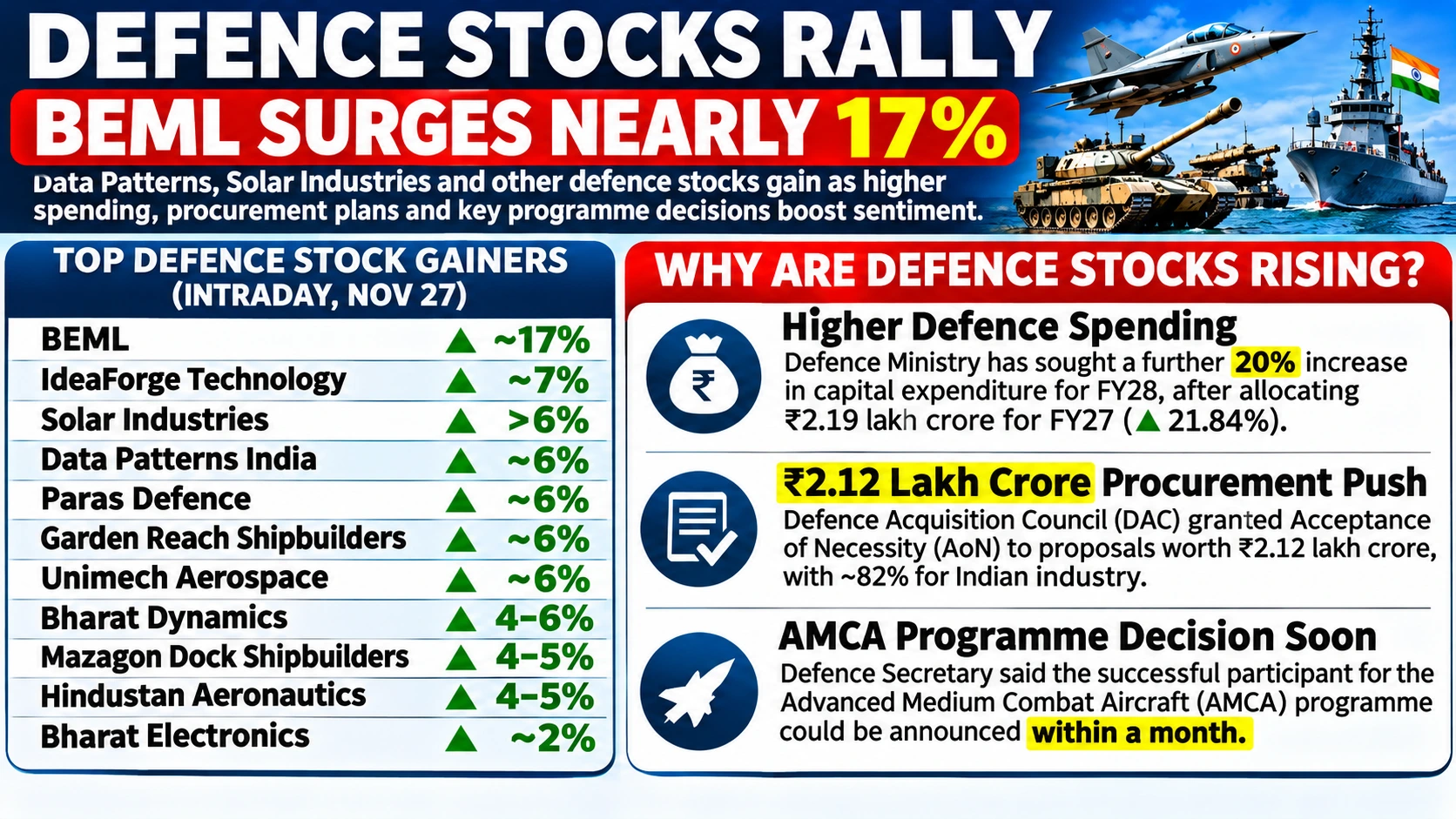
Why Are Defence Stocks Rising Today? Three Key Factors
1. Defence Ministry Seeks 20% Increase in FY28 Capital Expenditure
Expectations of higher government spending remain an important factor supporting the sector’s outlook.
On November 18, Defence Secretary Rajesh Kumar Singh said the Defence Ministry was seeking a further 20% increase in capital expenditure for FY28.
The proposal follows a record ₹7.85 lakh crore defence allocation under the Union Budget 2026–27, representing a 15.19% annual increase. Capital expenditure was allocated ₹2.19 lakh crore, up 21.84% from the previous year’s budget estimate.
Higher capital spending could expand procurement opportunities across aerospace, shipbuilding, defence electronics and military equipment manufacturing.
However, the proposed 20% increase remains a ministry request and has not yet received budgetary approval.
2. ₹2.12 Lakh Crore Defence Procurement Proposals
India’s expanding military procurement pipeline is another factor supporting the industry’s medium-term growth prospects.
On October 26, the Defence Acquisition Council (DAC) granted Acceptance of Necessity (AoN) to capital acquisition proposals estimated at ₹2.12 lakh crore.
Approximately 82% of the proposed procurement is expected to come from Indian industry, highlighting the government’s continued emphasis on domestic manufacturing.
The proposals could create opportunities for defence manufacturers and their suppliers across several business segments.
Importantly, Acceptance of Necessity represents in-principle administrative approval, not a confirmed commercial contract. Actual order inflows will depend on subsequent procurement procedures and contract awards.
3. Upcoming AMCA Programme Decision
Investor attention is also turning towards India’s Advanced Medium Combat Aircraft (AMCA) programme.
On November 18, the Defence Secretary indicated that the successful participant could be announced within approximately a month.
Reported contenders include Tata Advanced Systems, an L&T-led consortium and a Bharat Forge-led consortium involving BEML and Data Patterns.
The programme could create long-term opportunities for domestic aerospace and defence electronics manufacturers. However, participation in the bidding process does not guarantee contract awards or immediate revenue.
BEML Hits 52-Week High Despite 31% Q2 Profit Decline
BEML’s sharp share-price rally contrasts with its latest quarterly profitability.
According to its November 5 consolidated financial results, revenue from operations increased approximately 42% year-on-year to ₹1,191.61 crore in Q2 FY27. However, profit after tax declined 30.6% to ₹33.34 crore from ₹48.03 crore.
Its calculated PAT margin consequently fell from 5.72% to approximately 2.80%.
The company’s expanding order book, however, provides a different perspective on its business outlook.
BEML reported outstanding orders of ₹21,388 crore as of September 30, 2026, compared with ₹16,285 crore at the beginning of the quarter, representing an increase of approximately 31.3%.
Of the outstanding orders, ₹3,421 crore was classified as executable during FY27, while ₹17,967 crore was scheduled for subsequent years.
The order book covers BEML’s defence and aerospace, rail and metro, and mining and construction businesses. It should not be interpreted as exclusively defence-related contracts.
While the growing order pipeline supports future revenue visibility, improving profitability remains an important consideration for investors.
Solar Industries: Profit Jumps 80%, Bhargavastra Development in Focus
Solar Industries delivered a significantly stronger earnings performance during the September quarter.
According to its November 3 exchange filing, consolidated revenue increased 69% year-on-year to ₹3,519 crore, while EBITDA rose 75% to ₹1,021 crore.
Profit after tax increased 80% to ₹650 crore, and the EBITDA margin expanded by 107 basis points to 29.02%.
The company also reported an order book of ₹20,178 crore, with management expressing confidence in exceeding its FY27 annual guidance.
Its financial performance was supported by domestic explosives, international explosives and defence businesses, rather than defence operations alone.
Separately, its subsidiary, Solar Defence and Aerospace Limited, reportedly completed in-house development trials of Bhargavastra, an indigenous counter-drone system.
The development strengthens its defence technology portfolio. However, further testing and procurement milestones remain important before commercial revenue can materialise.
Data Patterns: ₹929 Crore Fresh Orders Despite Weak Q2 Earnings
Data Patterns‘ latest results highlight the difference between growing order visibility and actual financial performance.
Revenue from operations declined 56.7% year-on-year to ₹133.25 crore in Q2 FY27, while profit after tax fell 55.3% to ₹21.97 crore.
Despite weaker earnings, the company received fresh orders worth ₹929 crore during the quarter, taking first-half order inflows to ₹1,046 crore.
Its November 6 exchange disclosure showed confirmed orders on hand of ₹1,742.07 crore and another ₹955.76 crore in negotiated orders awaiting formal receipt.
The combined pipeline stood at ₹2,697.83 crore. However, the entire amount should not be treated as a confirmed order book.
Management expects stronger execution during the second half of FY27 and has retained its annual guidance.
The company’s upcoming results will be important in determining whether its expanding pipeline translates into higher revenue and profits.
BEML vs Solar Industries vs Data Patterns: What Q2 Earnings Reveal
Friday’s rally brought together three companies with significantly different financial performances.
| Q2 FY27 financial metric | BEML | Solar Industries | Data Patterns |
|---|---|---|---|
| Revenue | ₹1,191.61 cr | ₹3,519 cr | ₹133.25 cr |
| Revenue growth YoY | +42% | +69% | -56.7% |
| PAT | ₹33.34 cr | ₹650 cr | ₹21.97 cr |
| PAT growth YoY | -30.6% | +80% | -55.3% |
| Reported order book | ₹21,388 cr | ₹20,178 cr | ₹1,742.07 cr |
Source: Respective company financial disclosures. Order books relate to different business portfolios and disclosure dates. Data Patterns’ negotiated orders awaiting formal receipt are excluded.
Solar Industries delivered growth in both sales and profitability, while BEML’s revenue expansion was accompanied by declining margins. Data Patterns experienced weaker annual earnings despite substantial fresh order inflows.
The comparison demonstrates why a sector-wide rally should not be interpreted as uniform improvement in company fundamentals.
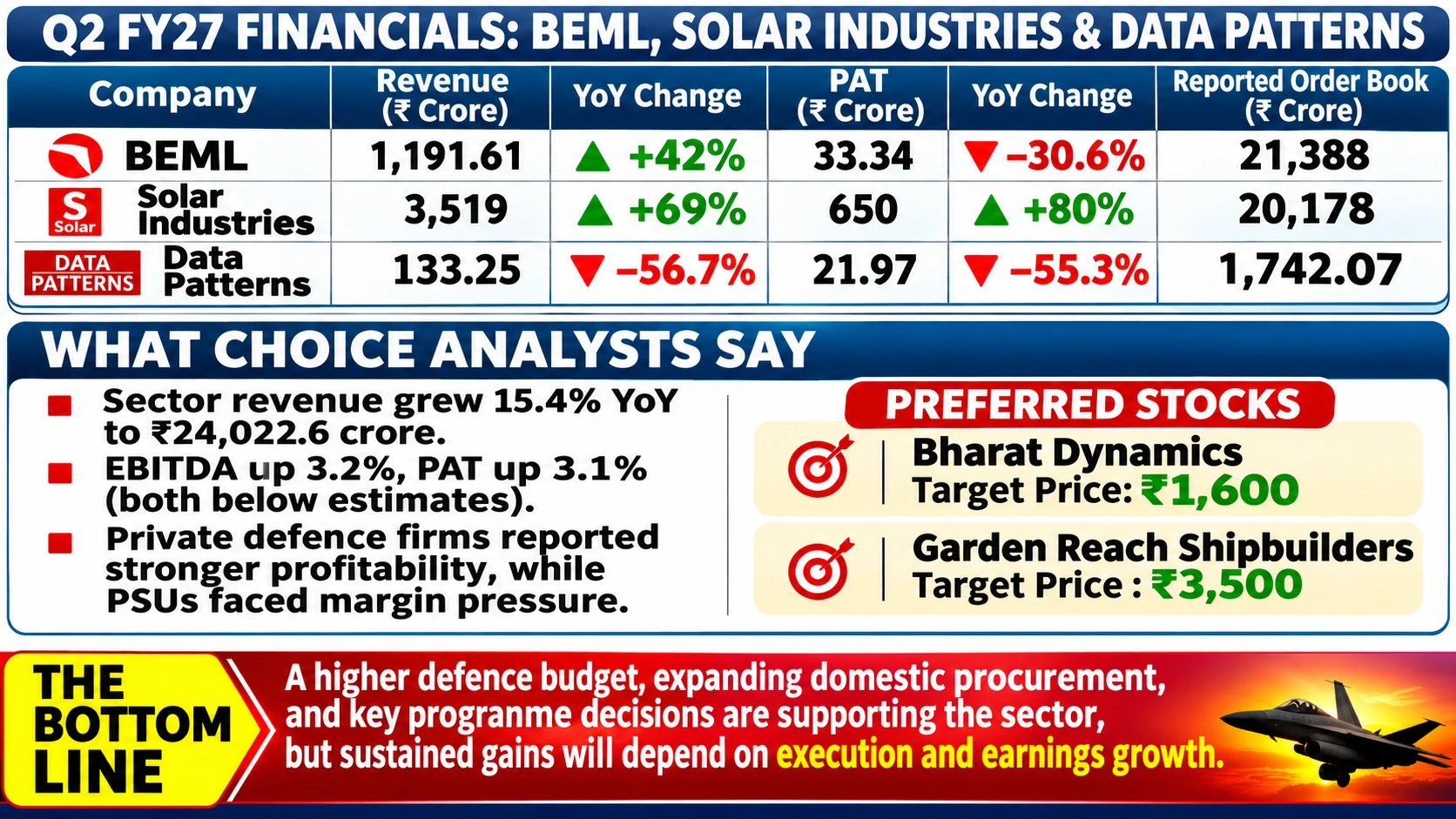
What Choice Institutional Equities Is Saying About Defence Stocks
Choice Institutional Equities’ Q2 FY27 sector review highlights a significant gap between revenue expansion and earnings growth.
According to its research, reported by Business Today on November 26, companies within the brokerage’s defence coverage universe generated aggregate revenue of ₹24,022.6 crore, up 15.4% year-on-year.
However, EBITDA increased only 3.2% to ₹4,849.2 crore, while PAT grew 3.1% to ₹4,538.7 crore.
EBITDA and PAT also fell below brokerage estimates by 10.4% and 7.4%, respectively.
The difference between public and private defence companies was particularly striking. Covered defence PSUs reported revenue growth of 14.7%, but EBITDA declined 1% and PAT increased just 1.2%.
Private defence companies, meanwhile, recorded revenue growth of 24.9%, EBITDA growth of 60.6% and PAT growth of 39.9%.
Choice’s analysis suggests that project execution, product mix and sustainable margins will become increasingly important in determining future earnings performance.
The brokerage identified Bharat Dynamics and Garden Reach Shipbuilders as its preferred long-term defence stocks, with respective target prices of ₹1,600 and ₹3,500.
These figures represent brokerage estimates and its specific research coverage universe, not the entire Indian defence industry.
Can the Defence Stocks Rally Sustain?
India’s expanding defence budget, domestic manufacturing initiatives and procurement pipeline provide a supportive long-term backdrop for the sector.
However, Friday’s rally does not eliminate execution risks, margin pressure or valuation concerns.
Investors will be watching the upcoming FY28 defence budget, AMCA programme selection, conversion of procurement proposals into commercial contracts and second-half corporate earnings.
BEML’s expanding order book, Solar Industries’ strong profitability and Data Patterns’ anticipated execution recovery illustrate different opportunities and risks within the same industry.
The next phase of the defence stocks rally may ultimately depend not just on how many orders companies secure, but on how efficiently they convert those contracts into sustainable earnings and cash flows.
Read Next: NSE Shares Rally 35% in a Month; RBI Clears Corporate Bond Index Futures
Disclaimer: This article is for informational and educational purposes only and does not constitute investment advice. Share-price movements reflect reported intraday trading. Brokerage target prices and management guidance are forward-looking estimates and do not guarantee future returns.