
Black Friday Turns Red: Sensex loses over 1,000 points as Nifty slips below 25,600
Indian stock markets witnessed renewed selling pressure on Friday, November 27, as the Sensex plunged more than 1,000 points and the Nifty 50 slipped below the crucial 25,600 mark. The decline came after two consecutive sessions of gains, with investors booking profits in heavyweight banking, automobile and information technology stocks.
At the indicative close, the BSE Sensex stood at 83,322.29, down 1,006.30 points or 1.19%. The Nifty 50 settled at 25,593.85, declining 290.65 points or 1.12%.
Rising crude oil prices, weakness in the Indian rupee, global trade uncertainty and profit booking after a strong November rally weighed on market sentiment.
However, the broader market showed relative resilience, with metals and several small-cap stocks outperforming frontline indices.
Track Live : NSE Option Chain — Live | BSE Option Chain — Live Sensex & Bankex Options Data Today
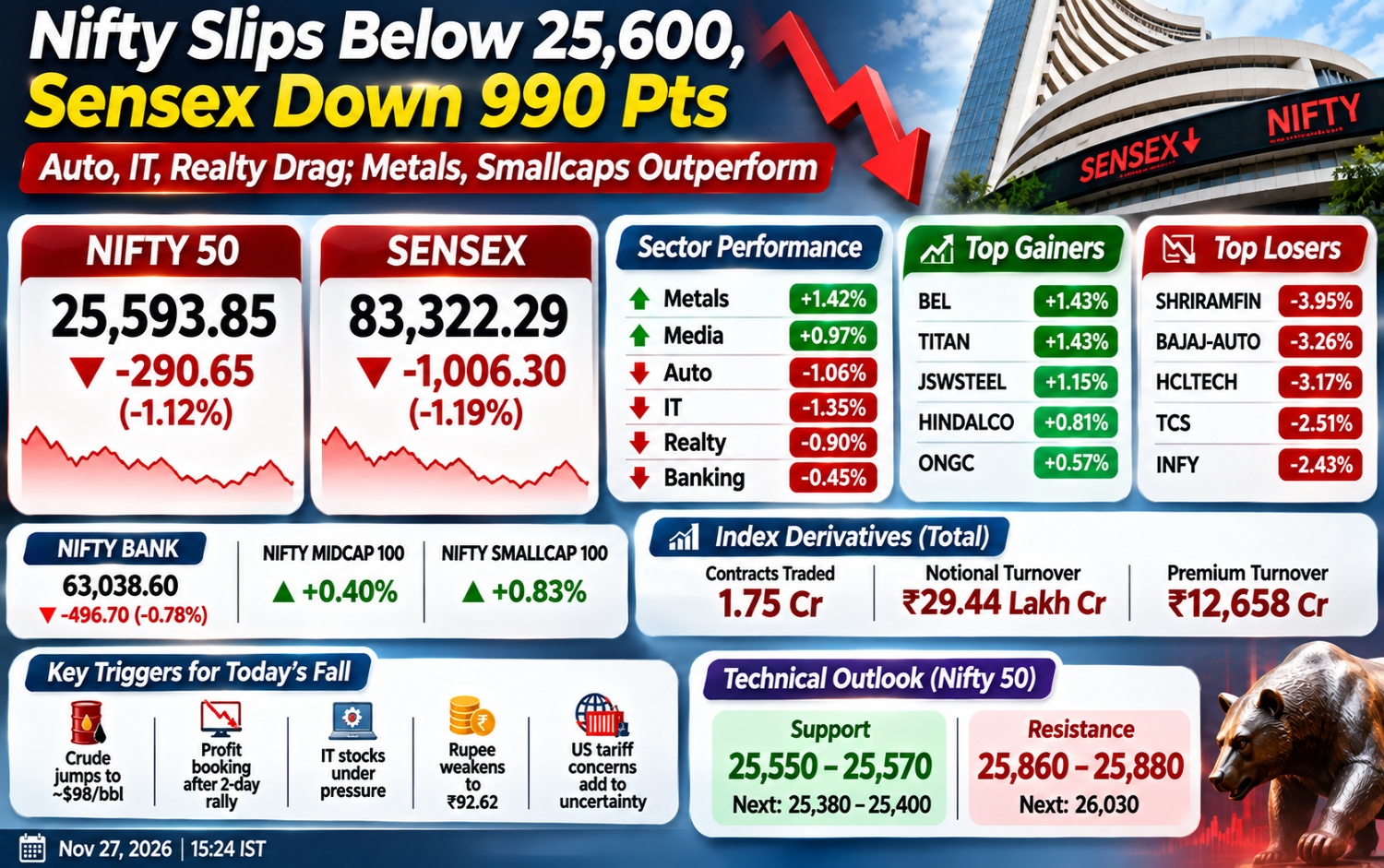
Sensex and Nifty fall sharply: Key market numbers
The selling intensified during afternoon trading, with both benchmark indices extending their losses.
| Index | Current Value | Change |
|---|---|---|
| BSE SENSEX | 83,322.29 | -1,006.30 (-1.19%) |
| NIFTY 50 | 25,593.85 | -290.65 (-1.12%) |
Indicative Closing Levels
November 27, 2026, 3:24 pm IST. Indicative close and traded index readings are separate data points.
The Nifty’s fall below 25,600 is particularly important from a technical perspective, as analysts had identified the 25,550–25,570 range as an immediate support zone.
Track Live : Nifty Levels Today | Sensex Levels Today | Bank Nifty Levels Today
Index derivatives activity: Put options see higher trading volume
The derivatives data from November 27 indicates substantial activity in index options, with put-option contracts recording higher trading volume than call options.
NSE index derivatives
| Instrument | Contracts traded | No. of trades | Turnover (₹ crore) |
|---|---|---|---|
| Index Futures | 1,263 | 1,148 | 215.95 |
| Index Call Options | 79,29,032 | 44,64,798 | 13,61,426.08 |
| Index Put Options | 95,92,273 | 53,63,348 | 15,82,296.89 |
| Total Options | 1,75,21,305 | 98,28,146 | 29,43,722.97 |
Track Live : NSE F&O Lot Size | FII DII Data Today
Metals and small-cap stocks outperform despite market weakness
The market decline was not uniform across sectors.
Metals advanced 1.42%, while the Media index gained 0.97%. The Nifty Midcap 100 rose 0.40%, and the Nifty Smallcap 100 gained 0.83%.
Among individual stocks, BEL and Titan gained 1.43% each, while JSW Steel advanced 1.15%.
On the losing side, Shriram Finance declined 3.95%, making it one of the weakest Nifty 50 constituents in the supplied stock list.
Waaree Renewable Technologies also attracted attention after receiving a letter of award for a 120 MWp turnkey EPC project, with its shares surging 10%.
Track Live : NSE Commodity Option Chain — Live MCX Options Data for Crude Oil, Gold, Silver & More
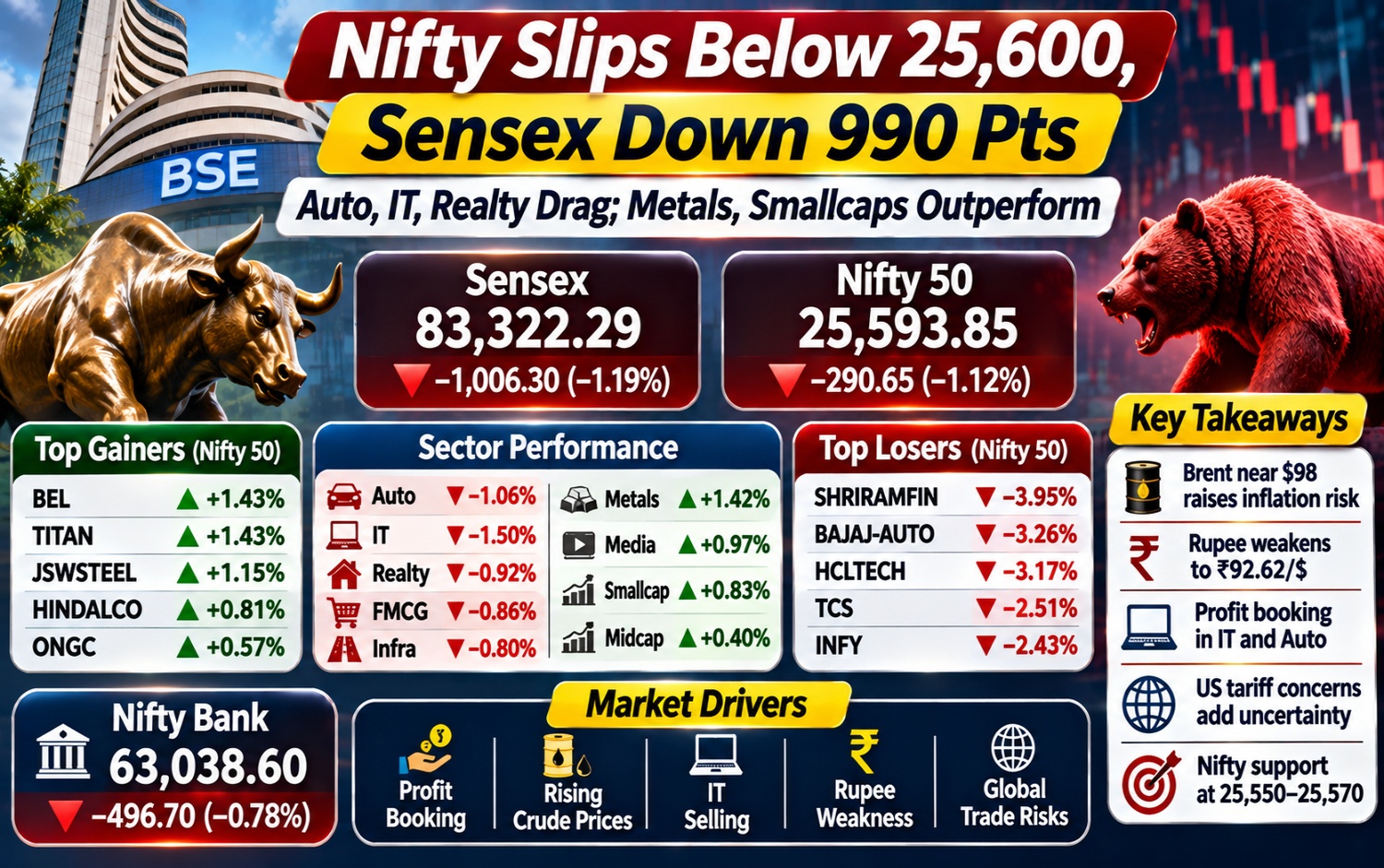
Auto, IT and banking stocks lead the market decline
Selling pressure was concentrated in heavyweight sectors, particularly automobiles, information technology, banking and financial services.
The automobile sector emerged as the weakest performer in the supplied sectoral snapshot, declining 1.06%.
IT stocks also witnessed profit booking after a strong rally over the previous four trading sessions.
| Sector / index | Reported movement |
|---|---|
| Auto | -1.06% |
| IT | -1.50% |
| Realty | Declined |
| FMCG | Declined |
| Infrastructure | Declined |
| Bank Nifty | -0.78% |
| Metals | +1.42% |
| Media | +0.97% |
| Nifty Midcap 100 | +0.40% |
| Nifty Smallcap 100 | +0.83% |
Read More : SEBI Looks at Tata Steel-APL Apollo Rs 28,000 Crore Deal: Why Proxy Firms Want 4 Transactions Judged as One
Top Nifty 50 gainers: BEL, Titan and JSW Steel outperform
Despite the broader correction, several stocks managed to close in positive territory.
Bharat Electronics, Titan and JSW Steel were among the leading gainers in the supplied market data.
Top Nifty 50 losers: Shriram Finance, Bajaj Auto and IT stocks decline
Selling pressure was more pronounced in financial, automobile and technology companies.
Shriram Finance emerged as the biggest loser among the five stocks listed in the supplied market snapshot.
| Stock | LTP | Change | % Change |
|---|---|---|---|
| Shriram Finance | ₹923.85 | -₹38.00 | -3.95% |
| Bajaj Auto | ₹10,496.00 | -₹354.00 | -3.26% |
| HCL Technologies | ₹1,422.00 | -₹46.60 | -3.17% |
| TCS | ₹2,574.00 | -₹66.30 | -2.51% |
| Infosys | ₹1,154.20 | -₹28.80 | -2.43% |
Bank Nifty falls below 63,100; Kotak Bank and Axis Bank drag
Banking stocks also remained under pressure, with the Nifty Bank index declining 496.70 points, or 0.78%, to 63,038.60.
Selling in private-sector banking stocks weighed on the index.
Top Bank Nifty gainers
| Stock | LTP | Change | % Change |
|---|---|---|---|
| Federal Bank | ₹359.70 | +₹2.85 | +0.80% |
| YES Bank | ₹17.76 | +₹0.08 | +0.45% |
| Bank of Baroda | ₹274.90 | +₹0.29 | +0.11% |
| IDFC First Bank | ₹86.75 | +₹0.04 | +0.05% |
| Union Bank | ₹210.21 | +₹0.01 | +0.00% |
Top Bank Nifty losers
| Stock | LTP | Change | % Change |
|---|---|---|---|
| Kotak Mahindra Bank | ₹500.35 | -₹9.60 | -1.88% |
| Axis Bank | ₹1,382.60 | -₹25.40 | -1.80% |
| ICICI Bank | ₹1,593.80 | -₹17.20 | -1.07% |
| SBIN | ₹1,125.55 | -₹11.10 | -0.98% |
| Canara Bank | ₹131.10 | -₹1.30 | -0.98% |
Brent crude approaches $98: Rising oil prices trigger inflation concerns
One of the biggest reasons behind Friday’s market weakness was the sharp increase in international crude oil prices.
Brent crude futures moved towards $98 per barrel amid concerns about possible disruptions to oil supplies from the Middle East.
Reports of attacks on vessels in the Strait of Hormuz and Saudi energy infrastructure increased concerns about the security of important oil transportation routes.
Brent crude had risen approximately 5% during the week, increasing pressure on oil-importing economies such as India.
Rupee weakens to ₹92.62 against the US dollar
The Indian rupee also came under pressure on Friday, adding another concern for domestic equity investors.
The currency weakened 24 paise to ₹92.62 against the US dollar in early trade, compared with its previous close of ₹92.38.
It opened at ₹92.44 before declining further amid rising crude prices and subdued domestic market sentiment.
Rupee movement on November 27
| Indicator | Level |
|---|---|
| Previous close | ₹92.38 |
| Opening level | ₹92.44 |
| Early-trade level | ₹92.62 |
| Change | -24 paise |
| Brent crude | Above $96 per barrel during early trade |
The rupee’s weakness is particularly important for companies with significant dollar-denominated import expenses.
A weaker currency can increase costs for aviation, oil-dependent industries and companies importing raw materials.
Five major factors contributed to Friday’s stock market decline.
1. Profit booking after November’s strong rally
Investors booked profits following two consecutive sessions of gains. The Sensex and Nifty had rallied nearly 15% over the previous four weeks, supported by strong foreign fund inflows and corporate earnings.
Foreign fund inflows reportedly reached approximately Rs 1.39 lakh crore during November, providing substantial support to Indian equities.
VK Vijayakumar, Chief Investment Strategist at Geojit Investments, said, “A consolidation phase appears likely in the near term.”
2. Brent crude crosses $98, raising inflation concerns
Brent crude futures crossed $98 per barrel, gaining around 5% during the week amid concerns about disruptions to global oil supplies.
Attacks on tankers in the Strait of Hormuz and Saudi energy infrastructure heightened supply concerns.
Higher crude prices are particularly negative for India because the country imports most of its oil requirements. Expensive energy can increase inflation, weaken the rupee and pressure corporate profit margins.
Vijayakumar also highlighted rising Brent crude and proposed US tariffs as threats to the market outlook.
3. IT stocks decline after recent gains
The Nifty IT index dropped approximately 1.5% as investors booked profits following an 8% rally over the previous four trading sessions.
HCL Technologies declined 3.17%, TCS fell 2.51%, while Infosys lost 2.43%.
4. Rupee weakness adds pressure to equities
The Indian rupee weakened against the US dollar, reflecting pressure from rising crude prices and subdued domestic market sentiment.
The supplied currency updates show the rupee trading around Rs 92.62–92.92 per dollar during the session.
A weaker rupee can increase import costs and create additional pressure on companies with significant overseas currency exposure.
5. Banking and automobile stocks drag benchmarks
The Nifty Bank declined 0.78% to 63,038.60. Kotak Mahindra Bank, Axis Bank, ICICI Bank and SBI were among the major banking losers.
Automobile stocks also witnessed selling, with Bajaj Auto falling 3.26%.
Foreign institutional investors: Why November inflows matter
Foreign investment flows have been an important driver of the November recovery.
According to Reuters, foreign investors bought approximately $15.5 billion in Indian equities during the month, equivalent to around ₹1.39 lakh crore at the approximate exchange rate used in the market reports.
These inflows helped support the benchmark indices despite global volatility.
| Indicator | Reported development |
|---|---|
| November foreign inflows | Approximately $15.5 billion |
| Approximate rupee equivalent | ₹1.39 lakh crore |
| Market impact | Supported November’s equity rally |
| Recent trend | Strong buying after earlier foreign outflows |
Nifty technical outlook: 25,550 support becomes crucial
According to SBI Securities, the immediate support zone for the Nifty lies between 25,550 and 25,570, while resistance is placed between 25,860 and 25,880.
A breakdown below 25,550 could expose the index to the next support zone of 25,380–25,400.
Conversely, a sustained move above 25,880 could open the possibility of an extension towards 26,030.
What should investors and traders watch next?
Investors should closely monitor Brent crude, rupee movements, foreign institutional flows and global trade developments.
For traders, the 25,550 support zone and 25,860–25,880 resistance range could become important levels in the next trading sessions.
For long-term investors, the correction may create opportunities in fundamentally strong companies, but fresh investments should consider earnings visibility, valuations and exposure to rising input costs.