Swiggy Instamart plans 340 job cuts as business restructuring gathers pace
Swiggy’s quick commerce business Instamart is preparing for a significant workforce reduction as the company attempts to improve operational efficiency and strengthen its competitive position. The company plans to lay off approximately 340 employees as part of a restructuring exercise, with increasing artificial intelligence adoption also forming part of the broader business transformation.
The development comes at a challenging time for Instamart, which has faced sustained losses, slowing growth momentum and intense competition from established and emerging quick commerce players.
For investors, the bigger question is whether Swiggy can turn these cost-cutting measures into improved profitability without weakening its ability to compete in India’s rapidly expanding quick commerce market.
Track Live : NSE Option Chain — Live | BSE Option Chain — Live Sensex & Bankex Options Data Today
Swiggy Instamart plans to cut 340 jobs: What happened?
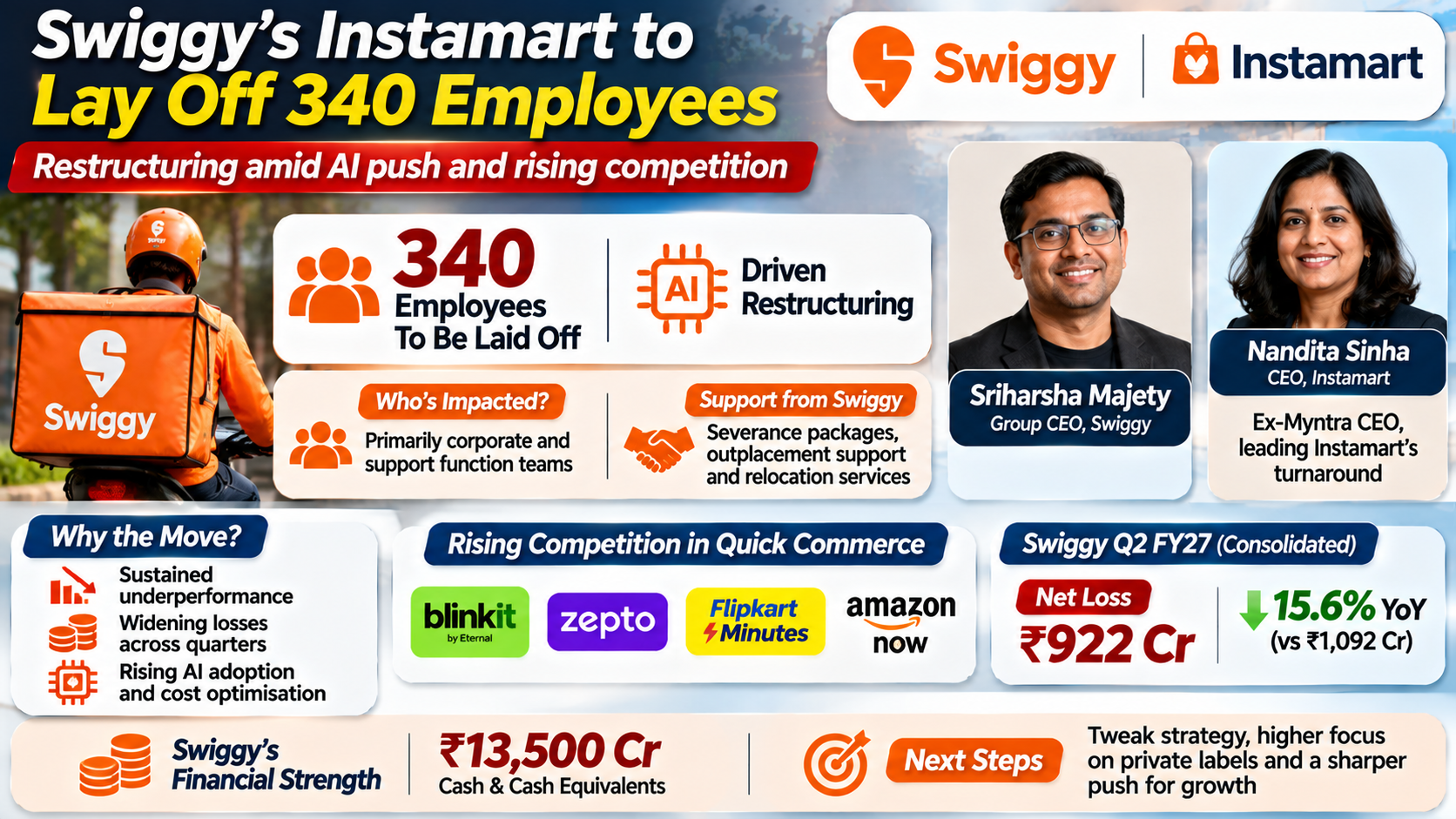
Swiggy’s quick-commerce division Instamart is set to reduce its workforce by approximately 340 employees as part of an organisational restructuring exercise.
The development was reported by Moneycontrol on November 27, citing people familiar with the matter.
The layoffs are primarily concentrated in corporate and support functions rather than being reported as a uniform reduction across all Instamart operations.
| Particulars | Details |
|---|---|
| Company | Swiggy |
| Business division | Instamart |
| Reported layoffs | Approximately 340 employees |
| Reason | Business restructuring and cost optimisation |
| Other context | Increasing AI adoption |
| Teams affected | Corporate and support functions |
| Severance support | Reportedly being provided |
| Outplacement assistance | Reportedly being provided |
| Relocation support | Reportedly being provided |
| Announcement date | November 27, 2026 |
What support will affected employees receive?
According to the report, Swiggy has put in place measures to support employees affected by the restructuring.
These reportedly include:
-
Severance packages.
-
Outplacement support to help employees find new opportunities.
-
Relocation assistance where required.
Swiggy had not responded to Moneycontrol’s queries at the time of publication. Consequently, the exact severance terms, affected departments and implementation schedule have not been independently confirmed.
Rising competition from Blinkit and Zepto puts pressure on Instamart
Instamart is operating in an increasingly competitive quick commerce market.
Eternal-owned Blinkit, Zepto, Flipkart Minutes and Amazon Now are competing aggressively for customers through faster deliveries, wider product selection and expansion of dark store networks.
To strengthen its position, Instamart is also increasing its focus on private-label products under the leadership of CEO Nandita Sinha.
Private labels could help the company improve margins, differentiate its offerings and reduce dependence on external brands.
Swiggy appointed Sinha, the former Myntra CEO, to lead Instamart from August 3, replacing Amitesh Jha. Her appointment signals the company’s determination to accelerate its turnaround strategy.
Track Live : NSE F&O Lot Size | FII DII Data Today
Is artificial intelligence replacing Instamart employees?
The reported workforce reduction comes amid increasing AI adoption and a broader restructuring of Instamart’s operations.
However, an important distinction is necessary: the report does not establish that all 340 positions are being eliminated specifically because AI is replacing employees.
The reported reasons include business restructuring, cost reduction and Instamart’s need to improve operational efficiency.
AI adoption is another important part of the changing business environment.
How AI could change quick-commerce operations
AI-based systems can help quick-commerce companies automate and improve several functions.
| Business function | Potential AI application |
|---|---|
| Inventory management | Forecasting demand and reducing stockouts |
| Warehouse operations | Improving picking, packing and stock allocation |
| Customer support | Automating routine customer queries |
| Delivery management | Optimising delivery routes and order allocation |
| Demand forecasting | Predicting product demand by location |
| Pricing and promotions | Optimising discounts and promotional spending |
| Marketing | Improving customer targeting and personalisation |
Swiggy has already been expanding AI-led product and operating capabilities within Instamart. Financial Express previously reported that its product leadership had introduced AI-powered search alongside other technology-led initiatives.
Swiggy’s Q2 FY27 loss highlights the challenge of improving profitability
Swiggy’s financial performance provides important context for the restructuring.
The company reported a consolidated net loss of Rs 922 crore in Q2 FY27, narrowing 15.6% from Rs 1,092 crore in the corresponding quarter last year.
However, the loss increased from Rs 791 crore in the previous quarter, reflecting continued pressure from its expansion-intensive quick commerce operations.
The sequential increase in losses makes cost management and operational efficiency important priorities for the company.
Despite these challenges, Swiggy remains relatively well capitalised, with cash and cash equivalents of approximately Rs 13,500 crore.
This financial position provides some flexibility to continue investing in Instamart while working towards improved profitability.
This indicates that losses increased despite improvements in order volumes and business scale.
| Instamart financial indicator | Q2 FY27 | Q1 FY27 |
|---|---|---|
| Adjusted EBITDA loss | ₹895 crore | ₹778 crore |
| Contribution margin | -1.0% of GOV | -0.2% of GOV |
| Net order value (NOV) | ₹6,954 crore | ₹6,133 crore |
| Sequential NOV growth | 13.4% | — |
| Orders processed | 130 million | — |
| Dark stores | 1,240 | 1,171 |
Track Live : NSE Commodity Option Chain — Live MCX Options Data for Crude Oil, Gold, Silver & More
Swiggy’s consolidated net loss narrows, but sequential losses increase
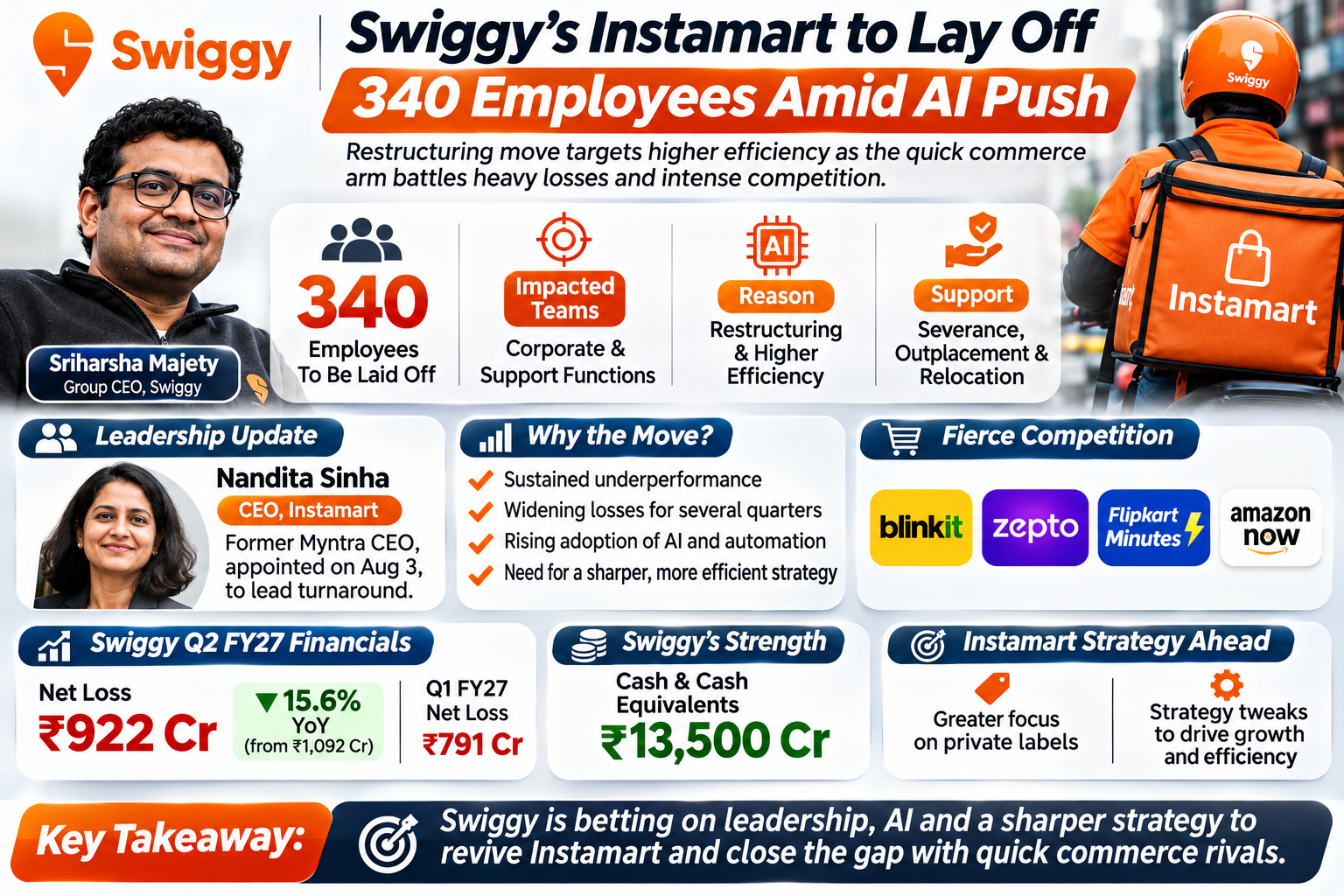
Swiggy reported a consolidated net loss of ₹922 crore in Q2 FY27, compared with ₹1,092 crore in the corresponding quarter of the previous year.
This represents a 15.6% year-on-year reduction in losses.
However, the net loss increased from ₹791 crore in Q1 FY27, indicating that the company’s overall losses widened sequentially.
| Financial metric | Q2 FY27 | Q1 FY27 | Q2 FY26 |
|---|---|---|---|
| Consolidated net loss | ₹922 crore | ₹791 crore | ₹1,092 crore |
| Revenue from operations | ₹7,571 crore | ₹6,812 crore | ₹5,561 crore |
| Adjusted EBITDA loss | ₹760 crore | ₹651 crore | ₹695 crore |
| Total expenses | ₹8,703 crore | ₹7,813 crore | ₹6,711 crore |
Instamart’s expansion continues despite workforce reduction
Interestingly, the reported layoffs come at a time when Instamart is still expanding its business.
During Q2 FY27, the company added 69 net dark stores, taking its total network to 1,240 stores across 133 cities.
Its order volumes also increased, indicating that the restructuring is not simply a withdrawal from quick commerce.
| Operational metric | Q2 FY27 |
|---|---|
| Total dark stores | 1,240 |
| Net dark stores added | 69 |
| Cities served | 133 |
| Net order value | ₹6,954 crore |
| Orders processed | 130 million |
| Monthly transacting users | 14.8 million |
| Year-on-year order growth | 29.3% |
How does Instamart compare with Blinkit?
Instamart’s restructuring comes amid a widening competitive battle with Blinkit, which has established a strong position in India’s quick-commerce industry.
The September-quarter results highlight the difference in profitability between the two businesses.
| Particulars | Instamart | Blinkit |
|---|---|---|
| Q2 FY27 GOV / comparable reported order value | ₹7,817 crore | ₹12,403 crore |
| Adjusted EBITDA | ₹895 crore loss | ₹4 crore profit |
| Store network | 1,240 | 1,816 |
| Quarterly order volumes | 130 million | Not directly comparable here |
Nandita Sinha faces a major challenge in turning around Instamart
Sinha’s appointment represents a strategic shift rather than simply a leadership change.
The former Myntra CEO has experience managing large-scale e-commerce operations, and Swiggy is counting on her operational expertise to revive Instamart’s growth.
The business has experienced repeated leadership changes, slowing momentum and challenges in establishing a distinct identity against competitors.
Her priorities include improving execution, strengthening private labels, controlling costs and rebuilding Instamart’s competitive position.
Sinha brings more than two decades of experience across Myntra, Flipkart, Britannia and Hindustan Unilever.
Nandita Sinha
-
Appointed: July 28, 2026
-
Effective date: August 3, 2026
-
Previous position: CEO of Myntra
-
Experience: More than 20 years
-
Previous organisations: Flipkart, Myntra, Britannia and Hindustan Unilever
Track Live : Nifty Levels Today | Sensex Levels Today | Bank Nifty Levels Today
Leadership instability has been another challenge for Instamart
Instamart has experienced several leadership changes in recent years.
The business has faced exits across senior operational and commercial roles, creating challenges around organisational continuity and execution.
The appointment of Nandita Sinha is intended to provide fresh leadership and a stronger operational direction.
| Leadership position | Development |
|---|---|
| CEO – Instamart | Nandita Sinha appointed August 3, 2026 |
| Previous CEO | Amitesh Kumar Jha resigned July 28, 2026 |
| Previous Myntra leadership | Nandita Sinha led Myntra for over four years |
| Chief Operating Officer | Ankit Jain reportedly exited in 2026 |
| Chief Business Officer | Hari Kumar reportedly exited in 2026 |
Read More : Tata Sons Board Is Set to Meet Nov 30 on a Possible Listing, but a 3 pm Court Hearing on Nov 27 Comes First
What should Swiggy investors watch after the layoffs?
For investors, the proposed 340 job cuts could indicate a stronger focus on cost discipline, but layoffs alone will not guarantee a turnaround.
The important indicators will be Instamart’s contribution margins, order growth, average order value, customer retention and dark store productivity.