NEED TO KNOW
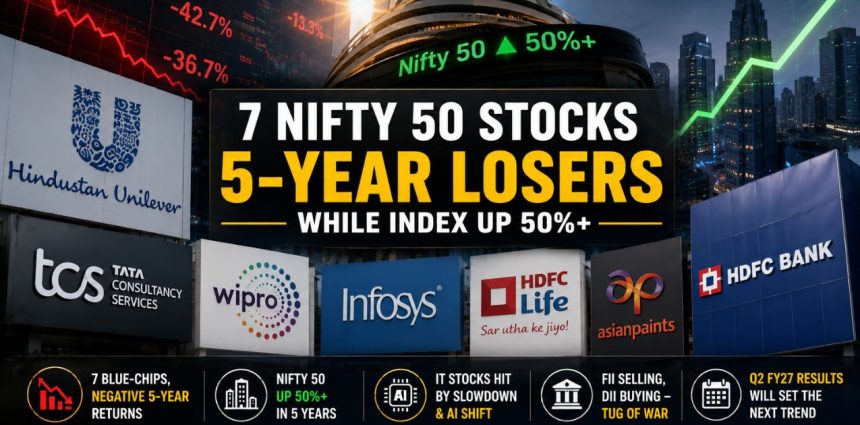
- Hindustan Unilever hit a fresh 52-week low of Rs 2,006.2 on August 24, one of seven Nifty 50 stocks now showing negative absolute returns over the last five years.
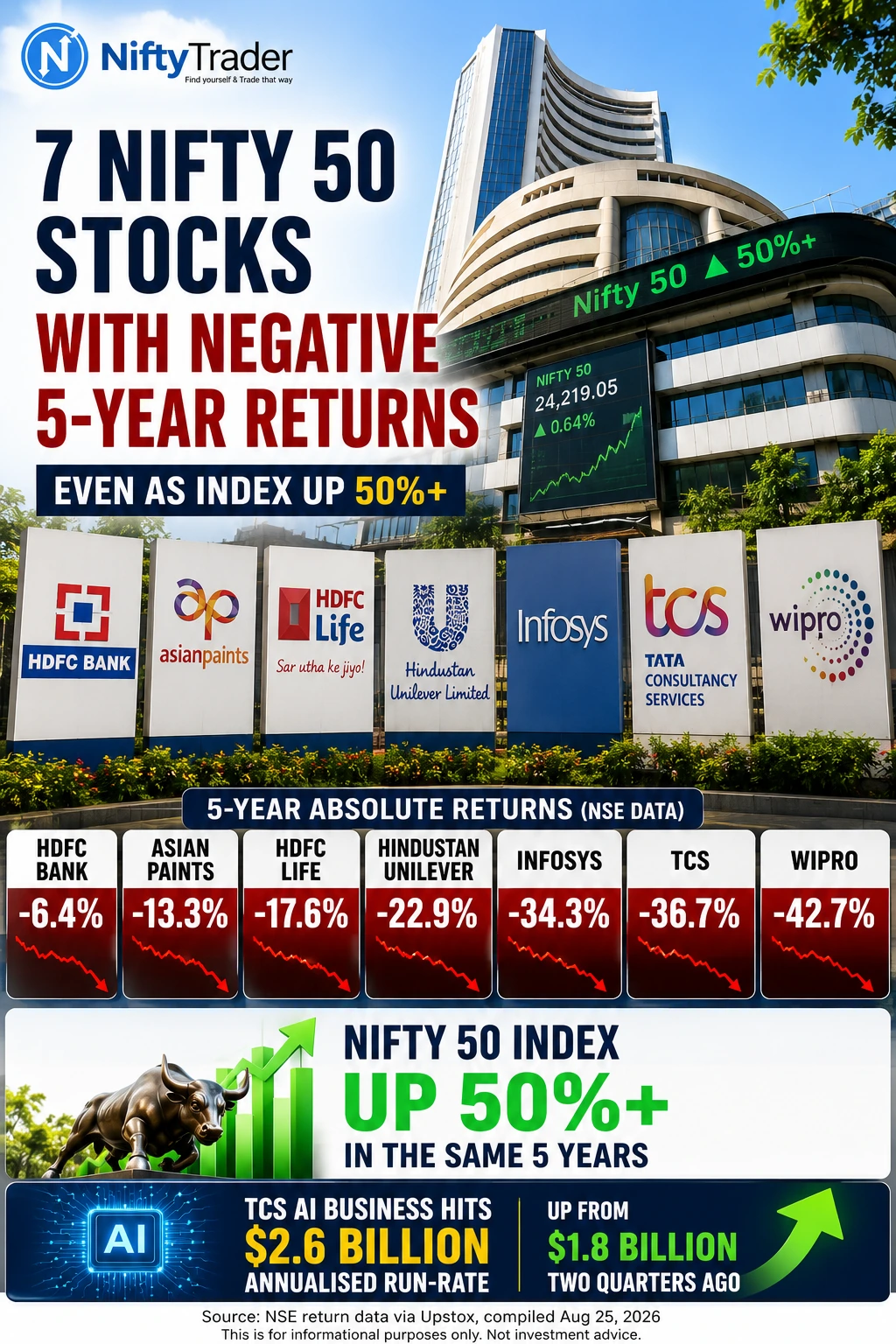
- TCS, Wipro, Infosys, HUL, HDFC Life, Asian Paints and HDFC Bank have all delivered negative five-year returns, per NSE data, even as the Nifty 50 gained more than 50% in the same period.
- Wipro’s 42.7% decline is the steepest in the group, and the stock most reports leave out, since it only shows up when NSE’s own data is used instead of aggregator ACE Equity.
- A separate Moneycontrol analysis from July, using five-year CAGR instead of absolute returns, found 13 Nifty 50 stocks, a quarter of the index, trailing the benchmark.
- TCS’s AI business has scaled to a $2.6 billion annualised run-rate as of Q1 FY27, up from $1.8 billion two quarters ago, its fastest-growing lever against the broader IT slowdown.
Hindustan Unilever’s stock touched a fresh 52-week low of Rs 2,006.2 on August 24, a live reminder of a bigger, less-discussed problem sitting inside the Nifty 50. HUL is one of seven index heavyweights that have delivered negative absolute returns over the past five years, even as the Nifty 50 itself gained more than 50% in the same stretch, fresh NSE-sourced data shows.
TCS, Wipro, Infosys, HUL, HDFC Life, Asian Paints and HDFC Bank make up this list of Nifty 50 stocks with negative returns, losses ranging from 6% to 43% for anyone who bought and held five years ago, while the index they belong to kept climbing.
THE FIVE-YEAR SCORECARD
| Stock | 3-Year Return | 5-Year Return |
|---|---|---|
| HDFC Bank | -7.6% | -6.4% |
| Asian Paints | -18.1% | -13.3% |
| HDFC Life | -12.3% | -17.6% |
| Hindustan Unilever | -21.3% | -22.9% |
| Infosys | -20.6% | -34.3% |
| TCS | -32.5% | -36.7% |
| Wipro | -12.1% | -42.7% |
Nifty 50 index: up more than 50% over the same five-year period. (Source: NSE return data via Upstox, compiled Aug 25, 2026)
WHY THE COUNT KEEPS CHANGING — 6, 7, OR 13?
Different outlets have published different numbers this week, and none of them are technically wrong, they’re measuring different things.
| Source | Data basis | Stock count | Method |
|---|---|---|---|
| ET (ACE Equity) | Third-party aggregator | 6 | Absolute 5-yr return |
| Upstox (NSE) | Exchange data | 7 (adds Wipro) | Absolute 5-yr return |
| Moneycontrol (Jul 2026) | NSE-based | 13 | 5-yr CAGR vs Nifty |
Exchange-sourced data takes precedence over third-party aggregator data, so the seven-stock list is the more complete picture. All three counts agree on the underlying story: a meaningful chunk of the Nifty’s biggest names haven’t created wealth for five-year holders.
IT’S TRIPLE WHAMMY: TCS, INFOSYS, WIPRO CAUGHT IN THE AI SHIFT
Wipro’s five-year decline of 42.7% is the steepest in the group, ahead of TCS at 36.7% (37% by ET’s ACE Equity count) and Infosys at 34.3%. All three are fighting the same battle: slower global tech spending, longer client decision cycles, and an AI-led delivery model breaking the old link between headcount and revenue.
TCS has felt this most visibly, confirming workforce reductions of roughly 12,200 employees, about 2% of its global headcount, in 2026 as it restructures around AI delivery, and later flagging a rare dollar-revenue decline for a company long seen as IT’s safest bet.
The bright spot: TCS’s AI business has scaled fast, hitting a $2.6 billion annualised revenue run-rate in Q1 FY27, up from $1.8 billion just two quarters earlier. Whether that growth can outpace the slowdown in traditional services is the real swing factor for the stock.
HDFC BANK: THE SMALLEST DECLINE, THE BIGGEST WEIGHT
HDFC Bank’s five-year fall is the mildest in the group at 6.4% (6.47% by ET’s ACE Equity data), but it carries outsized weight given the stock’s 10%-plus share of the Nifty 50.
Core business metrics are still expanding, gross advances grew 15.4% YoY to Rs 30.6 lakh crore in Q1 FY27, but net interest margin narrowed to 3.26%, its lowest level on record, as the aftermath of the 2023 HDFC Ltd merger continues to weigh on profitability.
Governance has added to the pressure: former chairman Atanu Chakraborty resigned in March citing a values mismatch, around the same time an internal probe surfaced allegations that the bank routed roughly Rs 45 crore in interest payments to a state agency through its marketing budget, a matter still working through a shareholder class-action process, not fully resolved. FII holding in the stock has fallen from 48.84% a year ago to 41.82% as of June 2026, even as domestic institutions have kept buying.
Check Live: HDFC BANK Options Chart | Nifty Trader
HUL AND ASIAN PAINTS: WHEN “DEFENSIVE” STOPS BEING DEFENSIVE
HUL’s fresh 52-week low extends a five-year decline of 22.9%. Q1 FY27 profit fell 3% YoY even as revenue grew 10%, as elevated palm oil costs and sluggish rural demand squeezed margins.
Asian Paints has lost 13.3% over the same period, facing its first serious competitive threat in decades: Grasim’s Birla Opus has captured close to 10% of the organised decorative paints market since its 2024 launch, and JSW’s rebranded Dulux business has added a second well-funded rival.
HDFC LIFE: GROWTH HASN’T MATCHED THE VALUATION
HDFC Life is down 17.6% over five years. Its June-quarter value of new business grew 9% YoY, but VNB margin slipped 10 basis points to 25%, and a SEBI review of surrender-value norms has left near-term product pricing in flux. FIIs have trimmed exposure across the life insurance basket through the year, adding to the drag.
THE FII-DII TUG OF WAR BEHIND THE INDEX’S CLIMB
FIIs have been net sellers across several of these names through 2026, while DIIs have kept absorbing the selling, HDFC Bank alone has seen FII holding fall more than 7 percentage points in a year.
That tug of war, plus strength in metals, telecom and select financials outside this list, is a big part of why the Nifty 50 kept climbing even as seven of its biggest constituents didn’t.
Check Live: FII DII DATA |NIFTYTRADER
WHAT COULD END THIS FIVE-YEAR LOSING STREAK
TCS and Infosys are both betting on AI-linked revenue to outrun the slowdown in traditional IT services, TCS’s jump from $1.8 billion to $2.6 billion in annualised AI revenue in just two quarters is the fastest-moving number in this entire list.
HDFC Bank’s core lending book keeps expanding even as the Street waits for margins to recover post-merger. Asian Paints still holds the largest distribution network in its category, even as Birla Opus and JSW Dulux eat into share.
The real test lands in October. Q2 FY27 earnings will show whether AI revenue growth at TCS and Infosys is big enough yet to move the needle, whether HDFC Bank’s margins have bottomed, and whether Asian Paints’ scale is enough to slow the paint war.
Get those three right, and the five-year losing streak could finally break, get them wrong, and today’s “safe” blue-chip trade stays underwater a while longer.
Read Next: SEBI Ends ₹3,912-Crore Max-Axis Case: What Changes for Axis Bank, MFSL
FAQ
Q1. Which Nifty 50 stocks have negative returns over the last five years?
NSE data shows seven: TCS, Wipro, Infosys, Hindustan Unilever, HDFC Life, Asian Paints and HDFC Bank, with declines of 6.4% to 42.7%, even as the Nifty 50 gained more than 50% in the same period.
Q2. Why do some reports say six stocks, not seven?
Reports using ACE Equity data count six, leaving out Wipro. Wipro shows up only when NSE’s own exchange data is used — and it’s actually the group’s worst performer, down 42.7%.
Q3. Is HDFC Bank’s underperformance a sign of weak fundamentals?
No — gross advances grew 15.4% YoY in Q1 FY27. The drag is margin pressure from the 2023 HDFC Ltd merger and governance-related concerns, not a slowdown in core lending.
Q4. How many Nifty 50 stocks have underperformed in total?
On absolute returns, seven. On five-year CAGR versus the benchmark, a broader Moneycontrol analysis from July, as many as 13, about a quarter of the index.
Q5. What could turn these stocks around?
AI-linked revenue growth for IT names (TCS’s AI business alone has grown from $1.8 billion to $2.6 billion annualised in two quarters), margin recovery for HDFC Bank post-merger, and category leadership holding up for HUL and Asian Paints against new entrants. Q2 FY27 earnings from October will be the next major signal.
This article is for informational purposes only, based on publicly available exchange and company data, and does not constitute investment advice. Please consult a SEBI-registered financial advisor before making investment decisions.