
Foreign investors spent two straight quarters cutting exposure to a group of Indian midcap and smallcap stocks. In the June 2026 quarter, they changed direction.
The interesting part is where they returned.
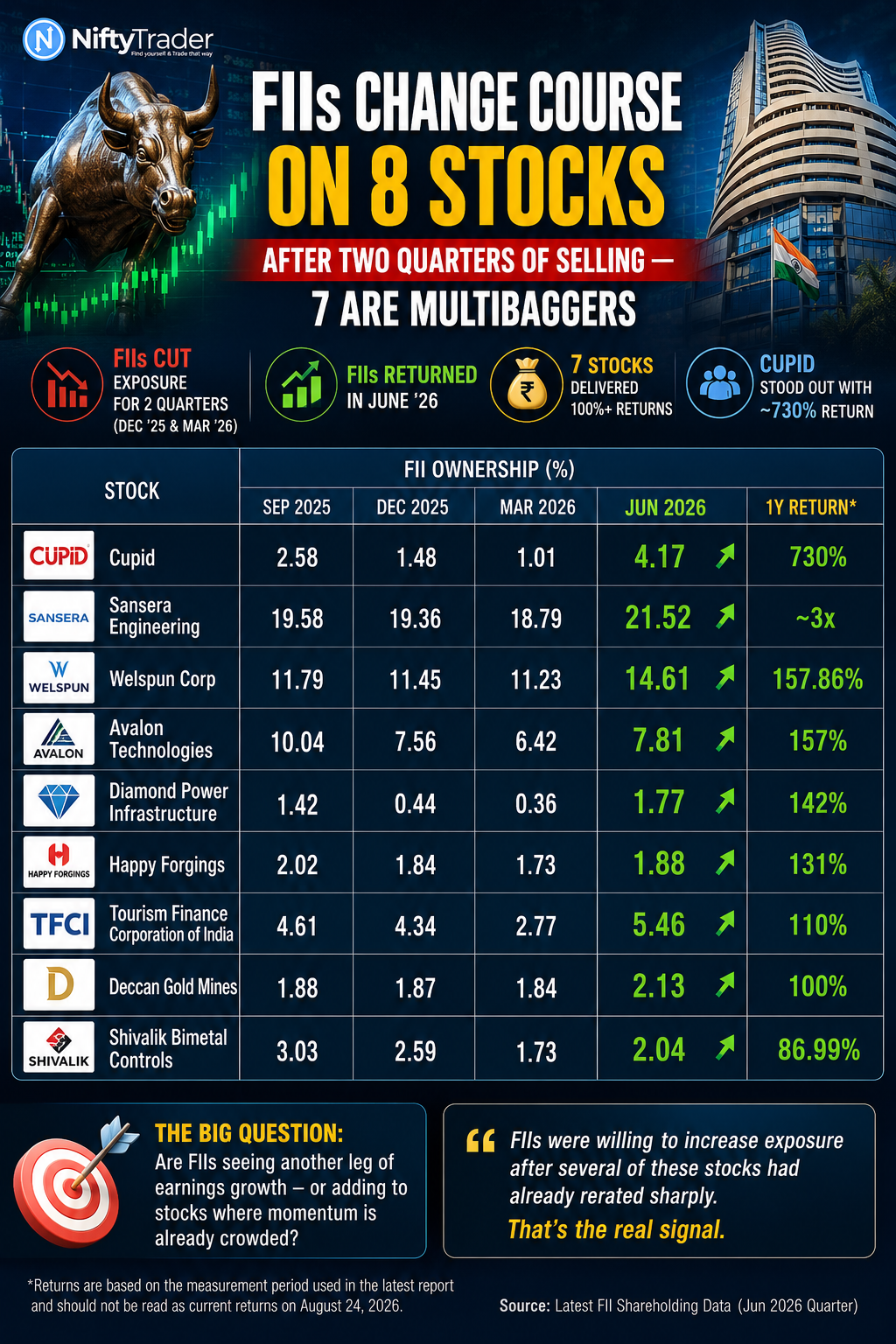
FIIs rebuilt positions in eight stocks that had seen their ownership fall in both December 2025 and March 2026. Seven of those stocks had delivered more than 100% returns over the one-year period cited in the latest screening, while the eighth, Shivalik Bimetal Controls, was up 86.99%. Cupid stood out with a reported 730% one-year gain.
This is not a simple “FIIs are back” story. The more important signal is that foreign investors were willing to increase exposure after several of these stocks had already rerated sharply.
That raises the question investors should be asking now: are FIIs seeing another leg of earnings growth, or are they selectively adding to stocks where momentum has already become crowded?
Check Live to Explore: FII DII DATA| NIFTYTRADER
The FII Exit Wasn’t Permanent
The June-quarter shareholding data shows a distinct reversal.
FIIs had reduced their stakes in these companies in both the December 2025 and March 2026 quarters. By June, their ownership had increased again.
| Stock | Sep 2025 | Dec 2025 | Mar 2026 | Jun 2026 | 1Y Return* |
|---|---|---|---|---|---|
| Cupid | 2.58% | 1.48% | 1.01% | 4.17% | 730% |
| Sansera Engineering | 19.58% | 19.36% | 18.79% | 21.52% | ~3x |
| Welspun Corp | 11.79% | 11.45% | 11.23% | 14.61% | 157.86% |
| Avalon Technologies | 10.04% | 7.56% | 6.42% | 7.81% | 157% |
| Diamond Power Infrastructure | 1.42% | 0.44% | 0.36% | 1.77% | 142% |
| Happy Forgings | 2.02% | 1.84% | 1.73% | 1.88% | 131% |
| Tourism Finance Corporation of India | 4.61% | 4.34% | 2.77% | 5.46% | 110% |
| Deccan Gold Mines | 1.88% | 1.87% | 1.84% | 2.13% | 100% |
| Shivalik Bimetal Controls | 3.03% | 2.59% | 1.73% | 2.04% | 86.99% |
Returns are based on the measurement period used in the latest report and should not be read as current returns on August 24, 2026.
The ownership numbers are the more durable part of the signal: Cupid moved from 1.01% to 4.17%, Sansera from 18.79% to 21.52%, Welspun Corp from 11.23% to 14.61%, and Avalon from 6.42% to 7.81%.
One correction is important: the source headline says seven multibaggers, but the broader screen contains eight stocks. Seven had crossed the 100% one-year-return mark in the cited data; Shivalik Bimetal Controls had gained 86.99%.
Cupid Is the Stock That Changes the Story
Cupid is where the FII reversal becomes difficult to ignore.
Foreign ownership dropped from 2.58% in September 2025 to 1.48% in December and 1.01% in March 2026. It then jumped to 4.17% in June — a 3.16-percentage-point increase in a single quarter.
The stock had already delivered an extraordinary rally.
An earlier ETMarkets screen, using a different measurement date, put Cupid’s one-year gain at about 664%, compared with the roughly 730% figure cited in the newer report. That difference illustrates why the return figure should always be tied to a specific measurement date.
But the ownership reversal itself remains clear.
And that creates the biggest expectation gap in this basket:
FIIs were not buying Cupid because it had simply fallen out of favour. They were rebuilding exposure after a huge re-rating.
For investors, that means the next phase has to be judged against earnings delivery. A stock that has already multiplied several times needs substantially stronger business performance to justify another major valuation expansion.
Sansera’s Numbers Give the FII Move More Context
Sansera Engineering offers a different interpretation of the same FII signal.
Foreign ownership declined gradually from 19.58% in September to 18.79% in March, before climbing to 21.52% in June. That is a 2.73-percentage-point sequential increase.
The company’s latest operating performance provides a possible explanation.
Sansera reported strong Q1 FY27 growth, with revenue rising about 33% year on year and EBITDA margin expanding by nearly 200 basis points, according to its Q1 investor presentation. Its Q1 earnings commentary also pointed to a strong order book and high-teens revenue-growth expectations.
That makes Sansera more than a momentum story.
Foreign ownership rose at a time when the underlying operating numbers were also improving.
The risk, however, is valuation. A stock that has already delivered roughly 150% over the cited one-year period cannot rely indefinitely on multiple expansion. The market will increasingly demand sustained earnings growth.
Welspun Corp Has a Different Trigger: Visibility
Welspun Corp saw FII ownership rise from 11.23% in March to 14.61% in June, after two quarters of decline. The stock was up 157.86% over the one-year period cited in the latest report.
Here, the business backdrop is particularly important.
Welspun Corp’s global order book was reported at around ₹24,750 crore, while the company retained FY27 guidance of about ₹20,000 crore revenue and ₹2,850 crore EBITDA.
The company also secured additional export orders worth around ₹1,400 crore in July, taking the reported order book to roughly ₹23,650 crore as of July 14; subsequent company commentary and updates have placed the figure higher depending on the order-book cut-off date.
That gives FIIs something beyond stock-price momentum to underwrite: visible execution ahead.
But the market’s next question is whether that order book converts into revenue and margins at the pace investors now expect.
Avalon Shows Why Institutional Buying Needs Context
Avalon Technologies is another case where FII buying returned after two quarters of selling.
FII ownership fell from 10.04% in September to 6.42% in March before recovering to 7.81% in June. The stock had delivered a 157% one-year return under the latest report’s measurement.
The company has since reported strong Q1 FY27 numbers. Consolidated net profit rose to about ₹34.9 crore from ₹14.2 crore in the year-ago quarter.
Avalon’s investor-relations page also lists its Q1 FY27 financial results, press release, investor presentation and earnings-call transcript, giving investors a primary-source trail for assessing the improvement.
This is important because FII buying should not automatically be treated as a universal institutional vote of confidence.
The better question is:
Are earnings improving fast enough to validate the stock’s re-rating?
Also Check: Avalon Technologies Limited – IPO
Diamond Power’s Reversal Is Sharp — But Expectations Are High
Diamond Power Infrastructure’s FII holding fell from 1.42% in September to just 0.36% in March.
It then jumped to 1.77% in June.
The stock had also delivered a very strong return in the period used by the FII screen.
The company has been pursuing capacity expansion, including investments aimed at increasing conductor and related manufacturing capabilities. That creates a potential structural growth angle as India’s transmission and power-infrastructure spending expands.
But this is also where investors need to separate capacity creation from earnings creation.
A higher order book or larger manufacturing footprint becomes meaningful only when it translates into sustainable revenue, margins and cash flow.
The Smaller Reversals Matter Too
Not every FII increase in the list carries the same weight.
Happy Forgings’ ownership rose only from 1.73% to 1.88% in June. That is a much smaller reversal than Cupid or Sansera.
Tourism Finance Corporation of India, by contrast, saw a much bigger move, from 2.77% to 5.46%.
Deccan Gold Mines moved from 1.84% to 2.13%, while Shivalik Bimetal Controls increased from 1.73% to 2.04%.
This distinction matters.
A rise of 15 basis points and a rise of more than 300 basis points should not be interpreted as equivalent signals simply because both appear under the heading “FII buying.”
This Is Selective Buying, Not a Broad FII Green Light
The wider flow picture has improved.
According to the latest report, FIIs bought Indian equities worth ₹11,045 crore in July and another ₹13,123 crore in August, after selling through much of the earlier part of the year.
That backdrop makes the June shareholding reversal more relevant.
But it would be premature to conclude that foreign investors have returned to Indian equities without reservation.
The same market continues to face questions around India’s valuation premium, global bond yields, geopolitical risks and the sustainability of global equity momentum.
That means FIIs may continue to favour companies where earnings visibility can justify premium valuations, rather than simply buying the broader midcap and smallcap universe.
The Market Is Now Asking a Harder Question
The first question was:
“Are FIIs coming back?”
The more useful question now is:
“What are FIIs willing to pay for?”
The June data suggests they are willing to rebuild positions in selected companies even after periods of substantial price appreciation.
That is potentially constructive for stocks with genuine earnings acceleration, improving order books or structural industry tailwinds.
But it also creates a market tension.
The stronger the previous rally, the stronger the earnings delivery has to be from here.
This is particularly relevant for Cupid, where the difference between business growth and valuation expectations could become extremely important. It also applies to Sansera, Welspun Corp and Avalon, where investors now have tangible operating triggers to monitor.
Read Next: IPO Watch: Lalithaa Soars 32%, Symbiotec Opens as GMP Swings
September’s Shareholding Data Could Be the Real Test
The June quarter tells us that foreign investors changed direction in these stocks.
It does not yet tell us whether the reversal will last.
The next round of shareholding data will therefore be more revealing than the June snapshot alone.
Investors should watch whether:
- FIIs continue adding in the September quarter;
- Q1 FY27 earnings momentum survives into the following quarters;
- order-book growth converts into actual revenue;
- margins remain elevated;
- valuations continue to outrun earnings expectations; and
- broader FII flows remain positive.
If foreign ownership keeps rising while earnings growth catches up with the share-price rally, the June reversal could prove to be an early signal of a deeper institutional re-rating.
If ownership stalls while earnings fail to meet elevated expectations, the current buying could instead turn out to have been a tactical move.
For now, the message from the data is not “FIIs are buying everything.” It is more selective — foreign money is returning to a handful of stocks where growth, momentum and institutional interest are converging. The next quarter will show whether that convergence is durable.