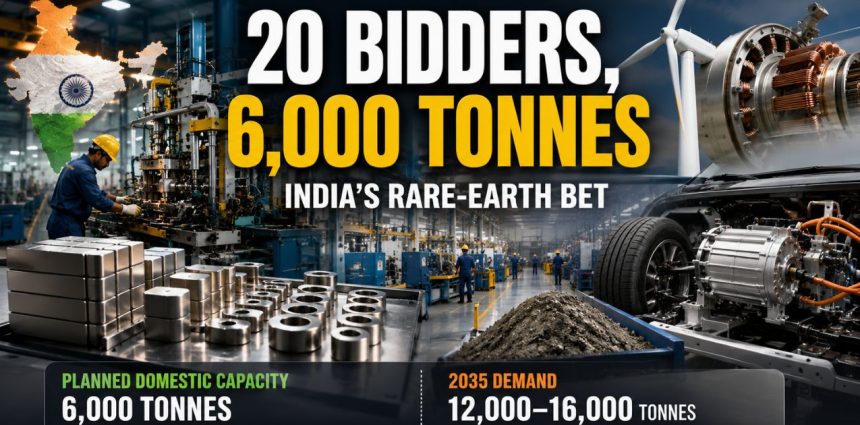
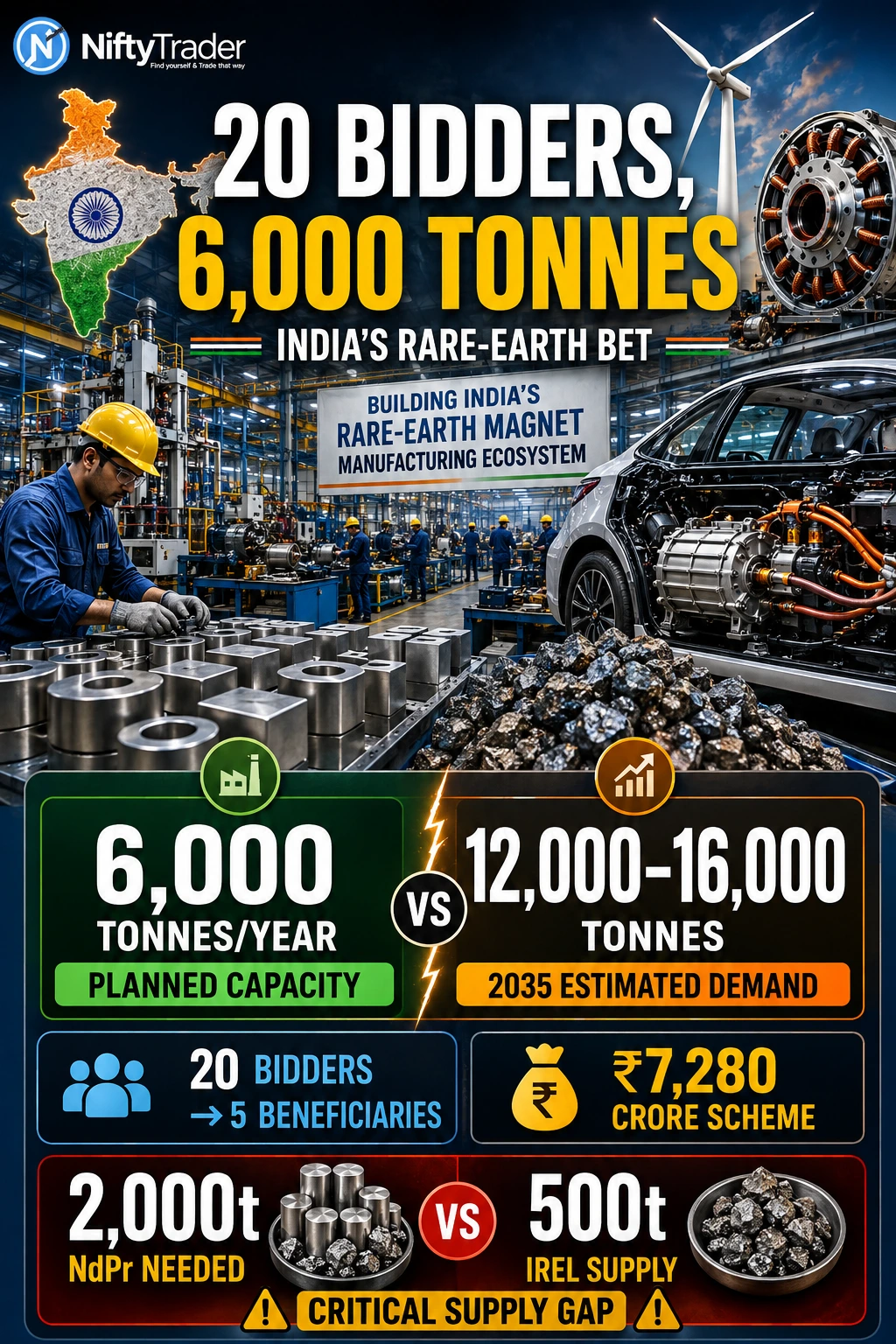
India just put real money behind a homegrown rare-earth magnet industry, ₹7,280 crore, 6,000 tonnes of planned annual capacity, up to five winning beneficiaries, seven years. Twenty companies showed up to bid for it. But run the government’s own demand numbers forward to 2035, and the scheme India just approved may already be too small.
20 Bidders, 5 Slots: The Race for India’s Magnet Money
On August 13, 2026, the Ministry of Heavy Industries opened technical bids for its Scheme to Promote Manufacturing of Sintered Rare Earth Permanent Magnets, and found 20 companies competing for what will eventually be just five awards.
The confirmed list reads like a cross-section of India Inc. Larsen & Toubro and Coal India, companies with zero prior rare-earth pedigree, bid alongside ReNew, 20 Microns, Attero Recycling, Lohum Magnets & Energy Solutions, Singapore’s NEO Performance Materials, Proterial India, Prozeal Green Energy, Shankaranarayana Constructions and Starteck Finance, plus a cluster of joint ventures built specifically to chase this tender, including BaRupOn-IRP and Keystone Infra-Huebox Interiors.
Coal India and L&T entering a rare-earth magnet tender is itself a signal, India’s largest coal miner and its biggest engineering conglomerate both see a strategic-materials business worth building from scratch. Shares of both companies were in focus in the days following the bid opening.
| Parameter | Detail |
|---|---|
| Total outlay | ₹7,280 crore (₹750cr capex + ₹6,450cr sales-linked/5yr) |
| Target capacity | 6,000 tonnes/year (MTPA) |
| Beneficiaries | Up to 5, each allotted up to 1,200 MTPA |
| Duration | 7 years — 2yr gestation + 5yr incentive payout |
| Bids received | 20; technical bids opened Aug 13, 2026 |
| Cabinet approval | November 26, 2025 |
Twenty bidders for five slots means selection, not the bid count, is the next real catalyst. Whoever gets picked, and how much capacity they’re handed, will matter more to markets than today’s applicant list.
Check Live: COAL INDIA Options Chart | Nifty Trader
The Number Nobody’s Talking About: 6,000 Tonnes vs 16,000
The scheme is sized for 6,000 tonnes of annual capacity. India’s own 2030 demand estimate, EVs at ~3,250 tonnes, wind turbines at ~1,800 tonnes, plus everything from BLDC fans to smartphones, comes to 8,220 tonnes. So even if every tonne of capacity gets built and sold, the scheme covers roughly 73% of 2030 demand.
Stretch to 2035, and it gets worse. Independent research puts India’s magnet demand at 12,000–16,000 tonnes a year by then, a range, not a single forecast. The 43% figure in this piece’s headline uses the midpoint of that range (14,000 tonnes); at the low end, coverage is 50%, at the high end, just 37.5%.
| Year | Projected demand | Scheme capacity | Coverage |
|---|---|---|---|
| 2030 | 8,220 tonnes | 6,000 tonnes | ~73% |
| 2035 (low) | 12,000 tonnes | 6,000 tonnes | 50% |
| 2035 (mid) | 14,000 tonnes | 6,000 tonnes | ~43% |
| 2035 (high) | 16,000 tonnes | 6,000 tonnes | 37.5% |
This scheme isn’t sized for self-sufficiency, it’s sized to stop India from being completely import-dependent. A second capacity round, on top of this one, looks increasingly likely before the decade ends.
The Bigger Problem: India Can’t Feed the Factories It’s Building
Capacity on paper is one constraint. Raw material is the tighter one.
State-run IREL remains the only company currently producing neodymium at scale in India, and its NdPr oxide supply is explicitly built into how this scheme allocates raw material.
IREL’s own rare-earth division head has said output collapsed to roughly 40 tonnes a year at the height of the 2025 crisis, and is targeted to reach ~200 tonnes by end-FY26 and 500 tonnes by FY27.
The feedstock math is tighter than the capacity numbers alone suggest. Producing 6,000 tonnes of finished NdFeB magnets requires roughly 2,000 tonnes of NdPr oxide a year.
Even at its FY27 target, IREL’s assured supply under the scheme tops out at 500 tonnes, about a quarter of what the full target needs, and enough for only ~1,500 tonnes of finished magnets.
That supply isn’t shared evenly either: only the three lowest-priced bidders get any assured IREL allocation at all, 200 tonnes of oxide (~600 tonnes of magnets) for L1, 167 tonnes (~500 tonnes) for L2, and 133 tonnes (~400 tonnes) for L3.
Every other winner, and the rest of every winner’s requirement beyond their IREL share, has to be sourced independently, likely through imports, while global supply is still tight.
Markets Already Placed Their Bets — Some More Justified Than Others
Investors didn’t wait for bid results to start pricing this theme.
When the Cabinet approved the scheme on November 26, 2025, Gujarat Mineral Development Corporation, developing a separate rare-earth project in Chhota Udepur, jumped 7.6% to ₹568.3 the next session, extending a two-session gain to 17%. GMDC isn’t a confirmed bidder in this scheme; the rally reflected broader sentiment, not a direct allocation.
Sona Comstar, whose own CEO has called it the country’s single largest importer of rare-earth magnets, in on-record comments to Reuters, sits closer to the actual exposure, but as a downstream buyer racing to secure supply, not a confirmed scheme beneficiary.
Its most recent quarter (three months to June 2026) showed revenue up 54% YoY to ₹1,310 crore, with its net order book at ₹24,000 crore, nearly two-thirds tied to EV programmes.
After losing heavy rare-earth magnet supply in 2025, the company shifted to light rare-earth magnets for its two-wheeler motors and developed a rare-earth-free ferrite-assisted motor for three-wheelers, even as it keeps building EV traction motors that do use REPMs.
Bidder status, downstream exposure, and confirmed beneficiary status under this scheme are three different things, only MHI’s final beneficiary announcement will separate them.
Why China’s “Truce” Hasn’t Actually Fixed India’s Problem
The scheme exists because of a chokepoint: China controls roughly 90% of global rare-earth magnet processing capacity, and has wielded that leverage unevenly rather than uniformly.
China imposed export controls on seven heavy rare earths, including dysprosium and terbium, in April 2025; those controls were never lifted. A broader October 2025 round of extraterritorial rules was suspended for one year as part of a US-China de-escalation, a suspension currently scheduled to run until November 10, 2026, not an automatic snapback on the 11th, but a real deadline worth tracking.
How that plays out depends heavily on which country is asking. Reuters reported in late August 2026 that Chinese exports of rare-earth yttrium to the US actually rose in July, the second-highest month since controls began, ahead of a planned Xi-Trump summit at the White House in September 2026. Japan has had the opposite experience: after a diplomatic dispute in late 2025, China cut it off from dysprosium and terbium oxide entirely for eight to nine straight months. Globally, exports of yttrium, dysprosium and terbium are still running roughly 50% below pre-restriction levels, but the treatment is clearly no longer one-size-fits-all.
Where India sits in that hierarchy isn’t fully clear from public reporting, and that ambiguity is itself the risk: even a friendlier US-China trade relationship doesn’t automatically extend to Indian buyers.
Also Read: Rare Earths, Chips and Tariffs: The 3 Words Indian Investors Should Watch
What to Watch Next
- Beneficiary selection — 20 bids, 5 slots. Capacity awarded (up to 1,200 tonnes each) decides who gets real scale.
- NdPr feedstock deals — watch who locks in supply beyond their limited IREL allocation; that’s a harder constraint than capital.
- Two China dates — the Xi-Trump summit at the White House in September 2026, and China’s November 10, 2026 truce deadline. Either could move global magnet prices and the case for domestic capacity.
- A second capacity round — if 2030 demand tracks toward 8,220 tonnes as projected, a 6,000-tonne scheme needs a sequel well before 2035.
India has started building an alternative to Chinese magnet dominance. Whether 6,000 tonnes turns out to be phase one of a bigger plan, or the ceiling of this one, depends on decisions still months away.
Read Next: FIIs Return to Stocks That Already Delivered 100%+ Gains
This article is for informational purposes only and does not constitute investment advice, a recommendation, or a solicitation to buy or sell any security. Readers should verify current data independently and consult a SEBI-registered investment advisor before making investment decisions.