Key Takeaways
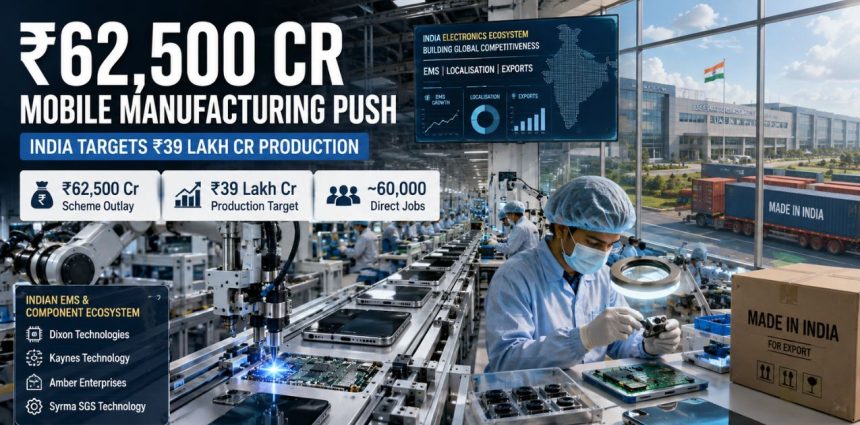
- The Ministry of Electronics and Information Technology notified the ₹62,500-crore Mobile Phone Manufacturing Scheme (MPMS) on August 21, operationalising a Cabinet decision from July 15. It is effective retroactively from April 1, 2026, and runs through FY31.
- Manufacturers with FY26 turnover above ₹10,000 crore get base incentives of 2.25–5% on eligible sales; Indian-owned brands get 5% plus a separate 3% incentive for design and R&D done in India; all players can earn up to 1.5% more for sourcing key components domestically.
- Electronics and IT Minister Ashwini Vaishnaw said Apple is expected to expand output beyond the iPhone in India, and that Google may shift a large share of its export-oriented device production out of China.
- EMS stocks Dixon Technologies, Kaynes Technology, Amber Enterprises and Syrma SGS Technology gained 6.1%, 3%, 2% and 1.5% respectively when the Cabinet cleared the scheme on July 15 — Friday’s notification confirms terms the market had already priced in.
- The government is targeting ₹39 lakh crore in cumulative mobile phone production and around 60,000 direct jobs over the scheme’s five-year tenure.
What the Notification Confirms
MeitY’s August 21 notification puts operational detail behind a scheme the Cabinet had already cleared in July. The Mobile Phone Manufacturing Scheme (MPMS) replaces the Production Linked Incentive Scheme for Large Scale Electronics Manufacturing (PLI-LSEM), whose tenure ended March 31, 2026, and runs from FY 2026-27 to FY 2030-31 with a budgetary outlay of ₹62,500 crore.
The scheme splits into two tracks. Target Segment 1 covers manufacturers, including contract manufacturers, with a minimum FY26 turnover of ₹10,000 crore, who can earn differentiated incentives of 2.25% to 5% on eligible sales.
Target Segment 2 is reserved for Indian brands and adds a 3% incentive specifically for design and R&D carried out in the country.
To qualify as an Indian brand, a company must hold its trademark and intellectual property in India, be majority-controlled by Indian citizens holding more than 51% of the entity, and run its own design and research work domestically, with no minimum sales floor, since selection runs through an inter-ministerial committee chaired by the MeitY Secretary.
EMS companies with at least 51% Indian ownership can separately qualify under Target Segment 2 at a lower ₹1,000-crore turnover threshold.
Both tracks carry a further incentive of up to 1.5% for domestic sourcing of components and sub-assemblies, display and camera modules, enclosures, batteries and USB cables, provided these are localised for at least 25% of the handsets a company sells annually.
Crucially, incentives apply to sales incremental over each company’s FY26 base, not flat turnover. For existing manufacturers, that incremental bar climbs from ₹5,000 crore in FY27 to ₹25,000 crore by FY31; a company with no prior scheme history needs to cross ₹10,000 crore in annual sales before it can claim anything at all.
Apple, Google and the Push Beyond Assembly
Asked directly whether Apple could manufacture more than iPhones in India, Vaishnaw said “yes,” adding that the government is in talks with the company to broaden the range of products it assembles domestically.
Apple has assembled iPhones in India since 2017 through suppliers including Foxconn and the Tata Group, and Counterpoint Research estimates put India’s share of global iPhone output at roughly 26% this year, with the bulk of Foxconn’s Indian output shipped to the US.
On Google, Vaishnaw said India is expected to absorb a large share of the export-facing device production the company currently routes through China.
Google has manufactured Pixel phones in India since October 2023, starting with the Pixel 8, through partners including Dixon Technologies.
Unconfirmed reports this week suggested Google may end China-based production of Pixel phones, watches and earbuds from 2027 and shift it to India and Vietnam, a move Google itself has not confirmed.
Separately, the government is working with three unnamed Indian companies it expects could grow into smartphone brands over the next 10 to 14 months, with each firm’s intellectual property and design assessed before any support is cleared.
The EMS Stock Angle Traders Are Watching
The market’s real-money reaction to this scheme came well before Friday’s paperwork. When the Cabinet approved MPMS on July 15, EMS stocks moved the next trading session: Dixon Technologies gained 6.1%, Kaynes Technology 3%, Amber Enterprises 2% and Syrma SGS Technology 1.5%, even as the Nifty 50 stayed largely flat.
ICICI Securities flagged Dixon’s existing backward integration into display modules, camera modules and enclosures as positioning it to capture the 1.5% localization bonus directly, while noting Amber’s manufacturing partnerships with Oppo, realme and OnePlus give it a similar localization lever. Jefferies separately called Amber a “sleeper beneficiary” of the broader ecosystem shift.
JM Financial Research flagged a nuance worth watching: because incentives apply only to sales incremental over each company’s FY26 base, a year in which Dixon alone made 32 million smartphones, the effective incentive pool is smaller relative to PLI 1.0, and the scheme’s sharper tilt toward exports brings more intense competition than the domestic-volume race that defined the first round.
Friday’s notification largely confirms terms the market had already absorbed in July rather than introducing new information, so there isn’t fresh stock-specific reaction data tied to the notification itself yet.
Check Live: DIXON TECHNOLOGIES (INDIA) Options Chart
Scale of the Opportunity — By the Numbers
The government is targeting cumulative mobile phone production of ₹39 lakh crore over the scheme’s five years. Vaishnaw separately framed the shift in annual run-rate terms, current annual production near ₹22 lakh crore, he said, is expected to nearly double to around ₹40 lakh crore by the end of the scheme period.
That’s a different metric from the ₹39 lakh crore cumulative figure and shouldn’t be read as the same number. On exports, Vaishnaw said the scheme targets more than doubling mobile phone exports to around ₹15 lakh crore from roughly ₹7.5 lakh crore under the outgoing scheme.
The predecessor PLI-LSEM beat its own targets: production reached ₹11.61 lakh crore against a ₹8.12 lakh crore goal, exports came in at ₹6.43 lakh crore against a ₹4.87 lakh crore target, and investment crossed ₹20,500 crore against a ₹7,000 crore target.
The broader structural story: mobile phone production is up roughly 33-fold and exports roughly 166-fold since FY15. Smartphones are now India’s single largest exported product category, ahead of diesel fuel and cut diamonds.
Mobile phones’ share of India’s electronics exports has risen to about 61% from roughly 4% a decade ago, and their share of electronics manufacturing to about 48% from around 10%. Today, 99.2% of phones used in India are manufactured domestically.
Read Next: From Cherlapally to Sitarganj: GAIL to Build 1,800-km LPG Pipeline Network Worth ₹7,000 Crore
Bottom Line
MPMS’s notification is confirmation, not surprise, the market moved on the Cabinet nod in July, and EMS names with existing localization capacity are the clearest structural beneficiaries so far.
The real swing factors from here are execution-side: whether Apple and Google convert Vaishnaw’s comments into actual commitments, and how MeitY’s still-pending detailed guidelines shape the quarterly incentive-claim process once it opens.
Track FII-DII activity around policy-driven rallies like this one on the NiftyTrader FII-DII Tracker: niftytrader.in/fii-dii-data
Disclaimer: This article is for informational purposes only and does not constitute investment advice. Stock market investments are subject to market risk. Please consult a SEBI-registered financial advisor before making any investment decisions. NiftyTrader does not hold any recommendatory position on the stocks mentioned.