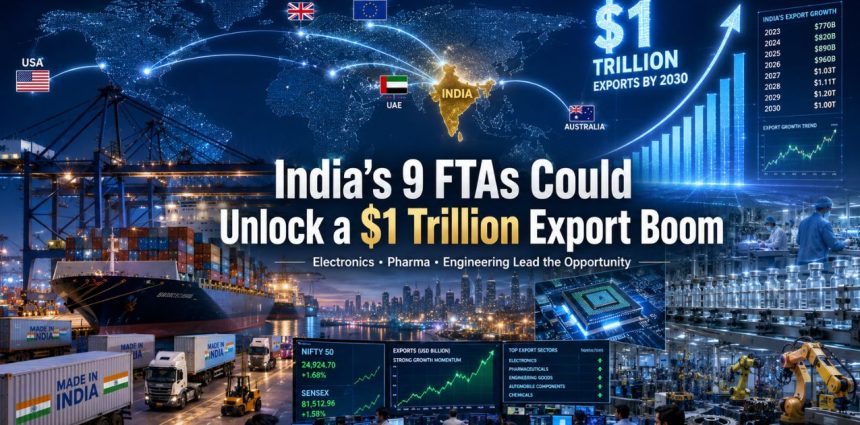
Nine trade deals signed in five years. Three headline sectors. One structural market bet. Yes Securities maps the opportunity and names the risk that could derail it.
Key Takeaways
- Yes Securities says India’s new-generation FTAs, layered over PLI schemes and China+1 supply-chain shifts, give the country its best shot yet at $1 trillion in merchandise exports by 2030.
- India now has 9 FTAs covering 38 countries; the trade share with FTA partners has already risen from 22.4% in FY21 to 28.7% in FY25, before the EU and UK deals have fully matured.
- Electronics, Pharmaceuticals, and Engineering & Machinery Goods are the three sectors identified as the strongest beneficiaries; electronics alone could reach $233 billion in exports by 2030.
- Listed stocks across EMS, pharma, capital goods, and logistics are the direct market plays on this thesis.
- The critical structural risk: merchandise export CAGR was just 3.5% over 2015–2025. Without fixing logistics costs, power tariffs and compliance drag, FTAs could widen the trade deficit rather than close it.
Why This Report Lands Now
India’s total goods and services exports crossed a record $863 billion in FY26, up 4.59% from $825 billion in FY25. But the headline conceals a structural split. Services exports rose 8.71% to an all-time high of $421.32 billion in FY26, while merchandise exports grew just 0.93% to $441.78 billion.
To hit $1 trillion in merchandise exports by 2030, India needs to nearly double goods shipments in four years, a CAGR of roughly 22%, against the 3.5% it actually delivered across the decade to 2025.
Yes Securities’ new report argues that India’s recently concluded FTAs, combined with PLI incentives and the global China+1 manufacturing realignment, are the scaffolding that makes this possible. The question the report is honest about: can India fix domestic competitiveness fast enough to capitalise on the access these agreements have created?
India’s FTA Network: Nine Deals, 38 Countries, One Strategy
In five years, India has moved from one of the most trade-agreement-averse large economies to one of the most active.
Starting with Mauritius in 2021, India added the UAE CEPA in May 2022, Australia’s ECTA in December 2022, the EFTA TEPA signed in March 2024 and in force from October 2025, the UK CETA in July 2025, Oman in December 2025, New Zealand in December 2025, and the EU FTA in January 2026.
With the US, India delivered a framework for an interim agreement in February 2026.
India’s Active FTA Network — As of June 2026
| Partner | Year In Force / Signed | Key Benefit for India |
|---|---|---|
| UAE (CEPA) | May 2022 | Zero-duty access for gems, textiles, engineering goods |
| Australia (ECTA) | December 2022 | Pharma, textiles, IT services preferential access |
| EFTA (4 nations) | October 2025 | CHF 100 bn investment pledge; pharma, machinery |
| UK (CETA) | July 2025 | IT services, pharma, auto components; professional mobility |
| Oman (CEPA) | December 2025 | Gulf manufacturing and re-export corridor |
| New Zealand | December 2025 | Agri-products, textiles, labour-intensive goods |
| EU | January 2026 | Day-1 zero-duty for textiles, gems, leather; pharma & autos |
| US | February 2026 | Framework for interim agreement; negotiations ongoing |
| Mauritius | 2021 | Financial services corridor |
Source: PIB / Ministry of Commerce, June 2026
The share of India’s total trade with FTA partner countries was around 22.4% in FY21 and has increased to 28.7% in FY25, even before the UK, EU, and US frameworks have had time to mature into full trade flows.
The Three Sectors That Win the Most
Yes Securities does not treat all sectors equally. Three categories get the clearest structural tailwinds.
Sector Export Opportunity Under India’s FTA Framework
| Sector | Approx. FY26 Export Base | Yes Securities 2030 Target | Primary FTA Lever |
|---|---|---|---|
| Electronics | ~$46–50 bn | $233 bn | US, EU, UK: component and finished goods tariff cuts |
| Pharmaceuticals | ~$27 bn | Regulated market expansion | EU, UK, Australia: regulatory harmonisation |
| Engineering & Machinery | ~$109 bn | Supply-chain integration | UAE, EU, UK: industrial corridor alignment |
According to Yes Securities, India’s electronics industry has undergone a structural transformation, evolving from a largely import-dependent sector into one of the fastest-growing contributors to merchandise exports, aided by PLI incentives, rising participation by global contract manufacturers, and the rapid expansion of smartphone manufacturing ecosystems led by Apple and its suppliers.
Electronics exports could reach $233 billion by 2030, surpassing the government’s own target of $200 billion for the sector.
The on-ground numbers support the optimism. Electronics exports reached $31 billion in the first eight months of FY26, growing at 38% year-on-year, the fastest-growing category among India’s top 30 export items.
Pharmaceuticals are expected to gain from stronger regulatory cooperation and improved access to developed markets, while engineering goods could benefit from lower tariff barriers and ongoing supply-chain diversification.
The Capex Transmission: Where FTAs Unlock Private Investment
The Yes Securities report’s most consequential argument concerns private investment, not just trade flows. With capacity utilisation around 75%, companies lack the demand visibility needed to commit large capex.
FTA-enabled export orders can shift that calculus, providing sustained utilisation improvement and eventual economies of scale that trigger investment cycles, mirroring the East Asian path where export growth catalysed manufacturing capital formation.
For Indian equity markets, this is the real unlock. When capacity utilisation moves above 80–85%, private capex cycles historically accelerate.
The sectors most likely to see this first: EMS and electronics component manufacturing, specialty chemicals, pharmaceutical API production, and port logistics.
Stocks That Could Benefit From India’s FTA Push
This is where the macro thesis meets the market. Listed Indian companies across four themes are the direct equity plays on FTA-driven export growth.
Electronics Manufacturing Services (EMS) & Component Makers
India’s EMS sector has already seen output rise sixfold over the past decade to ₹11.3 lakh crore in FY25, with exports growing eightfold to $38.6 billion.
Dixon Technologies is India’s largest EMS company, manufacturing smartphones, LED TVs, and home appliances for Samsung, Motorola, Nokia, and Reliance. Kaynes Technology is the fastest-growing IoT, industrial, and medical electronics EMS specialist.
Syrma SGS Technology is the RFID, precision electronics, and PCBA specialist. Amber Enterprises is the AC components and industrial electronics EMS specialist.
All four are PLI-qualifying companies. India’s electronics manufacturing output has grown sixfold in the past decade to ₹11.3 lakh crore in FY25, and exports have grown eightfold to $38.6 billion.
| Company | NSE Ticker | Why It’s Relevant |
|---|---|---|
| Dixon Technologies | DIXON | Largest EMS; Apple supply chain adjacency; ECMS-approved for camera modules |
| Kaynes Technology | KAYNES | IoT, defence, industrial electronics; ECMS-approved PCBs; ₹3,280 Cr ECMS investment |
| Syrma SGS | SYRMA | PCBA, RFID; defence and industrial export exposure |
| Amber Enterprises | AMBER | AC components; industrial electronics; Budget 2026 ECMS beneficiary |
| PG Electroplast | PGEL | Emerging EMS player; consumer electronics assembly |
Pharmaceutical Exporters
India commands 20% of global generic medicine supply and has a large base of US FDA-approved facilities. Sun Pharma derives around 67% of its revenue from international markets, making it the most export-dependent among large-cap Indian pharma companies.
Dr. Reddy’s has strong global revenues with focus on complex generics and biosimilars. Cipla maintains a more balanced domestic and international mix.
The EU and UK FTAs improve regulatory cooperation and market access, which translates into faster drug approvals and incremental revenue for all three.
| Company | NSE Ticker | FTA Angle |
|---|---|---|
| Sun Pharmaceutical | SUNPHARMA | 67% international revenue; EU/UK specialty drug access |
| Dr. Reddy’s Laboratories | DRREDDY | Complex generics, biosimilars; EU regulated market exposure |
| Cipla | CIPLA | UK, South Africa, US; respiratory generics franchise |
| Aurobindo Pharma | AUROPHARMA | Large EU formulations business; API + finished dose |
| Laurus Labs | LAURUSLABS | CDMO model; EU API and synthesis contracts |
Capital Goods & Engineering Exporters
Engineering goods currently face EU tariffs of up to 22%, limiting competitiveness against FTA-linked suppliers. Preferential access under the India-EU agreement could help Indian exporters win incremental orders in the EU’s engineering import market, estimated at over ₹170 trillion.
Companies with established EU exposure or export-ready platforms include Apar Industries, Elgi Equipments, Carborundum Universal, Thermax, Siemens Energy India, GE Vernova T&D India, CG Power, Hitachi Energy and Triveni Turbines.
| Company | NSE Ticker | Export Angle |
|---|---|---|
| Thermax | THERMAX | Industrial boilers, energy equipment; EU industrial exposure |
| Cummins India | CUMMINS | Engines, power solutions; USD-denominated export revenues |
| Apar Industries | APAR | Conductors, cables; EU and Middle East export contracts |
| Triveni Turbines | TRITURBINE | Steam turbines; global export order book |
| Elgi Equipments | ELGIEQUIP | Air compressors; 40%+ revenue from exports |
Logistics, Ports & Freight Operators
Higher export volumes mean higher throughput at ports, container yards and rail logistics networks. This is the infrastructure layer that captures FTA-driven trade regardless of which sector wins.
Adani Ports and Special Economic Zone is India’s largest commercial ports operator with 15 ports and a total capacity of 633 MMT. In Q2 FY26, it reported revenue growth of 30% YoY to ₹9,167 crore and net profit growth of 29% to ₹3,120 crore, with a three-year profit CAGR of 27%.
Container Corporation of India, as a dominant rail operator at ports with a 59% market share, is a direct beneficiary of rising export-import container volumes.
| Company | NSE Ticker | FTA Angle |
|---|---|---|
| Adani Ports & SEZ | ADANIPORTS | India’s largest port operator; IMEC corridor partner; EU-linked trade flows |
| Container Corporation | CONCOR | 59% EXIM rail market share; direct volume beneficiary |
| JSW Infrastructure | JSWINFRA | Fast-growing port capacity; Elara Capital Buy rating |
| Gateway Distriparks | GDL | Container rail logistics; EXIM volume recovery play |
Check Live: Adani Ports and Special Economic Zone Share Price Chart: Live
The Structural Risk That Cannot Be Ignored
Yes Securities itself flags the counterargument, and it is echoed by the Global Trade Research Initiative. The strongest counterargument is that India’s primary challenge lies not in market access but in domestic competitiveness.
Merchandise exports grew at just 3.5% CAGR over 2015–2025. Structural bottlenecks, including high logistics costs, expensive power, compliance complexity, and lower labour productivity remain. Without fixing these, FTAs could widen trade deficits if imports rise faster than exports.
The FY26 data makes this risk tangible. India’s overall trade deficit widened to $119.30 billion in FY26, up 26% from $94.66 billion in FY25. Electronic goods imports rose 17.8% to $116.2 billion, reflecting input demand from India’s expanding manufacturing base.
That dynamic captures the tension precisely, FTA-driven manufacturing growth is simultaneously pulling in more imports, and the deficit improvement depends on export growth eventually outrunning import demand.
The India-US negotiation is the wild card. The US remains India’s single largest merchandise export destination. The February 2026 interim framework is a start, but a comprehensive agreement would be a step-change for Indian exporters in electronics, pharma, and textiles, far larger than any single deal signed so far.
Bottom Line
India’s FTA architecture is now the most ambitious it has ever been, nine agreements covering 38 countries, with the EU deal in force and a US framework underway.
Yes Securities is right that the structural scaffolding is in place. Electronics is the headline opportunity at $233 billion by 2030. Pharma and capital goods provide the mid-cycle earnings visibility. Port and logistics stocks are the volume-agnostic infrastructure bet.
But the decade-long 3.5% merchandise export CAGR is a sobering baseline. The $1 trillion target by 2030 is not impossible, it requires India to fix its domestic competitiveness at the same pace it is signing trade agreements.
Investors watching this theme should track monthly DGFT export data, capacity utilisation surveys, and private capex announcements as the leading indicators of whether the FTA thesis is converting into earnings.
Data as of June 13, 2026. Sources: Yes Securities report, PIB Ministry of Commerce, DGFT/Ministry of Commerce FY26 trade data, PL Capital, Elara Capital, BusinessToday, ANI, Whalesbook. Stock mentions are for informational and educational purposes only and do not constitute investment advice or a buy/sell recommendation.