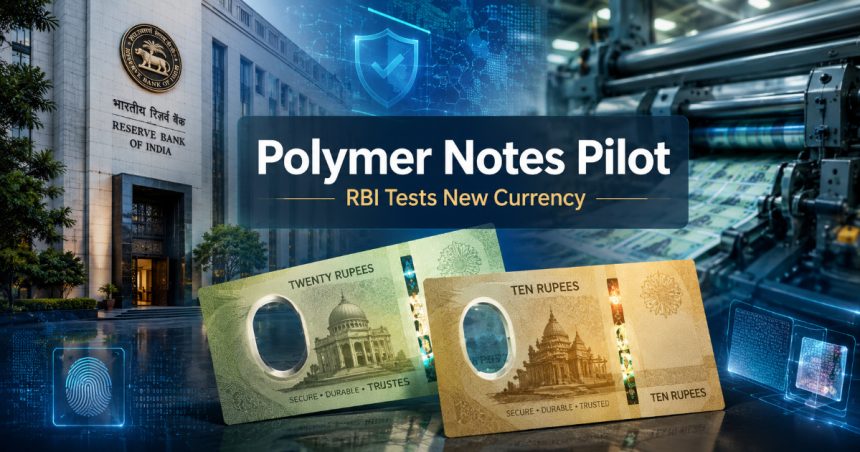
RBI Revives Polymer Currency Plan After 17 Years: Why ₹10 and ₹20 Notes Are Under Trial
The RBI polymer notes pilot is making a comeback after more than a decade, with the Reserve Bank of India preparing to introduce polymer ₹10 and ₹20 banknotes on a trial basis. While the move has sparked curiosity among the public, the central bank is not replacing paper currency just yet.
Instead, the pilot aims to determine whether polymer banknotes can withstand India’s demanding circulation conditions, reduce replacement costs, and improve currency durability before any decision is taken to expand the initiative to higher denominations such as ₹100 and ₹500.
The trial also marks the RBI’s second attempt after its first proposal in 2009 was shelved because of technical challenges.
Track Live : NSE-Listed Companies and Indian Stock List
Why RBI Revives Polymer Currency selected only ₹10 and ₹20 notes for the pilot
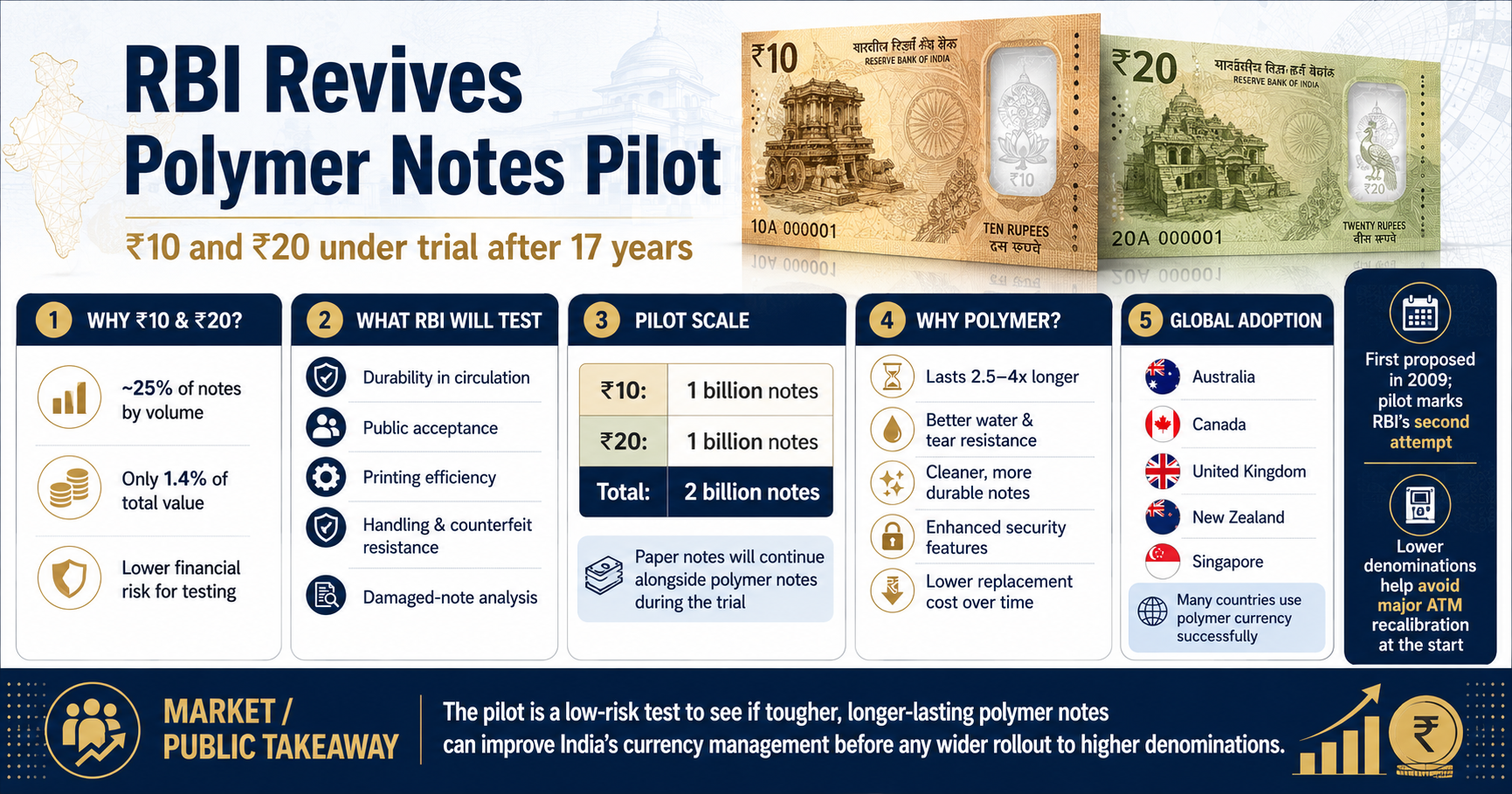
The RBI has deliberately chosen the ₹10 and ₹20 denominations because they offer the ideal testing ground with limited financial risk.
Together, these two denominations account for nearly 25% of the total volume of banknotes in circulation, but represent only 1.4% of the total value of currency in circulation.
This means even if operational challenges arise during the pilot, the financial impact would remain relatively small compared with introducing polymer notes in high-value denominations.
The RBI will use the trial to evaluate:
- Durability in different climates
- Public acceptance
- Printing efficiency
- Ease of handling
- Performance in circulation
- Resistance to counterfeiting
- Collection of damaged notes for analysis
If the pilot is successful, the RBI may consider extending polymer notes to higher denominations such as ₹100 and ₹500 in future phases.
Read More : Adani Enterprises Q1 FY27 Results: Revenue Jumps 50%, Record EBITDA at ₹5,642 Crore Despite One-Time Charge
Longer-lasting notes could reduce replacement costs
One of the biggest reasons behind the RBI polymer notes initiative is durability.
Unlike conventional paper currency, polymer banknotes are significantly more resistant to moisture, dirt, folding and tearing. Since ₹10 and ₹20 notes are among the most frequently used banknotes in India, they typically wear out much faster than higher denominations.
A longer lifespan would reduce the frequency of printing replacement notes, lowering the RBI’s long-term currency management costs.
Although polymer notes may have a higher initial production cost, their extended life cycle could make them more economical over time. In some cases, they may even compare favourably with the cost of minting low-value coins.
Pilot helps RBI avoid major ATM disruptions
Another important reason for selecting lower denominations is operational convenience.
Most ₹10 and ₹20 notes are distributed through bank branches, rather than ATMs. This allows the RBI to conduct the pilot without immediately requiring banks to modify thousands of ATMs and cash recycler machines across the country.
Polymer banknotes have a different texture, thickness and flexibility compared with traditional paper notes. Existing ATM systems are not yet calibrated to identify or process them efficiently.
If polymer notes were introduced directly in higher denominations such as ₹100 or ₹500, banks would need extensive software updates and machine recalibration, potentially disrupting cash withdrawals nationwide.
By beginning with lower denominations, the RBI can focus on testing the notes themselves before addressing infrastructure changes.
Second attempt after the 2009 proposal was shelved
This is not the RBI’s first effort to introduce polymer currency.
The central bank had proposed polymer banknotes in 2009, but the initiative was eventually abandoned because of technical issues encountered during evaluation.
Advances in printing technology and improvements in polymer banknote manufacturing have prompted the RBI to revisit the idea, with the upcoming pilot expected to provide fresh insights into operational feasibility under Indian conditions.
Government approves field trials
The government has approved the RBI’s proposal to print 2 billion polymer banknotes for testing:
| Denomination | Quantity Approved |
|---|---|
| ₹10 | 1 billion notes(100 Crore) |
| ₹20 | 1 billion notes(100 Crore) |
| Total | 2 billion notes(1200 Crore) |
The Finance Ministry has also clarified that paper currency will continue to remain in circulation alongside polymer notes during the trial period.
Global Adoption of Polymer Banknotes
Several countries have successfully adopted polymer (plastic) banknotes to improve durability, strengthen anti-counterfeiting measures, and reduce long-term currency replacement costs. Australia pioneered the technology in 1988, and many advanced economies have since transitioned fully or partially to polymer currency.
| Country | Polymer Notes | Notes |
|---|---|---|
| Australia | Yes | First country to introduce polymer banknotes in 1988; fully converted by 1996. |
| Canada | Yes | Completed transition to polymer banknotes by 2013. |
| United Kingdom | Yes | Bank of England completed the switch to polymer notes by 2021. |
| New Zealand | Yes | Fully adopted polymer currency in 1999. |
| Singapore | Yes | Uses polymer banknotes for several circulating and commemorative denominations. |
Why Many Countries Switched to Polymer Currency
| Benefit | Why It Matters |
|---|---|
| Better Counterfeit Protection | Transparent windows, holograms, micro-printing and advanced security features are significantly harder to replicate. |
| Longer Lifespan | Polymer notes generally last 2.5–4 times longer than paper notes, reducing replacement frequency. |
| Cleaner Currency | The non-porous plastic surface resists moisture, dirt, oil and sweat, making notes more hygienic. |
| Lower Lifecycle Costs | Although production costs are higher initially, fewer replacements reduce printing, transportation and destruction costs over time. |
| Environmental Benefits | Worn polymer notes can be recycled into plastic products, lowering the overall environmental footprint. |
| Machine Compatibility | Uniform size, strength and durability improve performance in ATMs, vending machines and cash-handling systems once calibrated. |
Here’s what happened today and why people are watching this closely
The RBI’s announcement has renewed discussions about the future of Indian currency.
Rather than replacing existing paper notes immediately, the central bank is adopting a phased approach by testing the lowest denominations first. The strategy enables the RBI to gather real-world feedback on durability, circulation patterns, counterfeit resistance and public acceptance before making any broader policy decision.
Financial institutions will also closely monitor how polymer notes perform under India’s diverse climatic conditions and intensive cash usage.
What the RBI polymer notes pilot means for the public
For now, there is no requirement for the public to exchange existing ₹10 or ₹20 paper notes. Both paper and polymer notes are expected to circulate simultaneously during the pilot phase.
If the trial proves successful, India could gradually move toward longer-lasting banknotes that reduce replacement costs, improve durability and strengthen currency security. Any wider rollout, however, is likely to depend on the pilot’s findings, operational readiness, and the cost of upgrading banking infrastructure.
For consumers, the immediate impact will be minimal. For the RBI, however, the pilot represents an important step toward modernising India’s currency management system while assessing whether polymer banknotes can deliver long-term economic and operational benefits.
What are the advantages of polymer notes?
| Feature | Polymer Notes | Paper Notes |
|---|---|---|
| Lifespan | Much longer | Shorter |
| Water Resistance | High | Low |
| Tear Resistance | High | Moderate |
| Dirt Resistance | Better | Lower |
| Anti-counterfeit Features | Enhanced | Standard |
| Replacement Cost | Lower over time | Higher |