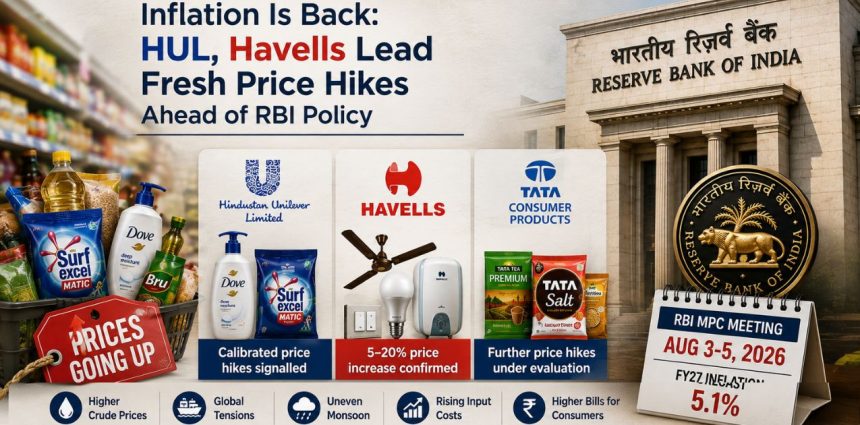
India’s biggest consumer companies are preparing another round of price hikes just as retail inflation has climbed above the RBI’s 4% target for the first time in 17 months. With the Monetary Policy Committee scheduled to meet August 3–5, investors are watching whether persistent cost pressures force the central bank to hold its cautious stance on interest rates, a combination that puts FMCG, durables and rate-sensitive stocks squarely in focus this week.
Why It Matters Today
- Retail inflation has moved above the RBI’s 4% target after 17 months
- Several major consumer companies have already started passing higher costs to customers
- Festive-season demand may support sales even as prices rise
- The RBI’s August 5 policy decision could shape borrowing-cost and market-sentiment expectations
June CPI Crosses 4% for the First Time in 17 Months
Per MoSPI’s press release dated July 13, 2026, CPI-based retail inflation rose to 4.38% (provisional) in June, up from 3.93% in May, above the 4.30% Reuters poll forecast and the highest since the CPI series was rebased to 2024 in January.
Food inflation (CFPI) climbed to 5.32% from 4.78%. At the item level, silver jewellery was the sharpest driver, up 133.21% year-on-year, followed by ginger (50.41%) and gold/diamond/platinum jewellery (36.82%), per official MoSPI data. Rural inflation at 4.74% continued to outpace urban inflation of 3.92%.
The RBI’s July Bulletin (released July 22) described headline inflation as having “inched up” in June, while noting core inflation excluding precious metals stayed low and liquidity conditions kept supporting credit growth.
CPI & CFPI — May vs June 2026 (MoSPI Data)
| Metric | May 2026 (Final) | June 2026 (Provisional) | Change |
|---|---|---|---|
| CPI – Combined | 3.93% | 4.38% | +45 bps |
| CFPI – Combined | 4.78% | 5.32% | +54 bps |
| CPI – Rural | 4.25% | 4.74% | +49 bps |
| CPI – Urban | 3.53% | 3.92% | +39 bps |
RBI Inflation Outlook (FY27)
| Metric | Value |
|---|---|
| FY27 CPI Forecast | 5.1% |
| RBI Target | 4% |
| Tolerance Band | 2–6% |
| Q3 FY27 Peak (Projected) | ~5.9% |
HUL, Havells, Tata Consumer Confirm Fresh Price Action
Hindustan Unilever raised prices by an average 5% in Q1 FY27 even as net profit fell 4% to ₹2,631 crore. After the July 28 results, CFO Niranjan Gupta said the company had “only passed half of the inflation in pricing” and would keep taking “calibrated, measured steps” in detergents and dishwash. HUL shares fell nearly 7% that day despite sales rising 10% to ₹16,514 crore.
Havells India has pushed through the sharpest hikes among listed peers. On its Q1 FY27 earnings call, CMD Anil Rai Gupta told analysts price increases ranged 5-20%, averaging 7-8%, corroborating the figure cited in wire reports.
Tata Consumer Products has signalled, but not confirmed, further hikes. MD and CEO Sunil D’Souza said on July 26 the company “could increase prices” to protect its FY27 margin-expansion target of 50-70 bps, citing West Asia-linked cost pressure. Wire reports also flag Asian Paints and Dodla Dairy as weighing increases, per post-earnings commentary.
Check Live:
HUL Option Chain (HINDUNILVR) — Live OI, IV & Greeks
HAVELLS INDIA Option Chain (NSE) — Live OI, PCR & Greeks
TATA CONSUMER PRODUCTS Options Chart
Stocks in Focus
| Company | Why in Focus |
|---|---|
| Hindustan Unilever | More calibrated price hikes signalled after Q1’s 5% increase |
| Havells India | 5–20% price increase confirmed on earnings call (avg. 7-8%) |
| Tata Consumer Products | Possible further hikes; CEO has flagged the option, not confirmed it |
| Asian Paints | Monitoring input costs, incl. titanium dioxide pricing |
| Dodla Dairy | Price hike under consideration, per post-earnings commentary |
What’s Driving the Cost Pressure
The common thread is the prolonged US-Iran conflict in West Asia, which has kept crude and commodity costs elevated. India relies heavily on imported crude oil, with a significant share transported through the Strait of Hormuz, making domestic input costs sensitive to disruptions in the region. Petrochemical-linked inputs used in soaps, detergents and paints have grown costlier as a result.
An uneven monsoon and El Niño risk add a second pressure point on food prices through the July-September quarter — the window when kharif output typically shapes food inflation. The finance ministry’s July Monthly Economic Report flagged Gulf tensions as an upside inflation risk even while describing the broader economy as resilient.
Commodity Watch
| Commodity | Why It Matters |
|---|---|
| Brent Crude | Traded in the $86–90/bbl range in late July — up over 20% for the month — after briefly topping $100/bbl on renewed US-Iran strikes; drives fuel and logistics costs |
| Palm Oil | Key input for soaps and packaged foods |
| Crude Derivatives (LAB) | Feeds into detergent and packaging costs |
| Natural Gas | Affects manufacturing and fertiliser costs |
| Rubber | Drives tyre-making costs |
| Titanium Dioxide | Core pigment input for paints |
The Inflation Chain Reaction
Middle East Tensions → Higher Crude & Commodity Prices → Higher Input Costs for FMCG, Durables & Paints → Companies Raise Consumer Prices → Retail Inflation Climbs → RBI Policy Watch Intensifies
RBI’s August 3-5 MPC Meeting Is the Next Big Trigger
The RBI’s Monetary Policy Committee meets August 3-5, with Governor Sanjay Malhotra due to announce the decision on August 5. The repo rate has held at 5.25% since the December 2025 cut, and most economists expect another pause.
At its June meeting, the RBI had already revised its FY27 CPI forecast to 5.1%, up roughly 50 bps from its earlier 4.6% estimate, with inflation projected to peak near 5.9% in Q3 before easing. Whether the August statement pushes this higher, or reiterates that pressures remain within the 2-6% tolerance band, will be closely watched by equity and bond markets.
Also Check: Sensex, Nifty Today — Market Outlook Ahead of RBI Policy
What Investors Should Watch Next
- RBI MPC outcome (August 5)
- July CPI print, due mid-August
- Brent crude price movement
- Monsoon progress through August-September
- FMCG companies’ volume growth alongside pricing
- Q2 FY27 pricing commentary from consumer companies
Sector Impact
| Likely Beneficiaries | Under Pressure |
|---|---|
| FMCG names with strong pricing power | Consumer discretionary categories |
| Premium brands with loyal demand | Low-margin manufacturers |
| Select staples (tea, salt, essentials) | Real estate, if rates stay elevated |
| Efficient appliance makers | Rate-sensitive NBFCs |
NiftyTrader Desk View
For retail investors, the inflation–price hike–RBI policy loop is best read as a sector signal, not a trading trigger. FMCG and durables names with strong pricing power, raising prices without denting volumes, have historically weathered such cycles better than peers reliant on discretionary demand.
A hawkish surprise on August 5 could also add near-term volatility to rate-sensitive sectors like banking, NBFCs and real estate. This is a macro observation, not investment advice; stock-specific decisions should factor in individual risk appetite and, where needed, a SEBI-registered advisor’s guidance.
The Road Ahead
The coming weeks will determine whether companies can pass on higher costs without hurting demand. If festive spending stays resilient, firms with strong brands and pricing power may protect margins. But if inflation broadens beyond food and fuel while commodity prices stay elevated, the RBI could remain cautious for longer, keeping markets focused on both corporate earnings and the inflation trajectory through the rest of FY27.
Read Next: July GST Numbers Are In: Here’s What the Latest Tax Data Says About India’s Economy
Disclaimer: This article is for informational purposes only and does not constitute investment advice or a recommendation to buy or sell any security. NiftyTrader does not guarantee the accuracy or completeness of data presented, which is sourced from official releases, company disclosures and public reporting as cited. Readers should conduct independent research or consult a SEBI-registered advisor before making investment decisions.