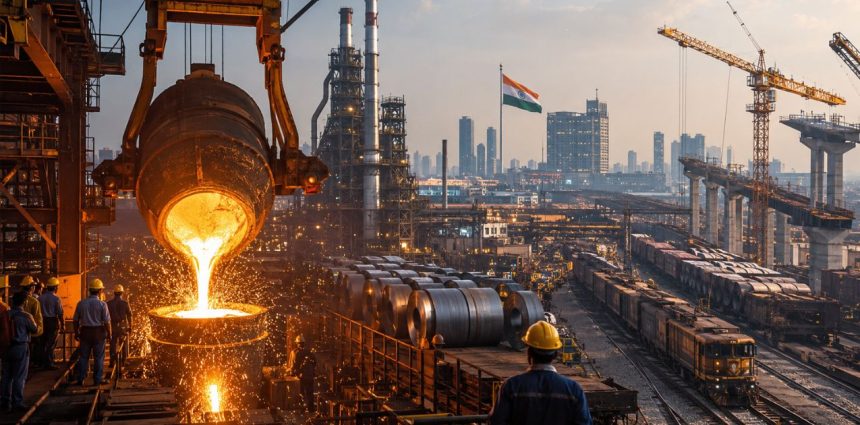
India is now the world’s second-largest steel producer, and global mining giants BHP and Rio Tinto say it is just getting started. Here is why the ₹9 lakh crore Indian steel story is different from China’s and what it means for investors.
Key Takeaways
- India’s finished steel consumption grew 9% YoY to 14.33 million tonnes in May 2026, driven by construction and infrastructure demand.
- Indians consumed just 108 kg of finished steel per capita in FY2024-25, less than one-fifth of China’s 601 kg, signalling massive headroom for growth.
- India’s government has set a target of producing 500 million tonnes of steel by 2047, up from 165 million tonnes last year.
- India’s steel industry is expected to attract nearly ₹9.01 lakh crore (US$100 billion) in investments to achieve its 2030 capacity targets.
- Unlike China’s property-driven steel boom, India’s demand is being shaped by infrastructure, manufacturing, and decarbonisation, making it slower but more durable.
Why the World Is Watching India Now
For over two decades, China’s steel appetite defined global commodity markets. That era is fading. Chinese steel demand is plateauing as its property boom unwinds, and the world’s largest miners are pointing firmly at India as the next growth engine.
At Singapore International Ferrous Week, executives from BHP and Rio Tinto delivered a coordinated signal: India and ASEAN are where the next decade of steel demand will be written, helping to offset the stagnation in Chinese demand.
BHP’s Sales and Marketing Officer Michiel Hovers was blunt: “I recently went to India. All our customers are doubling their capacity. It’s happening. It’s real.”
The arithmetic behind this optimism is simple. India’s per capita steel consumption stands at just 108 kg, compared to China’s 601 kg and a global average of 215 kg. The gap is not a weakness, it is the growth runway.
India vs China: A Steel Comparison
| Metric | India (2024-25) | China (2024) | Global Average |
|---|---|---|---|
| Per Capita Consumption (kg) | 108 | 601 | 215 |
| Crude Steel Production (MT) | ~165 MT | 1,005.1 MT | — |
| Steel Capacity (MTPA, FY26) | ~220 MTPA | ~1,200+ MTPA | — |
| 2030 Production Target | 300 MTPA | Stable/declining | — |
| Long-term Target | 500 MT by 2047 | — | — |
| Demand Driver | Infrastructure + Manufacturing | Real estate (slowing) | — |
Sources: World Steel Association, Joint Plant Committee (JPC), Steel Ministry of India
May 2026: Ground Reality Backs the Thesis
The growth story is not just a projection; it is already showing up in data. India’s crude steel production reached 14.21 million tonnes in May 2026, up 2.9% YoY.
Finished steel production rose significantly to 13.94 million tonnes, a 7.7% YoY increase, while domestic demand remained robust at 14.33 million tonnes, recording a strong 9.0% YoY growth.
India’s total crude steelmaking capacity reached approximately 220 MTPA in FY 2025-26, keeping the industry on track to achieve the National Steel Policy target of 300 MTPA by 2030.
In a significant step, SAIL has approved the expansion of its Bhilai Steel Plant from a crude steel capacity of 6.8 MTPA to 10.2 MTPA.
Infrastructure and Manufacturing: The Twin Engines
India’s steel story differs from China’s in one critical respect, what is consuming the steel. China’s boom was overwhelmingly property-driven. India’s demand is being shaped by an entirely different set of sectors.
Infrastructure accounts for 60–65% of current steel demand, funded by rising government capital expenditure on highways, ports, airports, freight corridors, and high-speed rail.
India’s bullet train project is significantly boosting the steel industry through large-scale infrastructure development, involving the construction of massive steel bridges and complex tunnel systems.
The manufacturing pillar is growing fast too. The government’s Make in India initiative is funnelling investment into automobiles, engineering goods, electronics, and heavy industry.
The Ministry of Steel signed ₹11,887 crore worth of MoUs with 55 companies under the third tranche of the PLI scheme, targeting 26 million tonnes of additional specialty steel capacity by 2030-31 and reducing import dependence.
India’s Steel Trade Balance: A Pressure Point
| Parameter | FY2020-21 | FY2024-25 | Apr–May FY2026 |
|---|---|---|---|
| Finished Steel Imports (MT) | 4.75 | 9.55 | 1.37 |
| Finished Steel Exports (MT) | 10.78 | 4.86 | 0.98 |
| Net Trade Position | Net Exporter | Net Importer (−4.69 MT) | Net Importer |
| Import Growth YoY | — | — | +45% |
Source: Joint Plant Committee (JPC), Steel Ministry of India
In May 2026, imports stood at 0.69 million tonnes and exports at 0.51 million tonnes, with imports registering YoY growth of 62.5% over May 2025 levels.
The surge in finished steel imports is a consequence of domestic capacity not yet fully catching up to fast-rising consumption, a gap that ongoing capex is designed to close.
Check Live: STEEL AUTHORITY OF INDIA Option Chain (NSE) — Live OI, PCR & Greeks
The Raw Material Challenge
India has abundant iron ore but remains heavily dependent on imported metallurgical coal for blast furnace steelmaking, a structural vulnerability China did not face at a comparable stage of development.
International coking coal costs edged up 2.8% month-on-month to $239/tonne in May 2026, sustaining elevated input cost pressures for integrated BF-BOF producers heading into Q2 FY2026-27.
Unlike China, which spent decades securing overseas mineral assets ahead of demand, India is building supply chains while simultaneously scaling up production.
Australian coking coal remains the primary import source, alongside the US, Canada, Mongolia, Russia, and emerging suppliers such as Mozambique.
The Green Steel Imperative
India is also building its steel industry under the global carbon microscope, a challenge China did not face during its expansion decades.
The government has set a target to reduce carbon emissions from steel production to approximately 2 tonnes of CO₂ per tonne of finished steel by the mid-2030s, from current levels of roughly 2.65 tonnes.
India’s green steel demand is forecasted to climb from negligible levels today to 4.49 million tonnes by FY30, driven by the construction sector, infrastructure, and automobiles, with projections rising to 24 MT by FY35 and 73 MT by FY40.
The EU’s carbon border tariff (CBAM) is accelerating this shift, pushing Indian steelmakers toward scrap-based and gas-based production routes.
Tata Steel reiterated an investment of ₹11,000 crore in Jharkhand for green steel development, aimed at advancing low-carbon production, generating employment, and strengthening the regional industrial ecosystem.
Capacity Expansion: Who Is Building What
| Company | Expansion | Investment | Focus |
|---|---|---|---|
| SAIL (Bhilai) | 6.8 MTPA → 10.2 MTPA | Government-funded | Integrated expansion |
| Tata Steel | Green steel facility, Jharkhand | ₹11,000 Cr | Low-carbon production |
| AM/NS India | New integrated mill, Andhra Pradesh | 890 hectares acquired | Greenfield capacity |
| PLI Scheme (55 cos.) | +26 MT specialty steel capacity by FY31 | ₹11,887 Cr MoUs | Specialty grades |
Sources: PIB, Steel Ministry, IBEF
Not a Replacement for China — A New Chapter
Analysts caution against reading India as a like-for-like substitute for China’s steel era. Crisil Intelligence Director Sehul Bhatt has noted that China’s share remains large enough to pull down global demand independently, and India’s gradual, private-sector-led ramp-up cannot compensate for that on a one-to-one basis.
But the direction is clear. Vale CEO Eduardo Pimenta expects India to import about 10 million tonnes of the miner’s ore this year, up from almost none a few years ago, and sees India posting 12% annual steel growth, in stark contrast to China where output will likely stabilize or even decline.
India’s rise will be defined less by a property frenzy and more by infrastructure capex, manufacturing ambition, raw material security, and decarbonisation. That makes India’s steel chapter not a replay of China’s, but an altogether more complex and more durable one.
Check live FII/DII flow data and sector OI positioning on NiftyTrader’s [Option Chain Tool] and [FII-DII Dashboard] before making any investment decisions.
Bottom Line
India is the world’s second-largest steel producer and the industry’s most consequential growth story for the next two decades. Per-capita consumption at 108 kg versus China’s 601 kg, a 300 MTPA capacity target by 2030, and ₹9 lakh crore in projected investments make the structural case compelling.
However, execution risks, land acquisition delays, metallurgical coal import dependence, and green steel transition costs mean this story will unfold over years, not quarters. For long-term investors, Indian steel and metal stocks deserve a place on the watchlist.