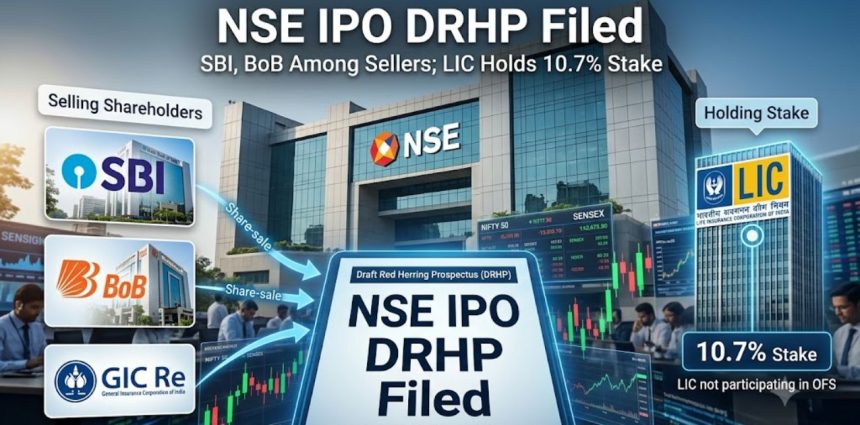
The National Stock Exchange has filed its Draft Red Herring Prospectus with SEBI, moving India’s most-awaited market infrastructure IPO closer to reality. The offer is structured as a pure offer-for-sale, but the bigger signal for investors is the contrast between institutions selling and LIC choosing to stay invested.
Key Takeaways
- NSE’s IPO is expected to be a pure OFS of up to 14.89 crore shares.
- State Bank of India, Bank of Baroda, GIC Re and other institutional shareholders are among the reported sellers.
- LIC, NSE’s largest shareholder with about 10.7% stake, is not selling in the OFS.
- NSE-linked stocks reacted differently after the DRHP filing, with IFCI and Bank of Baroda gaining while GIC Re stayed under pressure due to its own government OFS.
- The final IPO price band, issue size and dates will be known only after SEBI review and RHP filing.
Why NSE’s DRHP Filing Matters

NSE’s IPO has been one of the longest-awaited listings in India’s capital markets. The exchange first moved towards a public listing years ago, but the process was delayed due to regulatory hurdles, including the co-location matter.
The DRHP filing now marks a formal step towards listing India’s largest stock exchange. NSE dominates India’s derivatives market and remains one of the country’s most important market infrastructure institutions.
This IPO is not a fresh issue. NSE will not receive money from the public offer for business expansion, technology investment or debt reduction. Instead, existing shareholders will sell part of their holdings through an offer-for-sale.
That makes the seller list important. But for investors, the non-seller list is equally important. LIC’s decision to retain its NSE stake gives the story a sharper angle than a normal IPO filing.
Who Is Selling in the NSE IPO?
The NSE IPO is expected to involve an OFS of up to 14.89 crore shares.
State Bank of India is among the key selling shareholders. Bank of Baroda, GIC Re, New India Assurance, National Insurance, United India Insurance and Stock Holding Corporation of India are also among the reported institutional sellers.
Foreign and private institutional shareholders are also expected to participate in the OFS. For some long-term investors, the IPO offers a liquidity window after holding NSE shares for several years.
For public-sector shareholders, the listing gives a chance to monetise part of their NSE exposure. For the broader market, the IPO gives investors a rare opportunity to evaluate India’s dominant exchange business as a listed company.
LIC Is Not Selling—Why That Matters
The most interesting part of the NSE IPO is that LIC is not part of the OFS.
LIC holds about a 10.7% stake in NSE, making it the exchange’s largest shareholder. The insurer’s decision to stay invested suggests it is not treating the IPO only as an exit opportunity.
This does not mean LIC’s decision is a buy signal for investors. But it does show that India’s largest institutional investor may be looking beyond near-term listing liquidity.
For a business like NSE, where scale, market share, transaction volumes, clearing infrastructure, indices and data products matter, long-term ownership can be valuable. The contrast is clear: some institutional shareholders are using the OFS to sell part of their stake, while LIC is choosing to hold.
How NSE-Linked Stocks Reacted to the DRHP Filing — June 18, 2026
The NSE DRHP filing triggered a sharp divergence across listed NSE-linked stocks. Some shareholder stocks gained as the IPO moved closer, while GIC Re remained under pressure because of its own concurrent government OFS.
| Stock | Ticker | NSE Role | June 17 Close | June 18 Move | NSE Stake Link |
|---|---|---|---|---|---|
| IFCI | IFCI | Indirect NSE proxy via SHCIL | ₹89.70 | Up; touched around ₹94 intraday | IFCI holds 52.86% in SHCIL, which holds NSE stake |
| State Bank of India | SBIN | Key OFS seller | ~₹1,026 | Marginally higher | Direct OFS participant |
| Bank of Baroda | BANKBARODA | OFS seller | ~₹281.85 | Up; touched around ₹287 intraday | Direct OFS participant |
| GIC Re | GICRE | OFS seller in NSE IPO | ~₹353–355 | Under pressure | Direct NSE shareholder; also impacted by its own govt OFS |
| HDFC Life | HDFCLIFE | Minor NSE shareholder / reported OFS participant | ~₹574–581 | Up around 1%; near ₹589 in early trade | Limited NSE-linked impact |
| LIC | LICI | Largest NSE holder; not selling | ~₹418 | Largely flat in early trade | Long-term hold signal |
Data as of the June 17–18, 2026, market session. Intraday figures are indicative and should be updated with final closing prices after 3:30 PM IST. Source: NSE/BSE live market feeds and reported DRHP-linked disclosures.
Track live: FII-DII activity in these stocks on NiftyTrader’s FII-DII Tool.
IFCI and Other NSE Proxy Trades
IFCI has become one of the most watched NSE-linked proxy stocks because of its indirect exposure through Stock Holding Corporation of India. IFCI holds 52.86% in SHCIL, which itself holds a stake in NSE. That makes IFCI sensitive to fresh developments around NSE’s listing.
However, traders should avoid treating every move as a pure NSE IPO reaction. In some cases, the link is direct. In others, the stock reaction may also reflect company-specific news, broader market momentum, or separate corporate triggers.
That is why the DRHP seller list and the stock-reaction table should be read together. The table shows how listed NSE-linked names reacted, but it does not mean every move was caused only by the IPO filing.
Check Live: IFCI Share Price Chart| NIFTYTRADER
Why GIC Re Reacted Differently
GIC Re is a useful example. It is linked to the NSE IPO as a reported OFS participant, but the stock was also under pressure because of the government’s separate offer-for-sale at a floor price of ₹352 per share.
That concurrent OFS created near-term supply pressure. So GIC Re’s price action should not be interpreted only through the NSE IPO lens.
This is important for traders. A positive IPO-linked trigger can get diluted if the same stock is facing a separate supply event, discounted OFS or company-specific pressure.
Also Read: GIC Re OFS 2026: Govt Sells 5% Stake at ₹352, MPS Gap Remains
NSE Financials: The Numbers Behind the IPO
In FY26, NSE reported revenue of ₹16,601 crore and profit after tax of ₹10,302 crore, according to the DRHP. While both figures declined year-on-year, the exchange maintained an operating EBITDA margin of approximately 76% and held a ~93% share of India’s cash equity market.
These numbers show why the IPO is being watched closely despite the profit decline. NSE remains a highly profitable market infrastructure business with strong operating margins, dominant market share and deep participation across cash equities, equity derivatives, indices, clearing and data services.
Once listed, NSE will join BSE and MCX as publicly traded exchange operators in India. This will give investors another listed exchange business to compare on valuation, revenue mix, derivatives volumes, transaction charges and regulatory risk.
What Happens Next?
The DRHP filing is only the first formal step. SEBI will now review the offer document and may ask for clarifications. After that, NSE will file the Red Herring Prospectus, announce the price band, open the issue for subscription and complete allotment and listing.
Since NSE cannot list on its own exchange, the company is expected to list on BSE.
Investors should wait for the final RHP before making any decision. The final issue size, price band, valuation, risk factors and exact shareholder sale details will matter more than early market buzz.
Bottom Line
NSE’s DRHP filing is a major milestone for Indian capital markets. The IPO is expected to be a pure OFS, giving existing shareholders a liquidity window rather than raising fresh capital for NSE.
The most important angle is the split between sellers and holders. SBI, Bank of Baroda, GIC Re and other institutions are using the IPO to sell part of their stake, while LIC is choosing to retain its 10.7% holding.
For traders, the immediate action is in NSE-linked listed stocks such as IFCI, SBI, Bank of Baroda, GIC Re, HDFC Life and LIC. For investors, the real test will come when NSE announces its final price band, valuation and listing timeline.
Disclaimer: This article is for informational and educational purposes only. It is not investment advice or a recommendation to buy, sell or hold any security. Please consult a SEBI-registered financial advisor before making investment decisions.