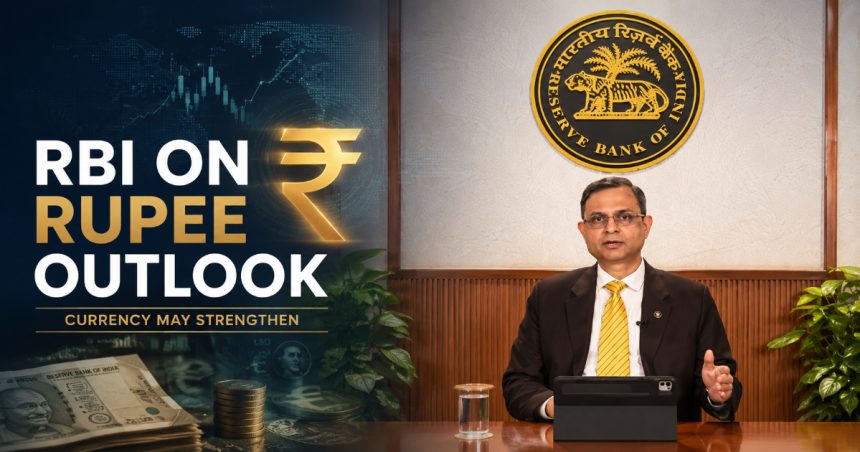
RBI Governor Malhotra Says Rupee Could Strengthen as Global Tensions Ease
The rupee outlook has received an important signal from the Reserve Bank of India: volatility may continue, but disorderly moves will not be allowed to dictate the currency’s direction.
RBI Governor Sanjay Malhotra said on Wednesday that the rupee could strengthen as global tensions ease, while stressing that India’s underlying economic fundamentals remain “very strong.”
For currency traders and equity investors, the message matters. An easing of geopolitical stress combined with RBI support could change sentiment around the rupee—but the central bank is not promising any particular exchange-rate level.
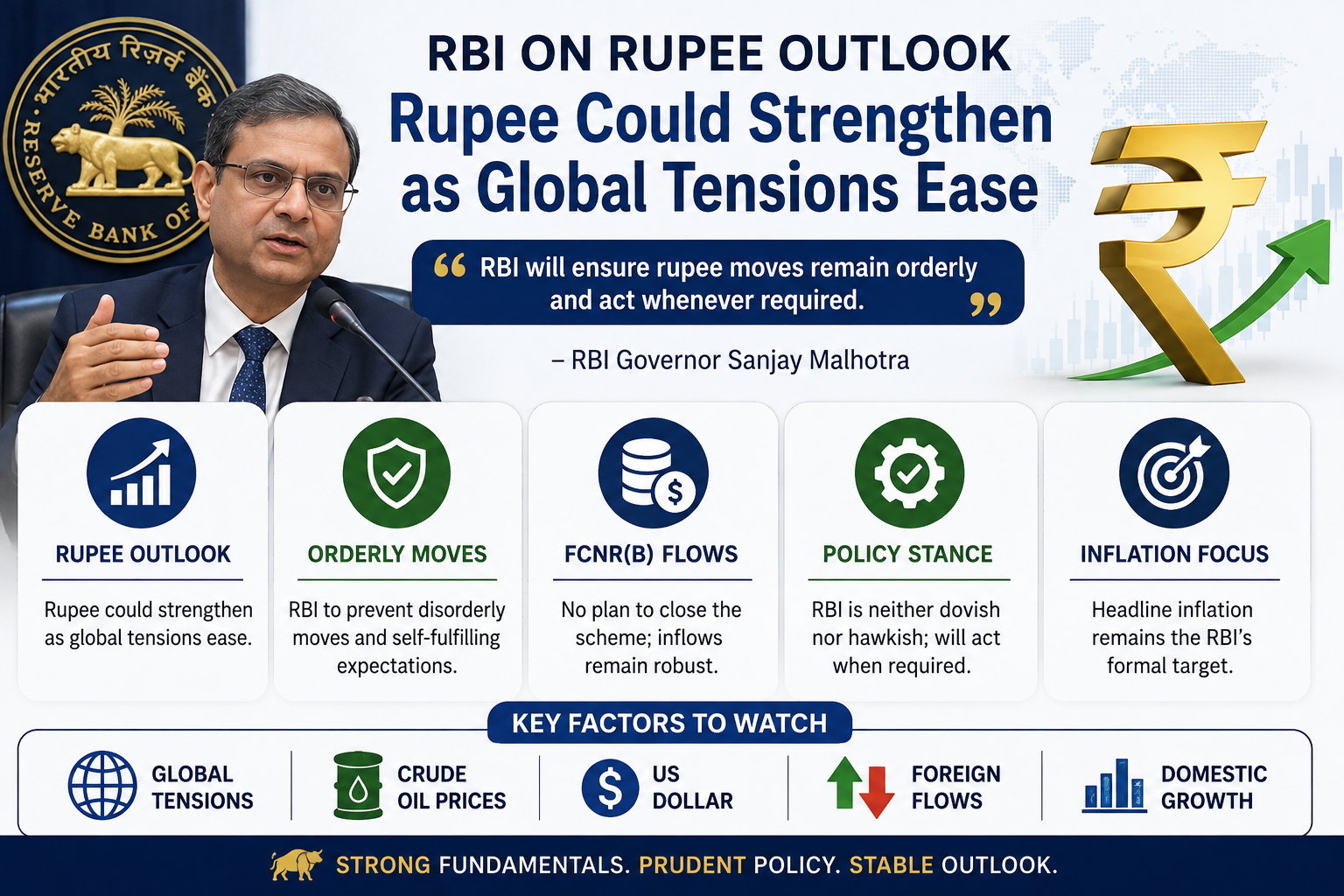
RBI Governor Malhotra says rupee could strengthen as global tensions ease
Speaking at the post-policy press conference, Malhotra said the RBI would work to ensure that movements in the Indian currency remain orderly.
He also indicated that the rupee could strengthen if global tensions ease, highlighting the role external uncertainty has played in currency-market sentiment.
The governor did not announce an immediate intervention or indicate a specific level that the RBI would defend.
Instead, he reiterated that the central bank would act “as and when required.”
The distinction is important for traders. RBI’s approach is aimed at limiting excessive volatility and disorderly market conditions rather than fixing the rupee at a predetermined exchange rate.
Read More : Hero MotoCorp Q1 FY27 Results on August 6, Earnings Call August 7 at 10:30 AM: Revenue Seen Up 30%
Key Takeaways from the RBI Press Conference
- Orderly Trajectory: The RBI will step in to check excessive volatility but will allow the currency to move in line with structural fundamentals.
- Global Headwinds: While current external factors pose challenges, the Rupee is positioned to recover and strengthen once global friction cools down.
- FCNR(B) Stability: Addressing market rumors, Malhotra confirmed there is no proposal to prematurely close the Foreign Currency Non-Resident (Bank) deposit scheme. Inflows under the FCNR(B) framework continue to be robust
- Headline vs. Core: The Governor explicitly reiterated that the RBI’s primary legislative target is headline inflation, not core inflation.
- Food & External Shocks: Headline inflation is expected to see short-term volatility due to fluctuating food prices and external global shocks.
- Medium-Term Target: The central bank remains committed to aligning headline inflation with its medium-term target and will deploy policy actions as necessary.
Why RBI wants to prevent self-fulfilling moves in the rupee
One of Malhotra’s key observations concerned self-fulfilling expectations in currency markets.
When traders collectively expect a currency to weaken sharply, increased dollar buying and defensive positioning can sometimes amplify the move.
The RBI wants to prevent such expectations from turning temporary volatility into a disorderly currency adjustment.
By signalling its willingness to intervene when required, the central bank can potentially discourage one-sided speculative positioning.
For the rupee outlook, that provides an important policy backstop even without an immediate RBI action.
Track Live : Results Calendar — NSE & BSE
Strong FCNR(B) flows provide another signal for the rupee
Malhotra also addressed Foreign Currency Non-Resident (Bank), or FCNR(B), deposits, saying flows under the scheme remained robust.
He clarified that there was no proposal under consideration to prematurely close the FCNR(B) scheme.
Strong foreign-currency deposit flows can provide an additional source of foreign exchange for the banking system and become relevant during periods of external-market volatility.
For investors watching India’s external position, continued FCNR(B) flows could therefore provide another layer of support to overall currency-market stability.
What a stronger rupee could mean for investor portfolios
A strengthening rupee does not affect every sector in the same way.
Companies dependent on imported raw materials can benefit when the rupee appreciates because their dollar-denominated input costs may become relatively cheaper.
Oil marketing companies, airlines and businesses dependent on imported commodities or equipment could therefore see some cost relief if rupee strength is sustained.
The impact can be different for export-oriented companies.
IT services, pharmaceuticals and other businesses earning a substantial portion of revenue in foreign currencies can benefit from rupee depreciation. A sharp appreciation could reduce some of that currency translation advantage.
Foreign portfolio investors may also view a more stable rupee positively because currency depreciation can reduce dollar-adjusted returns from Indian assets.
Direct Market Implications
- For Currency Traders: The assurance of “orderly moves” indicates the RBI will continue to build or utilize its forex reserves to build a floor for the USD/INR pair, limiting extreme intraday spikes.
- For Debt Markets: The neutral stance (“neither dovish nor hawkish”) suggests that domestic benchmark bond yields are likely to trade within a tight range, as immediate rate cuts appear off the table until headline inflation permanently stabilizes.
RBI says it is neither dovish nor hawkish on interest rates
Malhotra also defended the Monetary Policy Committee’s latest rate decision.
The governor said the RBI was “neither dovish nor hawkish”, arguing that the prevailing policy rate remained appropriate under current conditions.
That message suggests the central bank wants investors to focus on incoming economic data rather than interpret the policy stance through a simple rate-cut or rate-hike lens.
For bond and equity markets, future expectations will therefore remain closely linked to inflation, growth and external risks.
Headline inflation remains RBI’s target despite volatility
The RBI Governor also reiterated that India’s monetary policy framework targets headline inflation rather than core inflation.
Headline inflation can remain volatile because of food-price fluctuations and external shocks, Malhotra acknowledged.
The central bank’s objective is to bring inflation toward its target over the medium term rather than react mechanically to every short-term movement.
This matters for interest-rate expectations because food prices and global commodity shocks can significantly influence India’s headline inflation trajectory.
Here’s what happened today and why traders reacted
The RBI Governor’s comments gave currency and equity traders several signals to assess.
First, the central bank remains comfortable with India’s underlying economic fundamentals. Second, it believes an easing of global tensions could provide room for the rupee to recover.
Third, the RBI remains prepared to step into the currency market if movements become disorderly.
For traders, this reduces the probability that the central bank would simply allow speculative pressure to drive unchecked volatility in the rupee.
However, Malhotra’s remarks should not be interpreted as a guarantee of rupee appreciation.
The currency will continue to react to global risk sentiment, foreign capital flows, crude oil prices, the US dollar and domestic macroeconomic conditions.
What should rupee traders and investors watch next?
Malhotra’s comments offer reassurance, but the direction of the Indian rupee will ultimately depend on more than RBI intervention.
Investors should watch whether geopolitical tensions actually ease, how the US dollar behaves, the direction of foreign portfolio flows and whether crude oil prices moderate.
The RBI’s signal is nevertheless clear: it is prepared to prevent disorderly currency movements while allowing market forces to determine the broader trajectory.
For investors, the bigger takeaway is that India’s central bank sees the country’s economic fundamentals as strong and believes the rupee has room to strengthen if external pressure subsides.
Whether that recovery materialises will now depend largely on what happens beyond India’s borders.