State Bank of India has approved raising up to ₹60,000 crore through debt instruments in FY27, giving India’s largest lender flexibility to strengthen capital, support loan growth, and tap investors in India or overseas when market conditions are favourable.
Key Takeaways
- SBI’s board has approved raising up to ₹60,000 crore through debt instruments in FY27.
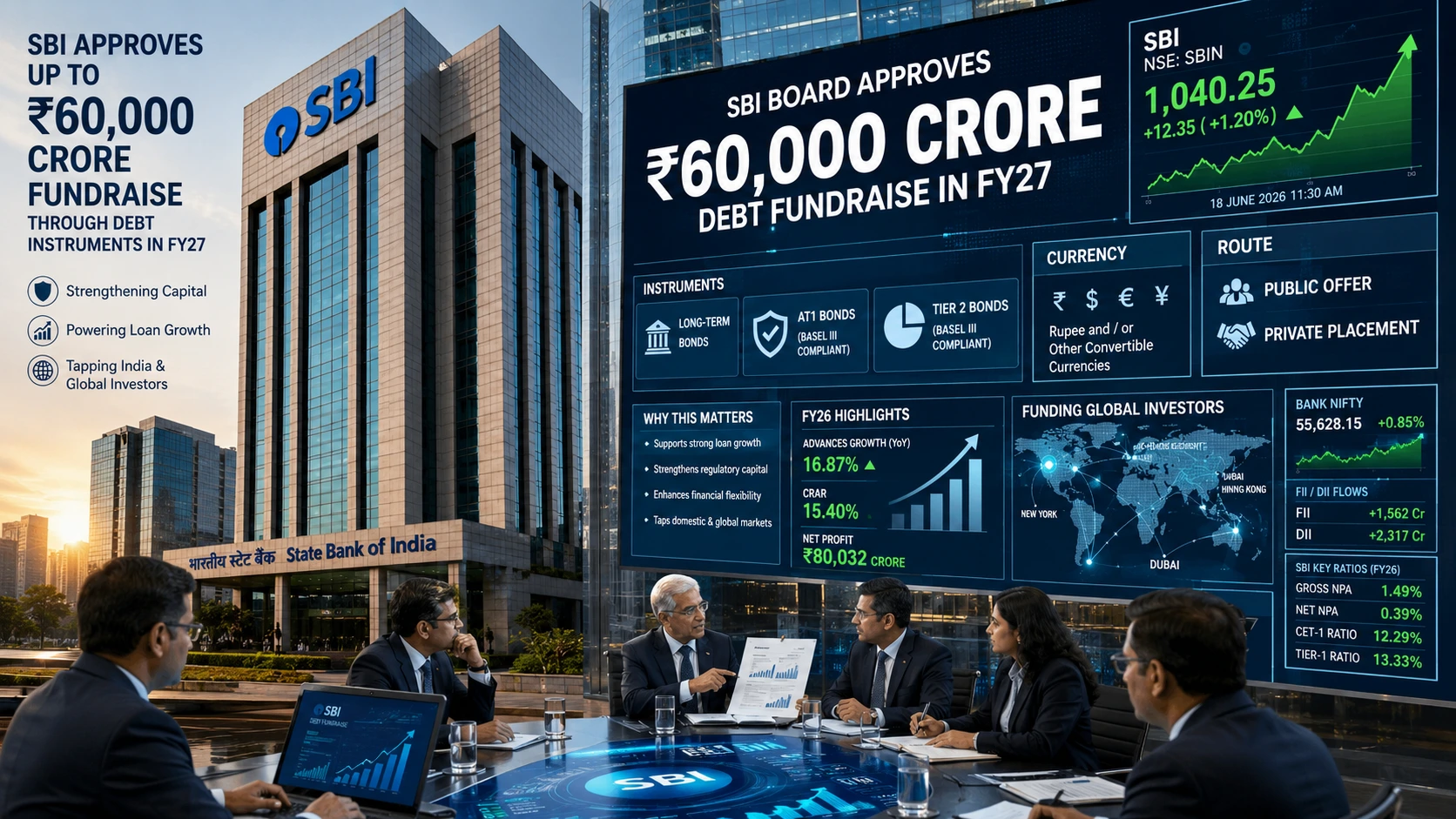
- The instruments may include long-term bonds, Basel III-compliant Additional Tier 1 bonds, and Tier 2 bonds.
- The funds may be raised in rupees or other convertible currencies through public offer or private placement.
- SBI had reported 16.87% YoY advances growth and 15.40% CRAR in FY ’26.
- The approval comes alongside SBI’s separate up to $2 billion offshore bond programme for FY27.
What SBI Has Approved
State Bank of India said its board has approved a proposal to raise up to ₹60,000 crore during the current financial year through debt instruments.
The bank may raise funds in Indian rupees and/or other convertible currencies. The instruments include long-term bonds, Basel III-compliant Additional Tier 1 bonds and Basel III-compliant Tier 2 bonds.
The issuance may be done through public offer or private placement, and SBI can tap Indian and/or overseas investors during FY27.
This does not mean the full ₹60,000 crore will be raised immediately. Such approvals usually create an enabling limit. SBI can issue bonds in one or more tranches depending on capital needs, interest rates, investor appetite and market liquidity.
SBI shares were trading around ₹1,040 on BSE after the announcement, up over 1% from the previous close, according to market reports.
SBI Bond Fundraise: Key Details
| Particulars | Details |
|---|---|
| Company | State Bank of India |
| Fundraising limit | Up to ₹60,000 crore |
| Financial year | FY27 |
| Instruments | Long-term bonds, AT1 bonds, Tier 2 bonds |
| Currency | Rupee and/or other convertible currency |
| Route | Public offer or private placement |
| Investors | Indian and/or overseas investors |
| Use case | Capital flexibility, long-term funding and regulatory capital support |
Data as of the June 18, 2026, market session. Source: SBI regulatory filing and market data reports.
Why SBI Needs This Capital Window
SBI enters FY27 from a position of scale and strong credit growth. In FY26, the bank reported whole-bank advances growth of 16.87% YoY, with domestic advances growing 16.33%.
The growth was broad-based. Retail advances grew 17.11%, SME advances grew 20.99%, agri advances grew 19.68% and corporate advances rose 14.83%.
This pace of loan growth increases the need for capital planning. As a bank’s loan book expands, its risk-weighted assets also rise. To keep lending without putting pressure on capital ratios, banks raise capital through instruments such as AT1 and Tier 2 bonds.
SBI’s CRAR stood at 15.40% at the end of Q4FY26. The bank is already well-capitalised, but the ₹60,000 crore approval gives it room to support FY27 growth while maintaining capital buffers comfortably above regulatory requirements.
Check Live: State Bank of India (SBI) Open Interest: Live OI Data
AT1, Tier 2 and Long-Term Bonds Explained
Banks do not use all bonds for the same purpose. The structure matters for both SBI and investors.
| Instrument | Capital Category | Main Purpose | Typical Structure |
|---|---|---|---|
| Long-term bonds | Senior debt | Fund long-term lending and balance-sheet growth | Fixed maturity |
| AT1 bonds | Tier 1 capital | Strengthen core capital and absorb losses under stress | Usually perpetual |
| Tier 2 bonds | Tier 2 capital | Add supplementary regulatory capital | Fixed tenure, often callable |
AT1 bonds usually carry higher risk than regular bonds because they are loss-absorbing instruments. Tier 2 bonds are also subordinated, but they generally have fixed maturity and sit below senior debt in the repayment hierarchy.
For SBI, the mix gives flexibility. If the bank needs long-term funding, it can issue senior long-term bonds. If it wants to improve regulatory capital, it can use AT1 or Tier 2 instruments.
Offshore Programme Adds Another Layer
SBI’s ₹60,000 crore domestic approval is separate from its offshore fundraising plan.
In May 2026, SBI approved raising up to $2 billion through overseas bonds during FY27 under Reg-S/144A. That programme may be executed in one or more tranches through public offer or private placement of fixed or floating-rate bonds in US dollars or other major foreign currencies.
Together, the domestic and offshore approvals give SBI multiple funding routes. If domestic rates are favourable, it can raise rupee debt. If global demand and hedging costs are attractive, it can tap overseas investors.
This flexibility matters because banks are managing credit growth, deposit costs, liquidity conditions and global rate movements at the same time.
SBI’s Capital and Growth Snapshot
| Metric | FY26 Reported |
|---|---|
| Net Profit | ₹80,032 crore |
| Whole-bank advances growth | 16.87% YoY |
| Domestic advances growth | 16.33% YoY |
| Retail advances growth | 17.11% YoY |
| SME advances growth | 20.99% YoY |
| Agri advances growth | 19.68% YoY |
| Corporate advances growth | 14.83% YoY |
| CRAR | 15.40% |
| Tier-1 Ratio | 13.33% |
| CET-1 Ratio | 12.29% |
| Gross NPA Ratio | 1.49% |
| Net NPA Ratio | 0.39% |
Source: SBI Q4FY26 results press release.
What It Means for PSU Banking Peers
SBI’s approval is significantly larger than some other PSU bank fundraising plans announced for FY27. For example, Bank of India’s board approved raising up to ₹7,500 crore through Basel III-compliant bonds, including ₹2,500 crore via AT1 bonds and ₹5,000 crore via Tier 2 bonds.
The comparison shows SBI’s scale. As India’s largest lender, SBI needs a bigger funding and capital window because its loan book, branch network, and corporate exposure are much larger than most peers.
For the broader PSU banking space, SBI’s move may keep attention on capital adequacy, credit growth and bond issuance pipelines.
Analyst View and Stock Watch
Axis Direct, in a June 2026 note, maintained a Buy rating on SBI with a target price of ₹1,280. The brokerage said SBI entered FY27 with healthy capitalisation, strong asset quality, and broad-based credit growth, while also flagging near-term margin and deposit-mobilisation trends as key monitorables.
This is an external brokerage view, not a NiftyTrader recommendation. Investors should treat it as one input, along with SBI’s actual bond issuance terms, quarterly results, and broader Bank Nifty trends.
Track SBI’s live price action, valuation, banking-sector momentum on Niftytrader tool.
STATE BANK OF INDIA Share Price Chart: Live
Bottom Line
SBI’s ₹60,000 crore bond approval is an enabling capital plan, not an immediate one-shot fundraising. It gives the bank flexibility to raise long-term, AT1, or Tier 2 capital in FY27 depending on market conditions.
The timing matters because SBI is coming off strong FY26 loan growth and remains focused on supporting future credit expansion while maintaining comfortable capital buffers. For investors, the next trigger will be the actual tranche details, issue size, coupon, maturity, currency, call option, and investor demand.
Also Check: FII/DII DATA| NIFTYTRADER
Disclaimer: This article is for informational and educational purposes only. It is not investment advice or a recommendation to buy, sell or hold any security. Please consult a SEBI-registered financial advisor before making investment decisions.