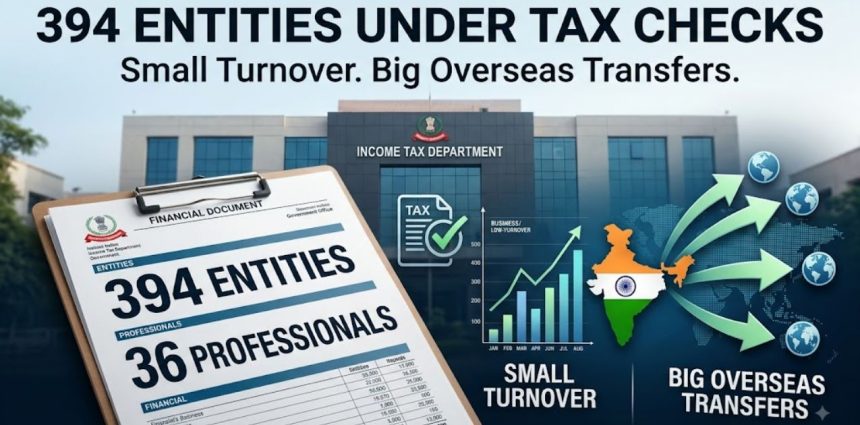
The Income Tax Department is examining 394 entities and 36 professionals after finding overseas remittances that appeared disproportionate to reported business activity, with 117 entities located in land-border states.
A large foreign payment is not necessarily suspicious. But when an entity reports little or no business activity, files a return showing a tiny turnover, or does not file at all, and still sends substantial amounts overseas, it can trigger a very different question: where did the money go, and what was the transaction actually for?
That mismatch is now at the centre of a nationwide Income Tax Department verification exercise launched on August 18.
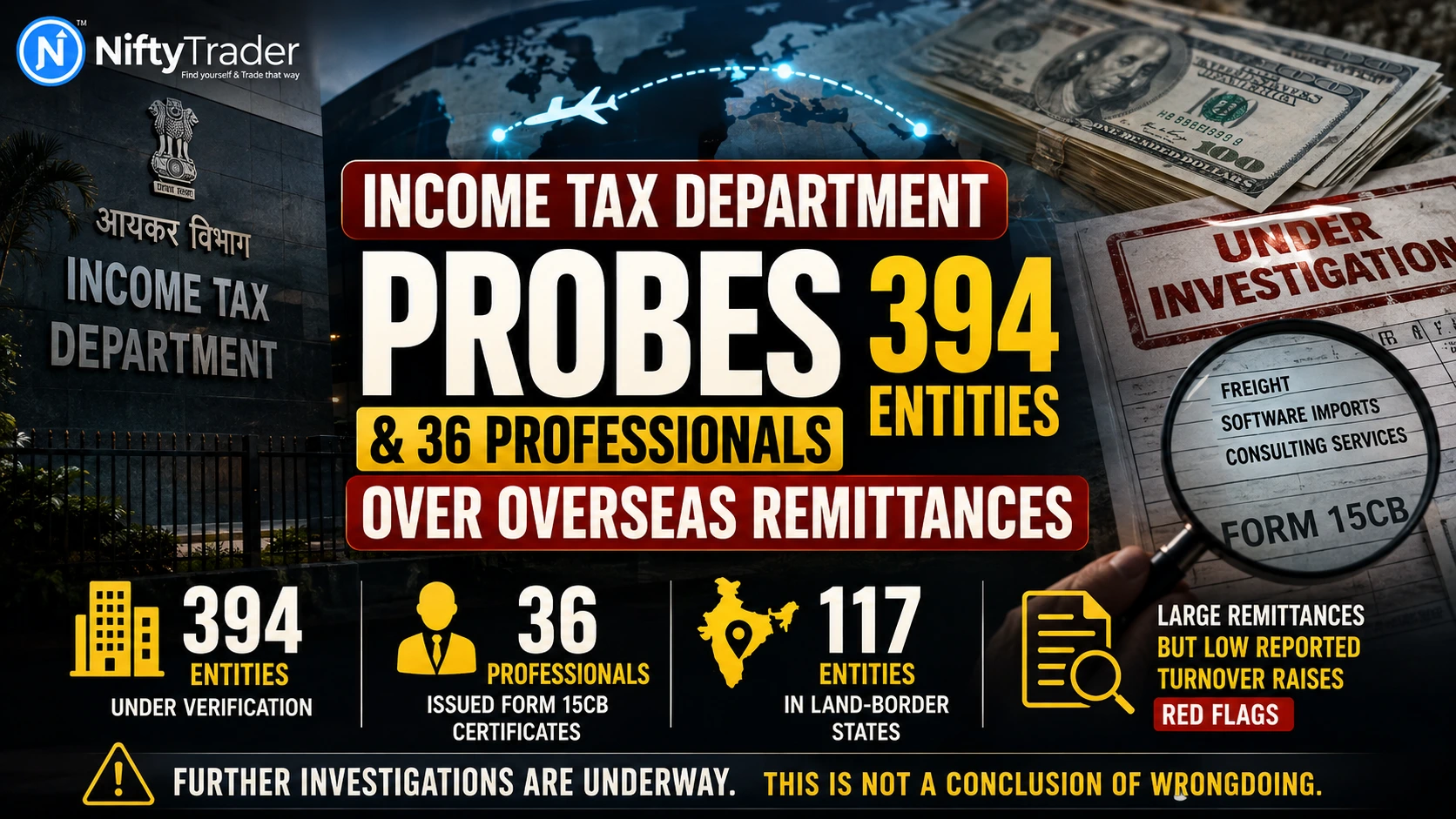
The department has covered approximately 394 entities, including 117 in states along India’s land borders, and 36 professionals who issued certificates connected with foreign remittances. The exercise is examining the entities, the people behind them and the professionals involved in certifying the transactions.
The investigation is still underway. The department has not established that every entity or professional under scrutiny committed wrongdoing.
Key Takeaways
- 394 entities are covered by the Income Tax Department’s verification exercise.
- 36 professionals who issued Form 15CB certificates are also being examined.
- 117 entities are located in states along India’s land borders.
- Some entities either did not file income-tax returns or reported very small turnovers.
- The department found that reported turnover had no apparent correlation with large amounts remitted overseas.
- Some payments were described as being for freight, software imports and consulting services, but their stated purposes did not appear to match the entities’ activities.
- Ground-level intelligence indicated that some entities were not operating from their declared addresses.
- Further investigations are continuing.
Why Did 394 Entities Come Under the Scanner?
The story began with a search operation involving a group of fictitious charitable trusts allegedly involved in providing accommodation entries against bogus donations or contributions.
That operation helped uncover a wider network of entities involved in sending funds abroad.
The Income Tax Department then analysed data on outward foreign remittances over the past three years and identified entities that had sent large amounts of foreign exchange.
The red flag was the disconnect between the money leaving the country and the business activity being reported by the entities.
Preliminary ground verification found that some of the entities were either non-filers or reported very small turnovers. According to the department, those turnovers had no apparent correlation with the amounts being remitted overseas.
That creates the central expectation gap in the case: why would an entity with little visible business activity be sending large sums abroad?
The verification exercise is intended to establish whether those transactions have genuine underlying commercial activity and proper documentation.
Also Read: How to Check Income Tax Refund Status in 2026: Complete Guide for Faster Refunds
Foreign Remittances for Freight, Software and Consulting Also Flagged
The stated purposes of some of the overseas payments included freight, software imports and consulting services.
On paper, these are ordinary commercial purposes for sending money overseas.
The problem arose where the stated purpose of the payment did not appear consistent with information gathered about the entity’s actual activities.
Ground-level intelligence also indicated that some entities were not operating from their declared addresses.
That combination can make a transaction more difficult to explain:
low reported turnover + large overseas remittance + questionable business activity + address mismatch.
The department is now checking the underlying transactions rather than relying only on the stated purpose of the remittance.
Importantly, these indicators are red flags for verification, not a final finding of illegality.
Why Are 36 Professionals Being Examined?
The Income Tax Department’s scrutiny does not stop with the entities sending the money.
Its data analysis found that a large number of Form 15CB certificates had been issued by a relatively small group of professionals, while the remitted funds were also received by a clustered group of entities.
That has put the certification trail under scrutiny.
Form 15CB is an accountant’s certificate used in the tax-compliance process for certain foreign remittances. The certifying accountant is required to examine the taxability of the remittance with reference to the books of account and other relevant documents.
The department said its findings have raised concerns over whether adequate due diligence was carried out before some certificates were issued.
The message to professionals is therefore significant: issuing a certificate is not simply a documentation exercise. The underlying transaction and relevant facts need to be properly examined before certification.
What Is the Form 15CB Angle?
Form 15CB matters because it sits directly in the documentation chain for certain foreign payments.
The certificate deals with the taxability of the remittance and related tax details. Under the newer tax framework, Form 146 corresponds to the earlier Form 15CB framework.
The department has specifically emphasised that professionals issuing Form 15CB/Form 146 should exercise due care, diligence and professional judgment and examine the underlying transactions before certifying them.
For businesses, the broader takeaway is straightforward: the paperwork supporting an overseas payment needs to make sense alongside the company’s books, tax filings and actual business activity.
Check Live to explore: NiftyTrader: Live Options Analytics & F&O Trading Tools
117 Entities in Land-Border States Are Also Under Watch
The geographic element adds another layer to the exercise.
Of the approximately 394 entities being examined, 117 are located in states along India’s land borders. The department has also included entities in districts along the country’s land borders that were remitting significant amounts abroad.
This does not mean those 117 entities have been found to have violated tax laws.
Their transactions have been included in the verification exercise based on the department’s data analysis and ground intelligence.
What Happens Next?
This is where the story could become more significant.
The department has identified the initial red flags. The next stage is to determine what sits behind those transactions.
Investigators can examine the underlying contracts, invoices, books of account, tax filings, business activity and other supporting documents to determine whether the overseas payments were genuine and properly reported.
The professional trail will also come under scrutiny where Form 15CB certificates were issued.
The eventual outcome is therefore still uncertain.
Some cases could turn out to involve legitimate transactions that require clarification or documentation. Others could reveal compliance failures or require deeper investigation. The department has not yet announced final findings against the entities or professionals involved. Further investigations are underway.
Why This Matters Beyond the 394 Entities
The bigger message from the exercise is about how India’s tax authorities are using data analysis to identify financial transactions that do not fit an entity’s reported economic profile.
A foreign remittance can have a legitimate commercial explanation. But if the amount is difficult to reconcile with the entity’s turnover, business activity or tax filings, the transaction can attract closer attention.
That creates a new compliance expectation for companies making overseas payments — the transaction, documentation and reported financial position need to tell the same story.
For professionals, the scrutiny of Form 15CB certificates adds another layer: certification itself can become part of the department’s data trail.
The Bigger Question: Where Did the Money Actually Go?
The most important question from the Income Tax Department’s exercise is not simply why 394 entities were flagged.
It is what investigators find when they follow the money trail behind those remittances.
The initial data has identified a striking mismatch between reported business activity and money sent abroad. The ongoing verification will determine whether that mismatch is explained by genuine transactions, weak reporting, inadequate professional due diligence or more serious irregularities.
For now, the department has identified the red flags, but the final answers are still to come.
Read Next: Paras Defence Hits 52-Week High on Heavy Volume After 163% Run
Bottom Line
The Income Tax Department has launched a nationwide verification exercise covering 394 entities and 36 professionals after identifying large overseas remittances that appeared inconsistent with reported business activity.
The scrutiny includes 117 entities in land-border states, while professionals who issued Form 15CB certificates are also being examined.
The biggest trigger is the apparent gap between what some entities reported as their business activity and the amount of money they sent overseas.
What the department ultimately finds remains uncertain, and that ongoing investigation is now the next key development to watch.