
New FDI Rules: India Plans Faster Foreign Investment With ₹15,000 Crore Threshold
India could be preparing a major change to its foreign direct investment framework, with the government considering a threefold increase in the FDI approval threshold for the Cabinet Committee on Economic Affairs (CCEA).
The proposed move could raise the current ₹5,000 crore FDI approval limit to ₹15,000 crore, while also easing rules governing downstream investments. If approved, the changes could allow ministries to clear larger foreign investment proposals without sending them to the CCEA.
For investors and companies, the move could reduce approval delays and make India more attractive for large overseas investments.
Track Live : NSE Option Chain — Live
New FDI Rules: Why the government wants to raise the FDI approval limit
The government is considering increasing the FDI approval threshold from ₹5,000 crore to ₹15,000 crore, according to sources.
A Cabinet draft note has reportedly been prepared, with preliminary discussions involving the Ministry of Finance, DPIIT and NITI Aayog.
The proposals could be taken up by the Cabinet for approval soon.
The current ₹5,000 crore threshold has been in place since November 2015. Under the existing framework, foreign investment proposals above ₹5,000 crore require CCEA approval, while proposals below that level can generally be cleared by the concerned ministry.
The proposed change would significantly widen the authority of individual ministries.
What could change
- FDI limit: ₹5,000 crore → ₹15,000 crore
- Faster approvals: Proposals up to ₹15,000 crore could potentially be cleared at the ministry level instead of going to the CCEA.
- Downstream FDI: The government is also considering reducing repeat approvals where the relevant foreign investment has already received approval higher up the ownership chain.
- Ease of doing business: The changes are aimed at reducing delays and making it easier for foreign investors to deploy capital in India.
- Cabinet decision: A draft Cabinet note has reportedly been prepared, but the changes still require government approval.
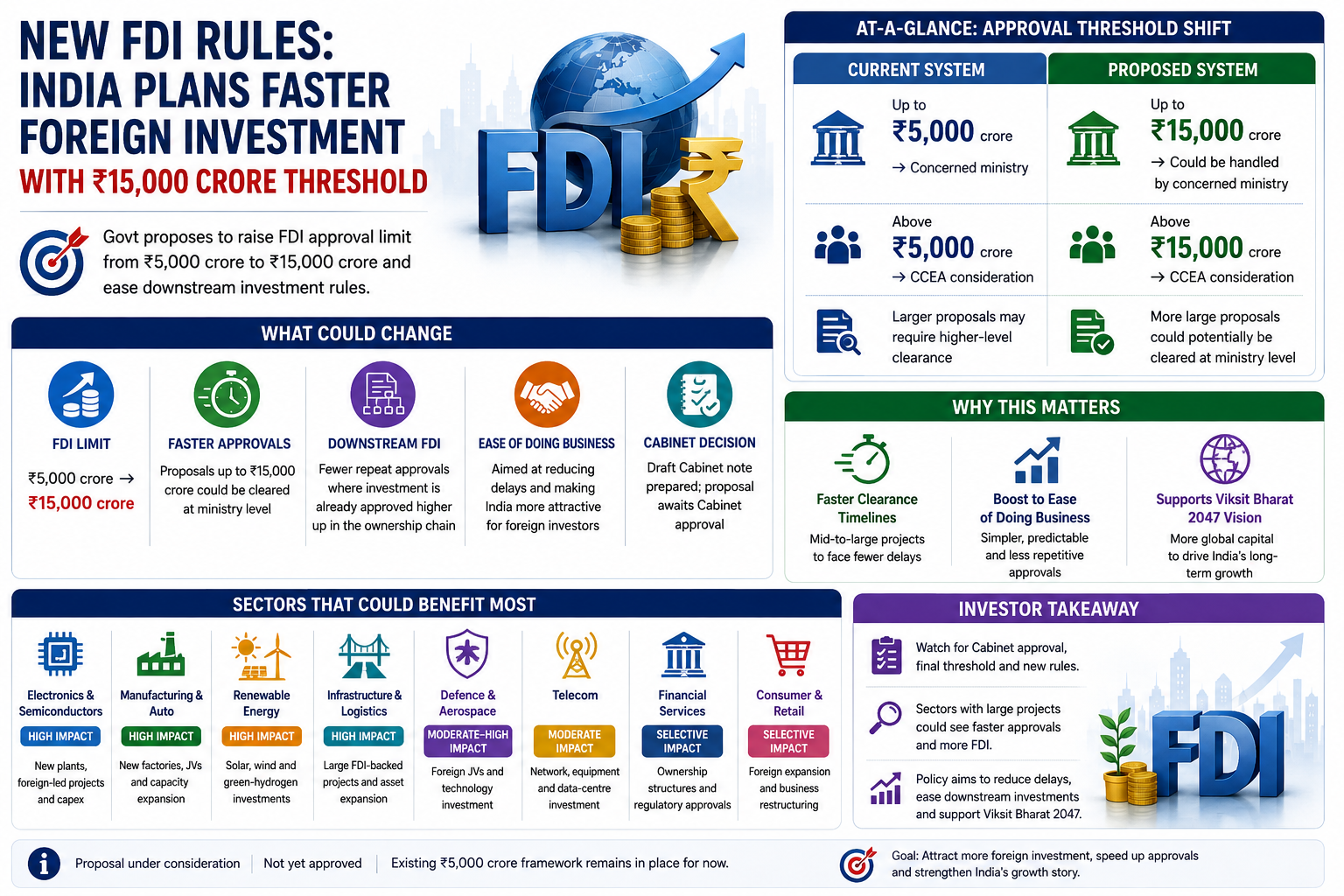
How the proposed ₹15,000 crore limit could speed up FDI approvals
If approved, FDI proposals of up to ₹15,000 crore could potentially be cleared at the concerned ministry level instead of being sent to the CCEA.
That could remove an additional layer from the approval process for large foreign investments.
The government is considering the change partly because the size of India’s economy and investment proposals has increased substantially since the ₹5,000 crore threshold was introduced.
The proposal is also aimed at improving the ease of doing business and reducing the time required for foreign investors to receive approvals.
For multinational companies planning large investments in India, faster regulatory decisions could make project execution more predictable.
| Current System | Proposed System |
|---|---|
| Up to ₹5,000 crore → Concerned ministry | Up to ₹15,000 crore → Could be handled by the concerned ministry |
| Above ₹5,000 crore → CCEA consideration | Above ₹15,000 crore → CCEA consideration |
| Larger proposals may require higher-level clearance | More large proposals could potentially be cleared at ministry level |
Expected Economic Impact
- Faster Clearance Timelines: Bypassing a full cabinet committee review for mid-to-large tier projects will dramatically slash processing times.
- Boost to Ease of Doing Business: The removal of duplicate or sequential approvals for downstream operations provides a more predictable and frictionless regulatory environment for multinational corporations.
- Alignment with “Viksit Bharat” 2047: This policy overhaul directly supports the economic roadmap laid out during the August 15, 2026, Independence Day address to aggressively pull in global capital to fuel domestic development.
Track Live : GIFT Nifty Live – Today Price, Chart, Timings and Nifty Opening Signal
Downstream FDI rules could also become easier
The second proposed change concerns downstream investment, or foreign investment that reaches an Indian company indirectly through another entity.
Under the proposal, an Indian company receiving indirect foreign investment may not need to seek fresh government approval if the domestic company higher up in the ownership chain has already obtained the required approval.
This could eliminate repeated approval requirements in certain ownership structures.
At present, prior government approval is required for downstream or indirect foreign investment in two broad situations: sectors where FDI follows the government approval route, and investments involving entities from countries that share a land border with India.
The proposed relaxation could make such transactions simpler.
Read More : Why India-US Trade Could Surge Toward $500 Billion as Business Ties Expand
Why downstream investment rules matter to foreign investors
Downstream investment rules can become complicated when foreign capital moves through multiple layers of corporate ownership.
If every stage requires a fresh approval despite the original investment already receiving government clearance, the process can become slower and more difficult to execute.
The proposed framework could reduce this duplication.
For foreign investors, that could mean fewer regulatory hurdles, faster capital deployment and greater certainty around corporate structures.
For Indian companies, easier downstream investment rules could also provide greater flexibility to attract overseas capital.
FDI reforms fit into the government’s Viksit Bharat strategy
The proposed changes come as the government continues to push for higher investment and faster economic growth as part of its Viksit Bharat 2047 ambition.
Prime Minister Narendra Modi outlined a growth-focused economic roadmap during his Independence Day address from the Red Fort on August 15, 2026.
The proposed FDI reforms could form part of the broader effort to attract more foreign capital into India and support long-term economic expansion.
A faster approval mechanism could become increasingly important as investment projects become larger and more complex.
Which Sectors Could Benefit From Easier FDI Rules?
If the proposed ₹5,000 crore → ₹15,000 crore CCEA threshold and downstream-rule changes are approved, the biggest potential impact would likely be in capital-intensive sectors where large foreign-funded projects require faster approvals. The proposal is still under consideration.
| Sector | Potential impact | What investors should watch |
|---|---|---|
| Electronics & Semiconductors | High | New plants, foreign-led projects and capex |
| Manufacturing & Auto | High | New factories, JVs and capacity expansion |
| Renewable Energy | High | Solar, wind and green-hydrogen investments |
| Infrastructure & Logistics | High | Large FDI-backed projects and asset expansion |
| Defence & Aerospace | Moderate–High | Foreign JVs and technology investment |
| Telecom | Moderate | Network, equipment and data-centre investment |
| Financial Services | Selective | Ownership structures and regulatory approvals |
| Consumer & Retail | Selective | Foreign expansion and business restructuring |
What the FDI changes could mean for investors
For investors, a higher FDI approval limit could be positive because it may reduce the administrative time required for large foreign investment projects.
Greater foreign capital can potentially support capacity expansion, employment, infrastructure development and technology transfers.
The downstream investment changes could also benefit companies with complex ownership structures by reducing repeated government approvals.
Investors should watch:
- Cabinet approval of the proposed FDI changes.
- The final ₹15,000 crore approval threshold.
- Details of the revised downstream investment rules.
- Sectors that could attract larger foreign investments.
- New investment announcements following the policy change.
- The impact on companies dependent on overseas capital.
Why the proposed FDI reform could matter for the market
Increasing the FDI approval limit from ₹5,000 crore to ₹15,000 crore would represent a significant change in India’s investment approval framework.
Combined with relaxed downstream investment rules, the proposal could make the process of bringing foreign capital into India faster and less repetitive.
For traders, the biggest opportunities could emerge when specific companies announce large foreign investments or strategic partnerships.
For long-term investors, the broader significance is India’s attempt to create a more predictable investment environment.
If approved, the reforms could strengthen India’s position as an investment destination while supporting the government’s wider Viksit Bharat 2047 growth strategy.