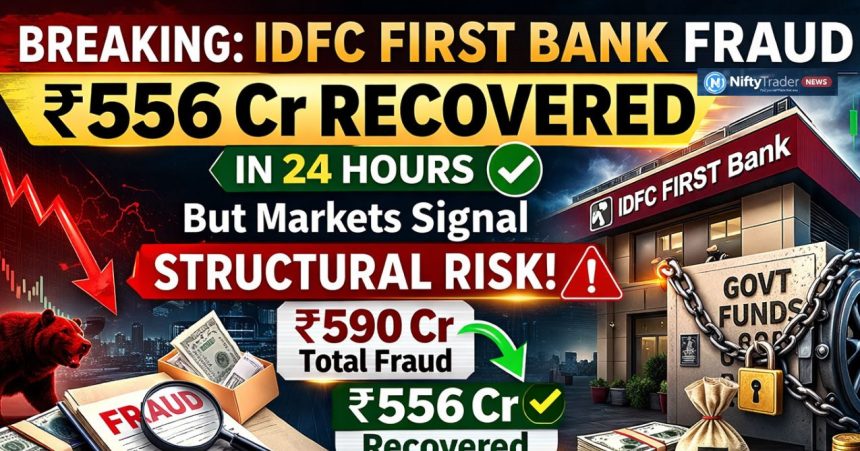
Indian Banking Stocks Under Pressure
Mumbai, 24 Feb 2026: Shares of IDFC First Bank saw momentum today after the lender announced the recovery of ₹556 crore linked to a major fraud case. The news lifted sentiment in bank stocks as traders weighed implications for credit quality and risk premiums in the sector.
Market Reaction—Shares and Index
Shares of IDFC First Bank traded 2.3% higher in early morning trade, outperforming the broader NIFTY Bank index, which slipped 1.2% amid sector-wide caution. Midcap private banks, especially those with CASA-heavy portfolios, underperformed as traders priced in governance risk and potential deposit outflows. Volatility remained elevated, with rotation into state-run lenders and low-risk financials, signaling heightened risk-on/risk-off sentiment.
Analysts note, “The recovery is a positive signal for credit quality among mid-tier banks, potentially easing some risk premium in the banking sector.”
What Exactly Happened — Fraud Details & Recovery
Haryana Chief Minister Nayab Singh Saini confirmed that ₹556 crore, including ₹22 crore interest, was recovered within 24 hours after fraudulent transactions were detected.
Key disclosures:
-
Total fraud exposure: ₹590 crore
-
Recovered: ₹556 crore (incl. ₹22 crore interest)
-
Employees involved: 4–5 mid-level staff
-
Investigation: FIR filed, forensic audit initiated, ACB probe underway
Authorities reaffirmed zero-tolerance action, including criminal investigation, forensic scrutiny, and tighter controls on government-linked accounts.
Sector Implications — Credit, Governance, and NPA Risk
The incident has re-rated mid-tier private banks in terms of governance and operational risk. Key implications:
-
Governance and Internal Control: Single-branch fraud exposes lapses in audit trails and transaction oversight.
-
CASA and Funding Risk: Potential shift of government deposits away from private banks could compress margins and affect yield-curve positions.
-
Valuation Impact: FY26 profit estimates for affected banks could see a 20–22% adjustment; sector common-stock multiples are under pressure.
-
Regulatory Oversight: Increased RBI supervision and tighter compliance norms expected, raising monitoring costs.
Trading & Investment Implications
Short-Term Trading:
-
Elevated volatility; any bounce likely faces heavy institutional selling
-
Sell-on-rallies strategy active for IDFC First Bank, CASA-heavy midcaps, and exposed listed companies
Medium-Term Strategy:
-
Monitor forensic audit outcome (4–5 weeks)
-
Track RBI supervisory stance
-
Watch CASA and government deposit trends for sector rotation
Sector Watchlist:
| Event | Market Sensitivity |
|---|---|
| Forensic Audit Report | Extremely High |
| RBI Supervisory Review | High |
| Govt Deposit Policy Shift | Very High |
| CASA Trend Data | High |
Banking Sector Reaction
The NIFTY Bank index slipped 1.2% despite the near-full recovery. Mid-tier private banks under CASA-heavy profiles faced sharper losses as traders priced in governance lapses and regulatory risk. Volatility remains elevated, with a sell-on-rallies strategy active until forensic audit conclusions.
Why It Matters Today
This incident reshapes near-term sentiment, liquidity, and regulatory risk pricing in Indian banking stocks:
-
Explains Today’s Sharp Stock Reaction
-
Markets are pricing governance failures, not just financial loss
-
Recovery does not erase internal control lapses
-
Investors fear regulatory tightening and deposit outflows
-
-
Triggers Sector Re-Rating Risk
-
Government actions could de-empanel IDFC First Bank and tighten rules for parking public funds in private banks
-
Implication: CASA flows at risk, funding costs may rise, valuation multiples may compress
-
-
Alters Trading Strategy
-
Volatility remains elevated
-
Forensic audit outcome pending
-
Traders are shifting to sell-on-rallies mode, impacting IDFC First Bank, mid-tier private banks, and CASA-heavy stocks
-
-
Raises RBI & Policy Intervention Probability
-
Increased likelihood of RBI audit tightening
-
Stricter compliance norms expected
-
Higher monitoring costs affecting earnings assumptions
-
Bottom Line
The ₹556 crore recovery mitigates immediate losses but signals a structural governance risk in Indian banking stocks. Traders should adjust strategies for short-term volatility and medium-term credit risk, while monitoring regulatory and CASA-driven sector shifts.
FAQs
Q1. How much money was recovered in the IDFC First Bank fraud case?
₹556 crore, including ₹22 crore interest, was recovered within 24 hours.
Q2. What was the total fraud amount involved?
The total exposure was ₹590 crore.
Q3. Why did IDFC First Bank stock crash despite recovery?
Markets reacted to governance failures, audit lapses, and regulatory risk rather than just financial loss.
Q4. Can this impact other private banks?
Yes. Government deposit policies may shift, impacting CASA balances, funding costs, and valuations.
Q5. Is IDFC First Bank safe for long-term investors?
High volatility remains until forensic audits and regulatory clarity emerge.