PhonePe, Google Pay Share Falls India’s UPI ecosystem may be witnessing a major shift.
For the first time since the National Payments Corporation of India (NPCI) began publishing app-wise transaction data, the combined UPI market share of PhonePe and Google Pay has fallen below 80%. The development comes just six months before the proposed implementation of NPCI’s 30% market cap rule for individual UPI apps.
While PhonePe and Google Pay continue to dominate India’s digital payments landscape, the latest data suggests that smaller UPI apps are finally starting to chip away at their long-standing dominance.
PhonePe and Google Pay’s Combined UPI Market Share Falls Below 80%
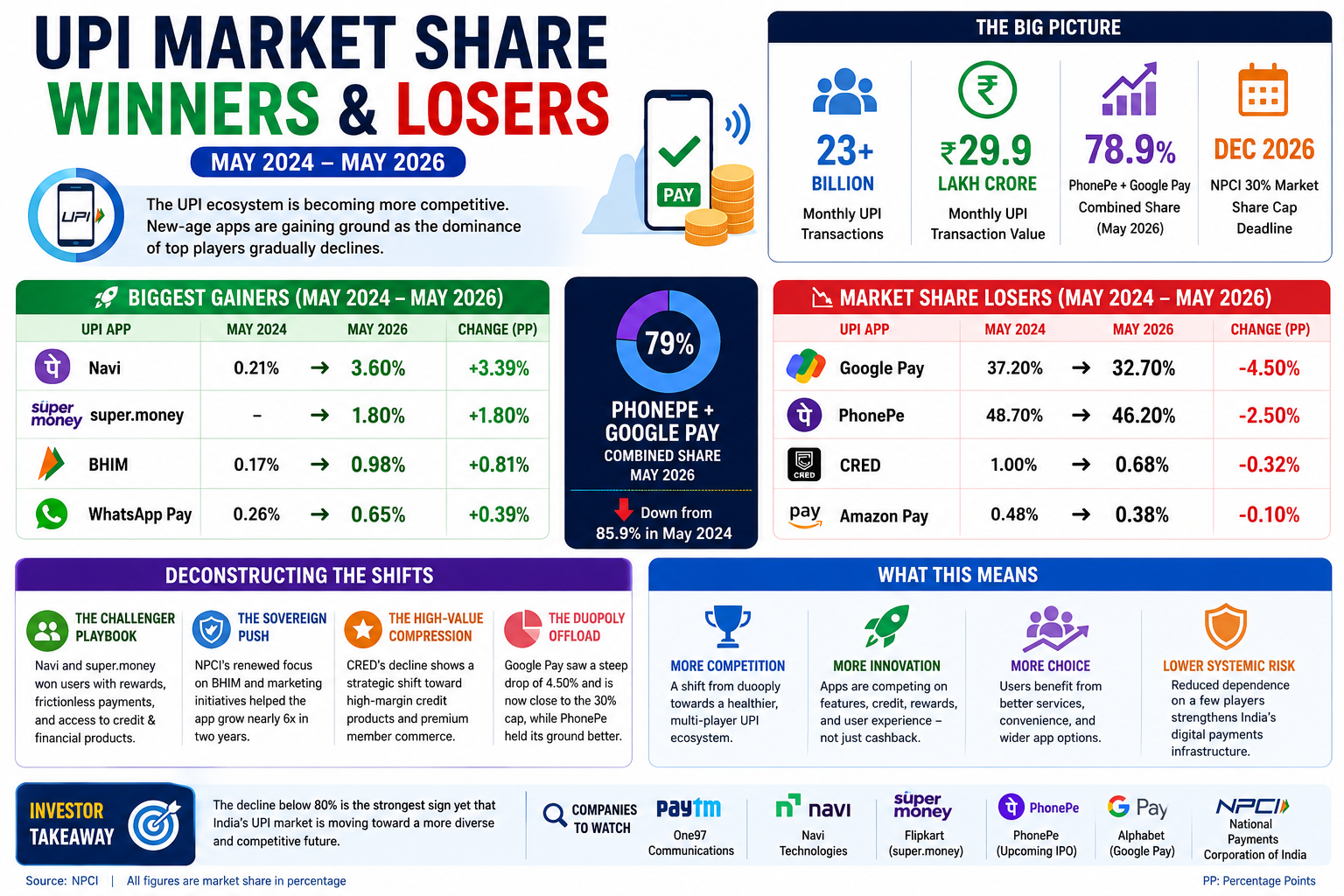
According to NPCI data, PhonePe and Google Pay together accounted for 79% of the total UPI market share in May 2026.
The decline marks a significant change in India’s digital payments industry. Just two years ago, the combined UPI market share of the two apps stood at 86%.
The latest figures show that NPCI’s efforts to diversify the UPI ecosystem may be beginning to deliver results.
Read More : GIFT City Funds Cross $3.8 Billion, but Why Are Investors Still Holding Back?
Combined Market Share Trend
| Year | PhonePe + Google Pay | Paytm |
|---|---|---|
| May 2026 | 79.0% | 7.9% |
| May 2025 | 82.6% | 6.8% |
| May 2024 | 86.0% | 8.1% |
| May 2023 | 82.6% | 13.1% |
| May 2022 | 81.6% | 13.1% |
| May 2021 | 80.0% | 11.5% |
The data highlights a gradual weakening of the UPI duopoly that has dominated India’s digital payments sector for years.
Why Is the Fall Below 80% Significant?
The combined market share of PhonePe and Google Pay falling below 80% for the first time is a major milestone for India’s UPI ecosystem. It suggests that NPCI’s efforts to reduce market concentration and encourage competition are beginning to show results. Smaller players such as BHIM, Navi, super.money, and WhatsApp Pay are gradually gaining users and transaction volumes.
Why it matters:
- Reduces concentration risk by lowering dependence on two dominant apps.
- Supports NPCI’s 30% market-cap goal ahead of the December 2026 deadline.
- Creates opportunities for emerging fintechs to scale and attract investment.
- Boosts innovation through rewards, credit products, and financial services instead of cashback-led competition.
What It Means for the NPCI 30% Cap
Even after the recent decline, PhonePe (46.2%) and Google Pay (32.7%) remain well above NPCI’s proposed 30% market-share limit. While competition is increasing, significant market-share shifts would still be needed before the rule can be fully enforced.
Many industry observers expect NPCI to adopt a gradual approach by supporting smaller UPI apps through incentives, faster approvals, and product innovation rather than imposing strict transaction restrictions immediately.
Which Companies Could Benefit?
As the UPI market becomes more competitive, several companies could benefit from the gradual decline in the dominance of PhonePe and Google Pay.
| Company | Potential Impact |
|---|---|
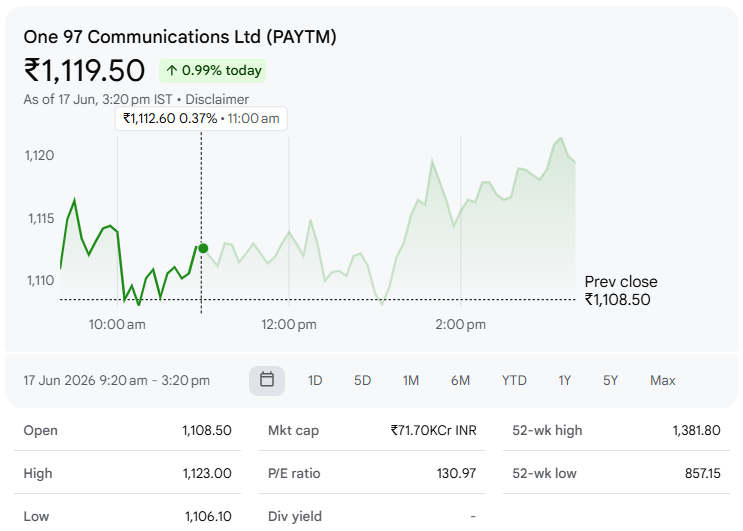
| One97 Communications (Paytm) | Rising market share could support payments growth and ecosystem monetisation |
| PhonePe | Market-share trends and IPO plans will remain closely watched |
| Navi Technologies | Fastest-growing UPI challenger gaining traction among users |
| Flipkart (super.money) | Expanding fintech ecosystem through payments, rewards and credit products |
| Alphabet (Google Pay) | Remains a dominant player but faces increasing competitive pressure |
| NPCI | Regulatory decisions will shape the future structure of the UPI market |
Smaller UPI Apps Are Emerging as Serious Challengers
The biggest winners have been emerging UPI apps such as BHIM, Navi, super.money and WhatsApp Pay.
These platforms have steadily expanded their UPI market share as NPCI accelerated approvals and introduced measures aimed at creating a more level playing field.
Navi has emerged as one of the fastest-growing UPI apps. Its market share jumped from just 0.21% in May 2024 to 3.6% in May 2026.
Similarly, Flipkart-backed super.money has quickly captured 1.8% of the market, while BHIM’s share has increased nearly fivefold over the past two years.
PhonePe Remains the Largest UPI App Despite Market Share Decline
Even as competition intensifies, PhonePe remains India’s largest UPI platform.
Top UPI Apps Market Share – May 2026
| UPI App | Market Share |
| PhonePe | 46.2% |
| Google Pay | 32.7% |
| Paytm | 7.9% |
| Navi | 3.6% |
| super.money | 1.8% |
| BHIM | 0.98% |
| Fampay | 0.85% |
| CRED | 0.68% |
| WhatsApp Pay | 0.65% |
| Amazon Pay | 0.38% |
PhonePe controlled 46.2% of the UPI market share in May 2026, while Google Pay held 32.7%.
Together, the two platforms accounted for 78.9% of all UPI transactions, down from nearly 86% in May 2024.
Meanwhile, Paytm improved its position, increasing its market share from 6.8% in May 2025 to 7.9% in May 2026.
NPCI’s Push for a More Competitive UPI Ecosystem Is Showing Results
NPCI has been working for several years to reduce concentration risks within the UPI ecosystem.
The regulator has introduced measures including faster TPAP approvals, relaxed feature parity norms and support for smaller fintech players.
The objective is simple: reduce dependence on a handful of apps and create a more resilient digital payments network.
The strategy appears to be working, albeit gradually.
The top three apps — PhonePe, Google Pay and Paytm — processed 95.2% of all UPI transactions in January 2024. That figure has now fallen to 87% in May 2026.
Fast-Tracked Approvals Are Helping New Fintech Players Grow
NPCI approved 20 new Third-Party Application Providers (TPAPs) in 2024 alone.
Many of these companies are building broader financial ecosystems around UPI by offering lending, investments, broking, credit cards and wealth products.
Several fintech firms are also launching RuPay credit cards linked to UPI, allowing customers to earn rewards, cashback and interest-free credit periods while making digital payments.
This strategy is helping newer apps attract users away from established players.
UPI Market Share Winners and Losers
The biggest story in India’s UPI ecosystem over the past two years has been the rise of challenger apps. While PhonePe and Google Pay remain dominant, newer players such as Navi, super.money, BHIM, and WhatsApp Pay have steadily gained market share.
Biggest Gainers (May 2024 – May 2026)
| UPI App | May 2024 | May 2026 | Change |
|---|---|---|---|
| Navi | 0.21% | 3.6% | +3.39% |
| super.money | NA | 1.8% | New Entrant |
| BHIM | 0.17% | 0.98% | +0.81% |
| WhatsApp Pay | 0.26% | 0.65% | +0.39% |
Biggest Losers (May 2024 – May 2026)
| UPI App | May 2024 | May 2026 | Change |
| Google Pay | 37.2% | 32.7% | -4.5% |
| PhonePe | 48.7% | 46.2% | -2.5% |
| CRED | 1.0% | 0.68% | -0.32% |
| Amazon Pay | 0.48% | 0.38% | -0.10% |
What Drove These Changes?
- Navi emerged as the fastest-growing UPI challenger, leveraging its lending and financial-services ecosystem.
- super.money, backed by the Flipkart Group, quickly gained users through rewards and credit-linked offerings.
- BHIM benefited from NPCI’s renewed focus on promoting its flagship payments app.
- WhatsApp Pay continued to add users by leveraging its massive messaging platform.
Meanwhile, Google Pay and PhonePe saw their combined market share decline as competition intensified, while CRED and Amazon Pay lost ground amid slower growth in payments volumes.