SpaceX ETFs Clock $8.2 Billion Volume in 3 Days as MSCI Fast-Tracks IPO Index Inclusion
The SpaceX IPO is already making waves across global financial markets.
Just days after the highly anticipated listing, SpaceX-linked exchange-traded funds (ETFs) generated a staggering $8.2 billion in trading volume, highlighting the massive investor appetite for exposure to Elon Musk’s space company.
But according to Jefferies, the bigger story may not be the trading frenzy itself. Instead, it could be the way mega IPOs like SpaceX are changing the structure of global stock market indices and increasing the dominance of US equities.
Why the SpaceX ETF Is Drawing So Much Investor Attention
The launch of 11 leveraged single-stock SpaceX ETFs on June 15 quickly attracted investors looking to capitalize on the company’s market debut.
According to Jefferies, these ETFs accumulated $638 million in assets within just three trading days.
The most active product was the Leverage Shares 2X Long SpaceX Daily ETF, which generated more than $3 billion in trading volume between June 15 and June 17.
Another notable fund, the Defiance Daily 2X Space ETF, was converted into a dedicated leveraged SpaceX vehicle on the day of the IPO. The ETF briefly experienced a trading halt after witnessing exceptionally strong activity during its opening session.
The surge in demand highlights the strong investor interest surrounding SpaceX and the rapidly growing space economy.
Read More : The 60-Day Hormuz Trap: Why Oil Markets May Be Celebrating Too Early
Unpacking the ETF Trading Surge
-
- Leverage Shares 2X Long SpaceX Daily ETF: Led the market with $3.003 billion in volume between June 15 and June 17.
- Defiance Daily 2X Space ETF: Converted into a leveraged SpaceX vehicle on IPO day, tracking $263 million in cumulative volume by Wednesday.
- Trading halts: High volatility caused a temporary trading halt on the Defiance ETF after it logged $50 million in volume during its opening hours.
SpaceX IPO 2026: Key Details at a Glance
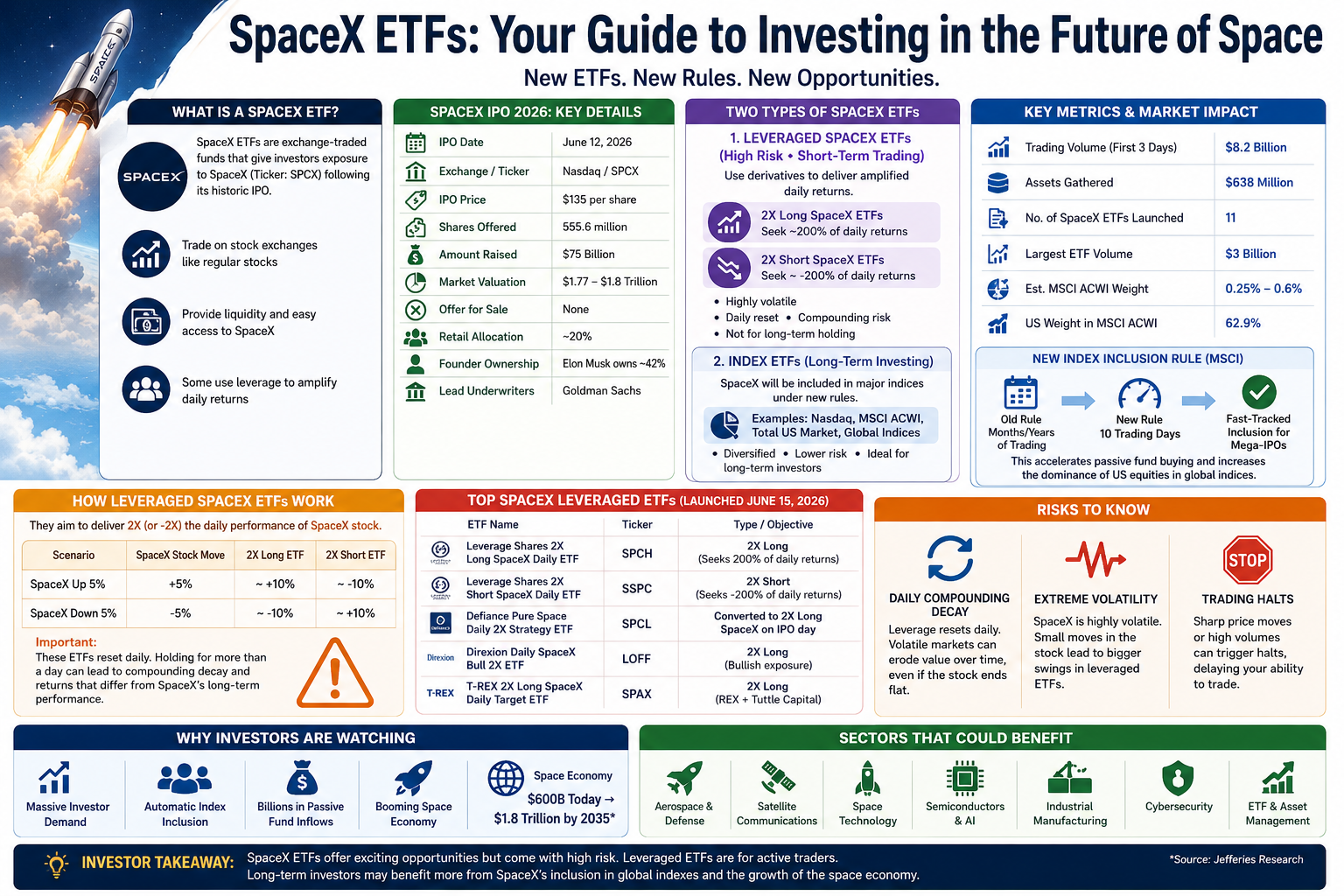
The highly anticipated IPO of SpaceX debuted on the Nasdaq on June 12, 2026, becoming the largest IPO in history. The company priced its shares at $135 each, raised approximately $75 billion, and debuted with a valuation of roughly $1.77 trillion–$1.8 trillion.
| Item | Details |
|---|---|
| Company | SpaceX |
| Listing Date | June 12, 2026 |
| Exchange | Nasdaq |
| Ticker Symbol | SPCX |
| IPO Price | $135 per share |
| Shares Offered | 555.6 million |
| Capital Raised | $75 billion |
| Valuation at IPO | $1.77–$1.8 trillion |
| Lead Underwriters | Goldman Sachs and Morgan Stanley |
| Retail Allocation | Approximately 20% |
| Offer for Sale (OFS) | None |
| Founder Ownership | Elon Musk retained about 42% equity stake |
| Listing Exchange | Nasdaq (SPCX) |
How SpaceX Could Influence the MSCI World Index
Jefferies estimates that SpaceX could eventually account for between 0.25% and 0.6% of the MSCI All Country World Index, depending on its free-float inclusion factor.
While that may appear small, it is significant for a newly listed company.
The MSCI All Country World Index is one of the most widely followed global equity benchmarks and is tracked by trillions of dollars in investment assets.
Because the United States already represents approximately 62.9% of the index, adding another mega-cap US company could further strengthen America’s influence over global benchmark performance.
Space Economy Growth Could Become the Next Big Investment Theme
Jefferies remains optimistic about the long-term growth potential of the global space industry.
The investment bank estimates that the global space economy could expand from roughly $600 billion today to $1.8 trillion by 2035.
This forecast is one reason investors are showing strong interest in SpaceX-related products despite the company’s recent listing.
The rapid expansion of satellite communications, commercial space launches and space-based infrastructure could create significant investment opportunities over the next decade.
What Investors Should Watch Beyond the SpaceX IPO
While SpaceX is attracting attention, Jefferies believes another important issue is unfolding in the broader technology sector.
The firm estimates that capital expenditure by major technology companies including Amazon, Alphabet, Meta and Microsoft could reach $680 billion this year, rising to approximately $710 billion when finance leases are included.
Much of this spending is tied to artificial intelligence infrastructure.
Jefferies cautioned that profits generated from the AI investment boom are currently benefiting chipmakers and hardware suppliers first, while the companies funding the spending may face pressure on future returns.
“The earnings from the AI capex boom are front-end loaded,” the report noted.
What Is a SpaceX ETF?
A SpaceX ETF is an exchange-traded fund designed to give investors exposure to SpaceX stock (Ticker: SPCX) following the company’s historic IPO. Unlike traditional ETFs that hold dozens or hundreds of companies, many of the newly launched SpaceX ETFs are single-stock leveraged ETFs, meaning they are designed to amplify the daily movement of SpaceX shares.
These products allow investors to gain exposure to SpaceX without directly trading the stock, although they come with significantly higher risk than conventional ETFs.
Types of SpaceX ETFs
1. Leveraged SpaceX ETFs (High Risk, Short-Term Trading)
These ETFs use derivatives such as swaps and futures to deliver amplified daily returns.
| ETF Type | Objective |
|---|---|
| 2X Long SpaceX ETF | Seeks to deliver approximately 200% of SpaceX’s daily gain or loss |
| 2X Short SpaceX ETF | Seeks to deliver approximately -200% of SpaceX’s daily return |
| Leveraged Space-Themed ETFs | Converted from broader space funds to focus heavily on SpaceX |
Key Characteristics
- Designed for active traders
- Amplify daily gains and losses
- Highly volatile
- Subject to daily compounding effects
- Not typically intended for long-term buy-and-hold investors
2. Traditional Index ETFs (Long-Term Investing)
SpaceX is expected to be added to major benchmark indices under revised index inclusion rules.
Potential buyers include ETFs tracking:
- Nasdaq indices
- MSCI All Country World Index (ACWI)
- Total US Stock Market indices
- Global equity benchmarks
These funds do not use leverage and offer diversified exposure.
Why Are SpaceX ETFs Making Headlines?
According to Jefferies:
| Metric | Value |
|---|---|
| Trading Volume (First 3 Days) | $8.2 Billion |
| Assets Gathered | $638 Million |
| Number of SpaceX ETFs Launched | 11 |
| Largest ETF Volume | $3 Billion |
| Estimated MSCI ACWI Weight | 0.25% – 0.6% |
The rapid adoption demonstrates extraordinary investor interest in SpaceX and the broader space economy theme.
How Do Leveraged SpaceX ETFs Work?
Assume SpaceX rises 5% in a single trading session:
| Investment | Expected Daily Return |
|---|---|
| SpaceX Stock | +5% |
| 2X Long SpaceX ETF | Approximately +10% |
| 2X Short SpaceX ETF | Approximately -10% |
Likewise, if SpaceX falls 5%, a 2X Long ETF could lose roughly 10%.
This leverage makes these products attractive to traders but risky for long-term investors.
Biggest Risks Investors Should Know
Daily Compounding Risk
Leveraged ETFs reset exposure every day.
Example:
| Day | SpaceX Move |
|---|---|
| Day 1 | +10% |
| Day 2 | -10% |
Although SpaceX may end only slightly lower over two days, a leveraged ETF can lose substantially more because of the compounding effect.
Extreme Volatility
SpaceX has become one of the most actively traded stocks globally. Large price swings can result in amplified ETF gains or losses.
Trading Halts
Heavy volume and rapid price movements can trigger exchange circuit breakers, temporarily halting trading.
Why Investors Should Track SpaceX ETF Growth
The ETF activity surrounding SpaceX is important because it signals:
Passive Fund Demand
If SpaceX enters major indices, passive funds will be required to buy shares, potentially creating billions of dollars in demand.
Growth of the Space Economy
Many analysts expect the global space economy to grow significantly over the next decade, driven by:
- Satellite communications
- Space launches
- Defense contracts
- Earth observation
- Space infrastructure
- Deep-space exploration
Impact on Global Indices
Jefferies estimates SpaceX could account for between 0.25% and 0.6% of the MSCI All Country World Index, making it one of the most influential new index constituents in years.
Which Sectors Could Benefit?
| Sector | Potential Impact |
|---|---|
| Aerospace & Defense | Increased spending on launch systems, satellites and defense technologies |
| Space Technology | Growth in commercial space infrastructure and services |
| Satellite Communications | Rising demand for connectivity and broadband services |
| ETF & Asset Management | New products and increased trading activity |
| Semiconductor Companies | Higher demand for advanced chips used in satellites and AI systems |
| AI Infrastructure | SpaceX’s AI and data-processing requirements may support cloud and computing demand |
| Industrial Manufacturing | Increased need for specialized aerospace components |
| Cybersecurity | Growing requirement to protect satellite networks and space assets |