
Rupee Falls 15 Paise to 94.48 in Early Trade Despite FII Inflows and Softer Crude Oil
The rupee has once again slipped against the US dollar, but the bigger question for investors is whether this is just a temporary move or the beginning of another volatile phase for the currency market.
Despite strong foreign investor buying and rising stock markets, the Indian rupee fell 15 paise to 94.48 against the US dollar in early trade on Monday. The decline comes at a time when global markets are closely watching developments in the Middle East, oil prices, and the strength of the US dollar.
For traders and investors, the movement in the rupee could have implications for stocks, foreign flows, inflation, and market sentiment in the days ahead.
Track Live : Live Stock Screener for Indian Markets
Rupee falls against US dollar despite supportive domestic factors
The rupee opened at 94.42 in the interbank foreign exchange market, down 9 paise from Friday’s closing level of 94.33.
During early trade, the domestic currency touched 94.24 before giving up gains and slipping further.
Forex traders said the rupee remained caught between two opposing forces. On one side, improving debt inflows and foreign capital supported the currency. On the other side, a strong dollar and geopolitical uncertainty weighed on sentiment.
The result was increased volatility in the USD/INR pair.
Key Takeaways for Investors
- The rupee weakened by 15 paise to 94.48 per US dollar in early Monday trade after opening at 94.42, pressured by a stronger US dollar and lingering geopolitical uncertainty in the Middle East.
- Forex traders noted that improving debt and deposit inflows supported the rupee, but a firm dollar and geopolitical risks continued to create volatility.
- The Dollar Index remained firm near 100.87, reflecting expectations of a hawkish US Federal Reserve stance.
- Brent crude oil fell to around $79.5 per barrel, which is generally positive for India’s economy as it helps contain import costs and inflation.
- Foreign Institutional Investors (FIIs) were net buyers of Indian equities worth ₹4,859 crore on Friday, providing support to domestic markets.
Sectors Likely to Benefit from a Weak Rupee
| Sector | Impact |
|---|---|
| IT Services | Positive |
| Pharma Exporters | Positive |
| Specialty Chemicals Exporters | Positive |
| Textile Exporters | Positive |
| Auto Ancillaries Exporters | Positive |
Read More : OMC Earnings Under Pressure as LPG Losses Hit Rs.500/Cylinder in Q1FY27
Analysts see key levels that traders should watch
Currency market experts believe the rupee still has important support levels that could prevent a sharper fall.
“Technically, the 94.00–94.20 zone continues to act as a key support area, while 94.80–95.00 remains the immediate resistance band,” said Amit Pabari, Managing Director of CR Forex Advisors.
He added that improving debt inflows and relatively stable crude oil prices could support the rupee and potentially push USD/INR towards the 94.00–93.80 zone.
For currency traders, these levels are likely to remain critical throughout the week.
Global developments keep pressure on the rupee
The rupee today is also reacting to global developments.
High-level talks between the United States and Iran ended in Switzerland, with both sides agreeing to continue diplomatic discussions over the coming weeks.
However, uncertainty remains high after Iran reiterated that it had closed the Strait of Hormuz, a vital route for global energy shipments.
At the same time, the US dollar remained firm. The dollar index was trading near 100.87, supported by expectations of a hawkish US Federal Reserve.
A stronger dollar typically puts pressure on emerging market currencies, including the Indian rupee.
Brent crude oil offers some relief to markets
One positive factor for the rupee was a decline in crude oil prices.
Brent crude, the global oil benchmark, slipped 1.28% to $79.54 per barrel.
“Brent oil was very near to $79 per barrel as talks between US and Iran were progressing,” said Anil Kumar Bhansali of Finrex Treasury Advisors LLP.
Lower crude oil prices are generally beneficial for India because the country imports a large portion of its energy needs. Softer oil prices can reduce pressure on inflation, imports, and the rupee.
Rupee Volatility, Geopolitical Ceasefires, and the RBI’s Defensive Firepower
The Indian rupee opened 9 paise lower at 94.42 against the US dollar on Monday morning, eventually drifting to 94.48 in early trade due to persistent dollar strength in global markets. While intraday updates capture immediate technical reactions, investors must look at the larger structural forces shaping Indian macroeconomics in the first half of 2026.
- The RBI’s Active Intervention Framework
The current rupee weakness comes despite aggressive, proactive measures deployed by the Reserve Bank of India (RBI) during its June 5, 2026, monetary policy meeting. Moving to defend the currency after it hit record lows past the 95/$ threshold in May, the central bank introduced heavy incentives to pull in foreign capital:
FCNR(B) Subsidies: The RBI is fully subsidising FX hedging costs for commercial banks raising fresh 3-to-5-year Foreign Currency Non-Resident deposits.
- ECB Swap Window: A concessional foreign exchange swap facility was opened to lower costs on External Commercial Borrowings for public sector undertakings (PSUs).
- Tax Exemptions: The government retrospectively removed capital gains and interest income taxes for foreign institutional investors on government bonds.
Analyses from institutions like MUFG Research and HDFC Bank indicate these actions could mobilise between $40 billion and $50 billion in fresh dollar inflows, fundamentally shifting the medium-term balance of payments outlook.
- Geopolitical Reality: The Strait of Hormuz & India’s Energy Vulnerability
While Switzerland talks have initiated a temporary diplomatic window, the Strait of Hormuz remains India’s most critical supply-chain bottleneck. India’s structural exposure to this maritime choke point is driven by two specific vulnerabilities:
- Refinery Inelasticity: Indian refiners have heavily optimized their infrastructure for specific Middle Eastern crude grades, meaning substituting them with African or American blends requires expensive capital overhauls and triggers lower processing margins.
- Limited Strategic Reserves: India’s Strategic Petroleum Reserve (SPR) capacity remains low relative to its massive daily consumption, leaving the economy exposed to physical oil supply disruptions.
Any sustained shutdown or threat in the Strait directly widens India’s current account deficit, triggering a sharp spiral in import costs that structurally devalues the rupee.
- Deconstructing the 60-Day Ceasefire Framework
The “de-confliction cell” and 60-day structured negotiation window established in Switzerland represent a conditional pause rather than a permanent resolution. Markets remain on edge because multiple core issues are completely unresolved:
- No verification mechanisms have been verified to police compliance on the ground.
- Iran’s primary nuclear enrichment infrastructure continues to operate.
- Regional proxy networks maintain the capacity to cause unexpected disruptions.
For investors, this means the risk premium has not disappeared; any breakdown in negotiations will instantly reignite oil price volatility.
- Oil Price Context and Macro Impact
Global crude markets have seen extreme swings in 2026. Driven by the peak of the Middle East crisis, global benchmark Brent crude surged past $120 per barrel earlier in the year, bloating India’s trade deficit. While prices have tumbled nearly 20% from those highs to trade around $79.54 per barrel due to temporary ceasefire optimism, the market remains highly defensive.
- Analyzing FII Flow Structural Trends
While headlines cheer single-day events—such as Foreign Institutional Investors (FIIs) purchasing ₹4,859 crore on a given Friday—the broader 2026 trend shows continuous net selling. Driven by the US Federal Reserve’s hawkish policy and elevated US treasury yields, global capital has consistently fled emerging markets for safer, dollar-denominated returns. A single day of buying is simply an opportunistic technical rebound, not a reversal of the capital flight putting pressure on the rupee.
- India’s Macro Cushion: Robust Forex Reserves
A primary pillar of safety for India in 2026 is the sheer scale of its foreign exchange reserves. Even with recent interventions drawing down capital from a peak of $728.5 billion to around $681.6 billion, India’s reserve adequacy covers roughly 10 to 11 months of imports.
This provides a drastically stronger cushion than during the 2013 Taper Tantrum (when import cover fell below 7 months), reassuring foreign investors that the RBI has the necessary ammunition to smooth out speculative panics.
- Sensex Market Context
Though a snapshot of the Sensex trading at 77,210 points may seem resilient, the index has actually undergone a 13–14% correction from its all-time high of 86,000 recorded in late 2024. This contraction reflects ongoing global risk-off sentiment, high domestic valuations, and corporate margin pressures resulting from the 2026 energy shock.
Summary of Investment Impact
| Macro Factor | Current Status | Direct Impact on Investors |
| RBI Policy | Emergency capital incentives active | Expects $40B+ inflows; supports medium-term rupee stability. |
| Crude Oil | Volatile; down 20% from $120+ peak | Temporarily narrows the trade deficit, but headline risks remain high. |
| FX Reserves | Strong at ~$681.6 Billion | High safety margin prevents rapid currency collapse. |
| FII Flows | Short-term buying amid long-term outflows | US Fed rate path continues to dictate equity market caps. |
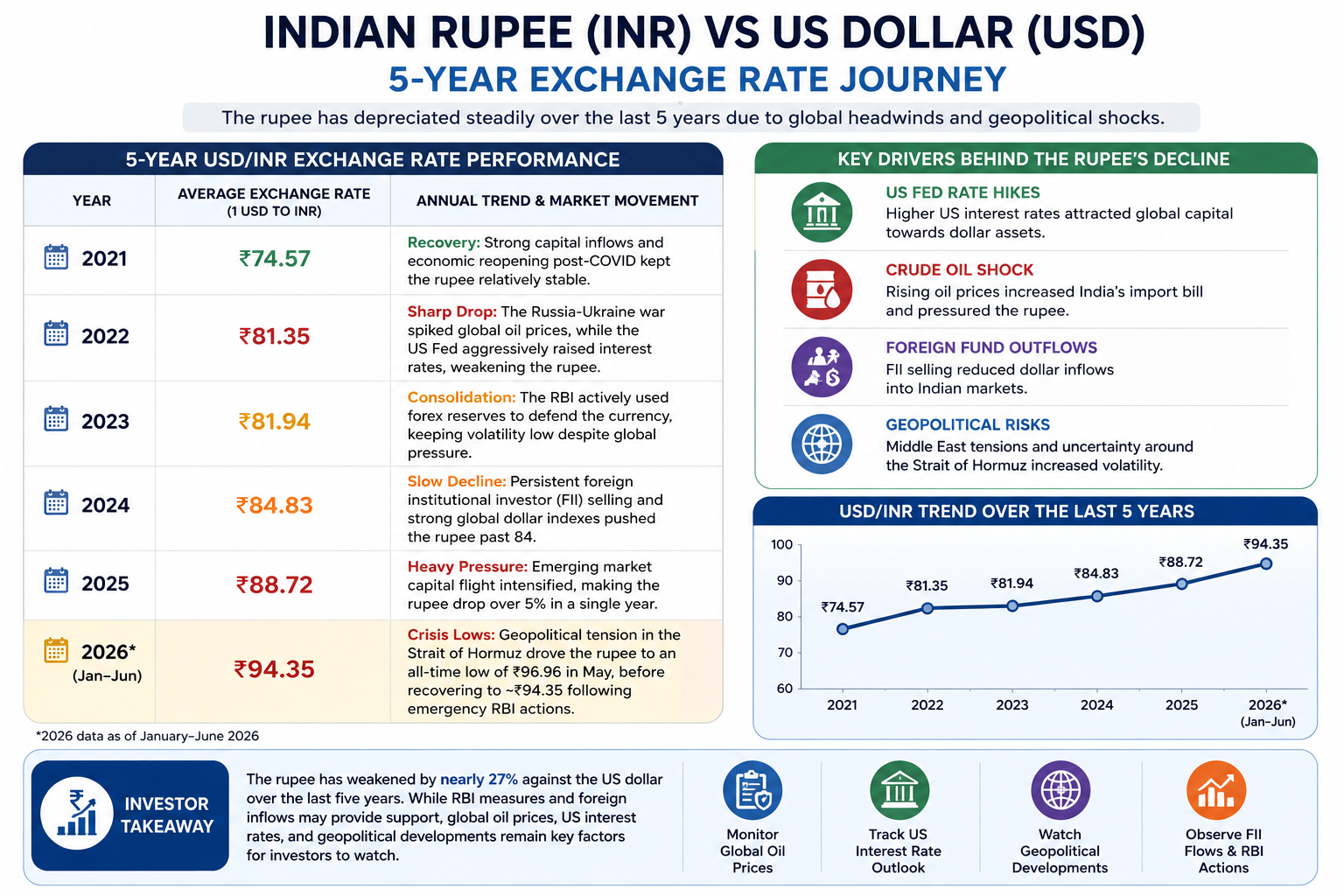
5-Year USD to INR Exchange Rate Performance
| Year | Average Exchange Rate (1 USD to INR) | Annual Trend & Market Movement |
| 2021 | ₹74.57 | Recovery: Strong capital inflows and economic reopening post-COVID kept the rupee relatively stable. |
| 2022 | ₹81.35 | Sharp Drop: The Russia-Ukraine war spiked global oil prices, while the US Fed aggressively raised interest rates, weakening the rupee. |
| 2023 | ₹81.94 | Consolidation: The RBI actively used forex reserves to defend the currency, keeping volatility low despite global pressure. |
| 2024 | ₹84.83 | Slow Decline: Persistent foreign institutional investor (FII) selling and strong global dollar indexes pushed the rupee past 84. |
| 2025 | ₹88.72 | Heavy Pressure: Emerging market capital flight intensified, making the rupee drop over 5% in a single year. |
| 2026 (Jan–Jun) | ₹94.35 | Crisis Lows: Geopolitical tension in the Strait of Hormuz drove the rupee to an all-time low of ₹96.96 in May, before recovering to ~₹94.35 following emergency RBI actions. |
Key Turning Points in the Last 5 Years
- The US Fed Rate Hikes (2022–2023): The US Federal Reserve raised interest rates from near zero to over 5%. This caused foreign investors to pull funds from India to chase higher, safer yields in the US.
- The Forex Firepower Defense (2024): The RBI aggressively bought rupees and sold dollars from its reserves, building a buffer to prevent a rapid crash of the currency.
- The Energy Shock (First Half of 2026): Middle East geopolitical escalations pushed crude oil prices above $120 per barrel, ballooning India’s import bill and forcing the rupee past the ₹94 mark.