Key Takeaways
- Wall Street heads into a pivotal week with the June jobs report expected to shape interest-rate expectations.
- Strong employment data could reinforce expectations that the Federal Reserve may keep rates higher for longer.
- AI-driven semiconductor stocks remain under pressure after an exceptional rally in the first half of 2026.
- Inflation, oil prices and geopolitical developments continue to influence market sentiment.
- Investors are preparing for one of the biggest macro-driven trading weeks of the year.
Wall Street Faces a Crucial Test Heading Into the Second Half
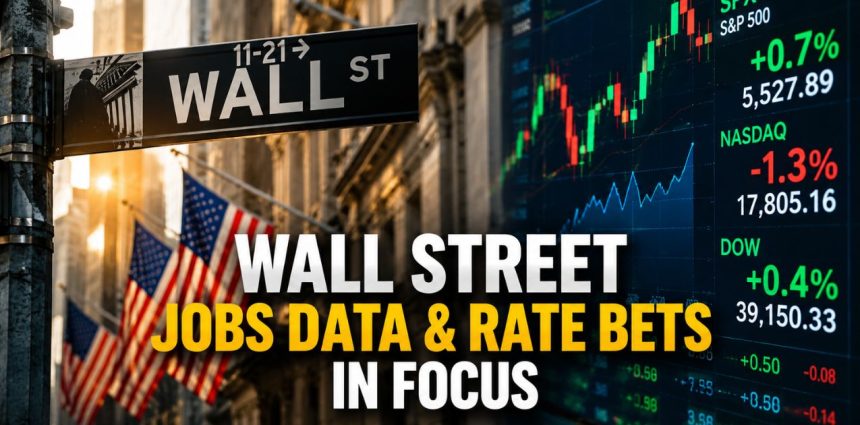
U.S. markets closed the first half of 2026 on a strong note, but investor uncertainty has increased amid mixed economic signals. The June jobs report and inflation running above 4% could widen the gap between market expectations and Federal Reserve policy.
High-flying semiconductor and AI stocks are facing fresh pressure after massive gains earlier this year, highlighting growing market tension. Investors are now assessing whether resilient economic growth, persistent inflation and changing interest-rate expectations could reshape Wall Street’s outlook for the second half of 2026.
The S&P 500 has gained roughly 7% year-to-date, although June trading has become increasingly volatile.
Technology and semiconductor stocks powered much of this year’s rally before pulling back as investors reassessed the likelihood of higher interest rates.
The coming week’s June payrolls report is expected to become the biggest catalyst for financial markets.
A stronger-than-expected jobs report could paradoxically trigger market weakness, as investors may interpret robust employment as a reason for the Federal Reserve to maintain restrictive monetary policy for longer. In other words, markets may already have priced in an expectation gap where positive economic news becomes negative for equities.
Jobs Report in Focus
The U.S. economy has continued adding jobs at a healthy pace, with May payrolls rising by 172,000.
Economists currently expect approximately 110,000 new jobs during June, representing the slowest pace of hiring in several months.
If hiring significantly exceeds expectations, it would reinforce signs of a resilient economy and strengthen market expectations that the Federal Reserve may consider another rate hike as early as September.
Conversely, weaker-than-expected employment data could ease concerns about additional policy tightening, potentially supporting equities while pushing Treasury yields lower.
| Scenario (June Jobs) | Likely Fed Reaction | Market Impact | Investor Strategy |
|---|---|---|---|
| Strong Beat (>140K) | Higher-for-longer stance | Pressure on tech stocks; yields rise | Reduce excessive growth exposure; hedge risk |
| Around Expectations (~110K) | Wait-and-watch | Mixed market reaction | Stay diversified and focus on quality |
| Weak Report (<90K) | Dovish expectations strengthen | Stocks may rally; yields decline | Consider selective buying in growth sectors |
Tech and Semiconductor Stocks Face Their Next Test
Artificial intelligence remains one of Wall Street’s biggest investment themes.
The Philadelphia Semiconductor Index has rallied roughly 85% since late March, although recent profit booking suggests investors are questioning whether AI-related valuations have become stretched.
Strong earnings from memory-chip companies such as Micron helped stabilize sentiment, but the Nasdaq Composite still posted weekly losses as investors reassessed growth expectations.
This market tension reflects concerns that higher interest rates could weigh on richly valued technology companies, whose future earnings become less valuable when borrowing costs remain elevated.
Federal Reserve officials continue to emphasize bringing inflation back toward the 2% target, reinforcing concerns that monetary policy could remain restrictive if economic data stays resilient.
Inflation and Fed Outlook
Inflation has once again become Wall Street’s biggest macro concern.
Recent data showed consumer prices rising above 4%, the highest level in more than three years, partly due to earlier energy-price spikes linked to Middle East tensions.
Although oil prices have moderated in recent weeks, policymakers continue prioritising price stability.
The June FOMC meeting reinforced that inflation remains the Federal Reserve’s primary focus. Futures markets currently indicate growing expectations that another rate increase remains possible later this year if inflation and labour-market data remain stronger than anticipated.
Geopolitical and Oil Risks Remain in Focus
Geopolitical developments continue to create forward-looking risks for investors.
Oil prices have retreated to roughly $70 per barrel after touching around $100 during heightened Middle East tensions.
Lower crude prices could help ease inflationary pressures over coming months.
However, any renewed escalation in geopolitical conflicts could quickly reverse that trend, creating another inflation shock that complicates the Federal Reserve’s policy path.
Market Impact
Wall Street remains delicately balanced between resilient economic growth and restrictive monetary policy.
If the economy continues outperforming expectations, Treasury yields could rise further while high-growth technology stocks face additional pressure.
On the other hand, signs of cooling economic activity could revive hopes for a less aggressive Federal Reserve and provide renewed support for equities.
Investors will also monitor Nike’s quarterly earnings for fresh insights into U.S. consumer spending before the broader second-quarter earnings season begins later in July.
Investor Takeaways
- Diversify portfolios to manage volatility as interest-rate uncertainty remains elevated.
- Closely monitor the June jobs report, wage growth and unemployment data, which could significantly influence Federal Reserve expectations.
- Remain disciplined on AI and semiconductor stocks after their substantial rally, particularly if higher interest rates continue pressuring valuations.
Key Upcoming Events
| Date | Upcoming Event | Market Impact |
|---|---|---|
| June 30, 2026 (Tuesday) | Nike Q4 FY2026 Earnings | First major earnings report of the quarter; offers insight into U.S. consumer demand. |
| July 2, 2026 (Thursday) | US June Nonfarm Payrolls Report | The week’s biggest catalyst. Strong jobs data could strengthen Fed rate expectations, while weaker data may support equities. |
| July 2, 2026 (Thursday) | US Unemployment Rate & Average Hourly Earnings | Key labour-market and inflation indicators watched by the Federal Reserve. |
| July 3, 2026 (Friday) | US Markets Closed (Independence Day Observed) | NYSE and Nasdaq remain closed, resulting in lower global trading volumes. |
Check here:
Bottom Line
The June jobs report is shaping up to be Wall Street’s most important event before markets enter the second half of 2026. Whether hiring remains resilient or begins to cool will likely determine expectations for Federal Reserve policy, Treasury yields, AI-driven technology stocks and overall investor sentiment in the weeks ahead. With inflation still above target, oil prices stabilising and earnings season approaching, investors should prepare for heightened volatility as markets search for their next major catalyst.
Sources: Reuters, Federal Reserve, U.S. Bureau of Labor Statistics (BLS), LSEG market data and Nike Investor Relations.