India’s LPG Consumption Falls 8% as West Asia Conflict Disrupts Supply Chain
India’s cooking gas market has hit an unexpected speed bump.
India LPG consumption fell 8% during the first half of 2026 after the conflict in West Asia disrupted fuel shipments through the Strait of Hormuz, one of the world’s busiest energy trade routes. The decline was not driven by weaker demand but by a shortage of supplies, highlighting India’s continued dependence on imported LPG.
For millions of households and investors tracking India’s energy sector, the latest data raises an important question: Can India reduce its dependence on imported cooking gas before the next global supply shock?
India’s LPG consumption drops as supply disruptions hit imports
According to provisional data released by the Petroleum Planning and Analysis Cell (PPAC), India LPG consumption declined to 14.74 million tonnes (mt) between January and June 2026.
During the same period last year, India LPG consumption stood at 15.95 million tonnes, marking an 8% year-on-year decline.
The PPAC said the drop was entirely due to lower LPG availability rather than weaker consumer demand.
India’s LPG import profile
| Metric | Value |
|---|---|
| Domestic requirement met through imports | 60% |
| Imports sourced from Middle East | 90% |
| H1 2026 consumption | 14.74 million tonnes |
| H1 2025 consumption | 15.95 million tonnes |
| Year-on-year decline | 8% |
Read More : Adani’s Rs1.08 Lakh Crore Odisha Aluminium Bet: 53,500 Jobs, India’s Biggest Metallurgy FDI
India remains heavily dependent on imported LPG
The latest figures underline India’s dependence on overseas LPG supplies.
Despite efforts to expand domestic energy production, imported LPG continues to play a vital role in meeting household cooking fuel demand.
The country’s average daily LPG consumption has steadily increased over the past three financial years:
- FY26: Around 90,991 tonnes per day (TPD)
- FY25: Around 85,830 TPD
- FY24: Around 81,271 TPD
The long-term trend shows that demand continues to grow even though supply disruptions temporarily reduced consumption during the first half of 2026.
Why did India LPG consumption decline?
The biggest reason behind the fall in India LPG consumption was the disruption of fuel supplies from West Asia.
India imports nearly 60% of its domestic LPG requirement, and around 90% of those imports come from the Middle East Gulf (MEG). Most LPG cargoes pass through the Strait of Hormuz, a critical shipping route affected by the recent geopolitical conflict.
As cargo movements slowed and shipping routes became uncertain, oil marketing companies faced lower fuel availability, leading to reduced LPG supplies across the country.
8 Key Reasons Investors and Consumers Should Care
India’s 8% decline in LPG consumption during the first half of 2026 is more than a temporary demand slowdown—it highlights the country’s vulnerability to global supply disruptions and underscores the importance of strengthening energy security. Here’s why the market is paying close attention.
1. Supply Shock, Not Weak Demand
The fall in LPG consumption was primarily driven by reduced availability, not a decline in household demand. With fewer LPG cargoes arriving due to disruptions in West Asia, oil marketing companies had less fuel to distribute, leading to lower overall consumption.
2. India’s Heavy Dependence on Imports
India imports around 60% of its LPG requirements, and before the conflict, nearly 90% of those imports came from the Middle East, with most shipments passing through the Strait of Hormuz. This makes India’s cooking gas supply highly sensitive to geopolitical tensions in the region.
3. West Asia Conflict Exposed Supply Chain Risks
The disruption to shipping routes and temporary closure of the Strait of Hormuz delayed LPG cargoes, increased freight costs and tightened domestic availability. The episode highlighted the risks of relying heavily on a single region for critical energy supplies.
4. Impact on Households and Commercial Users
Although the government prioritised domestic cooking gas supplies, commercial and industrial users faced supply restrictions. Restaurants, hotels and small businesses experienced delays and higher costs, while some households also saw longer refill intervals during the peak of the supply crunch.
5. Pressure on Oil Marketing Companies (OMCs)
To shield households from steep international price increases, state-owned OMCs absorbed much of the higher procurement cost instead of fully passing it on to consumers. This increased under-recoveries and put pressure on their profitability during the crisis.
6. Push for Diversified LPG Imports
The crisis accelerated India’s efforts to diversify LPG sourcing. Imports from the United States rose sharply, while cargoes also arrived from countries such as Argentina, Chile, France, the Netherlands and Iran, reducing dependence on the Gulf region.
7. Strengthening India’s Energy Security Strategy
The disruption is expected to encourage policymakers to expand strategic LPG storage, increase domestic production and diversify long-term import contracts. These measures could make India’s energy supply chain more resilient to future geopolitical shocks.
8. Signs of Recovery Have Emerged
As tensions eased and the Strait of Hormuz reopened, LPG availability improved. The government has restored commercial and industrial LPG supplies to pre-crisis levels, and oil marketing companies have resumed normal allocations, indicating that supply conditions are stabilising.
What is the impact on consumers?
For households, lower India LPG consumption does not necessarily mean families are using less cooking gas by choice.
Instead, reduced fuel availability can lead to delayed cylinder refills, tighter inventory and logistical challenges in some regions.
Restaurants, hotels and small businesses that rely heavily on LPG may also face higher operating costs if global supply disruptions continue.
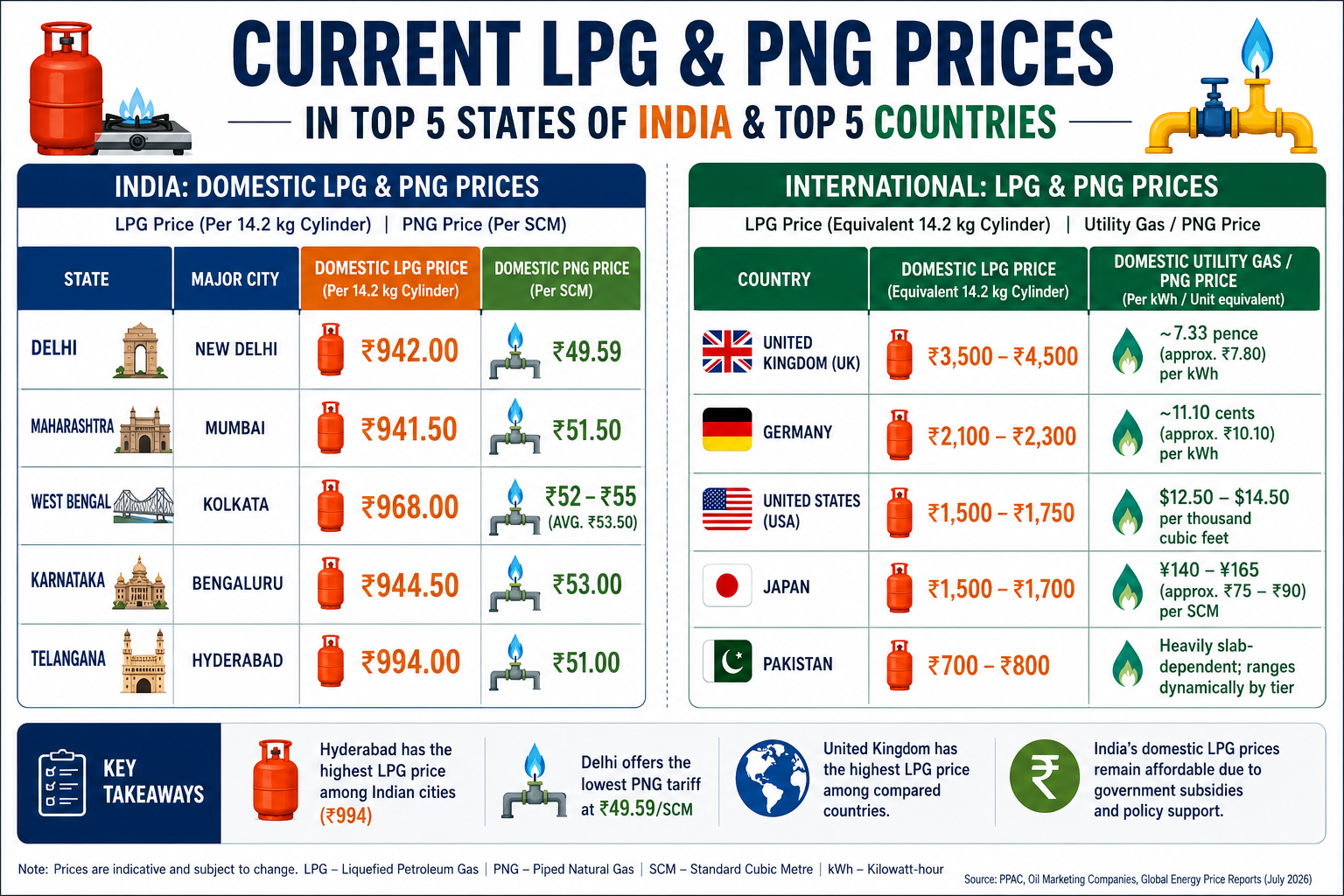
Current Domestic LPG and PNG Prices: Top 5 Indian States vs Top 5 Countries (July 2026)
India: Domestic LPG & PNG Prices
| State | Major City | Domestic LPG (14.2 kg Cylinder) | PNG (Per SCM) |
|---|---|---|---|
| Delhi | New Delhi | ₹942.00 | ₹49.59 |
| Maharashtra | Mumbai | ₹941.50 | ₹51.50 |
| West Bengal | Kolkata | ₹968.00 | ₹52–55 (Avg. ₹53.50) |
| Karnataka | Bengaluru | ₹944.50 | ₹53.00 |
| Telangana | Hyderabad | ₹994.00 | ₹51.00 |
Key observations
- Hyderabad has the highest domestic LPG price among the five cities at ₹994 per cylinder.
- Mumbai has the lowest LPG price in this comparison at ₹941.50.
- Delhi offers the lowest PNG tariff at ₹49.59 per SCM.
- Domestic LPG prices have remained largely unchanged despite recent reductions in commercial LPG cylinder prices.
International Comparison
| Country | Domestic LPG* | Domestic Natural Gas / PNG |
|---|---|---|
| United Kingdom | ₹3,500–₹4,500 (14.2 kg equivalent) | ₹7.8 per kWh |
| Germany | ₹2,100–₹2,300 | ₹10.1 per kWh |
| United States | ₹1,500–₹1,750 | US$12.5–14.5 per thousand cubic feet |
| Japan | ₹1,500–₹1,700 | ¥140–165 per SCM (approx. ₹75–90) |
| Pakistan | ₹700–₹800 | Tiered, government-regulated tariffs |
*Approximate retail equivalents converted to Indian Rupees for comparison. Prices vary by region, supplier, taxes and exchange rates.
Why Are Prices Different?
- India: Household LPG prices are partially insulated by government policy and subsidies such as the PM Ujjwala Yojana, while state taxes and distribution costs create regional differences.
- United Kingdom & Germany: Higher energy taxes, environmental levies and distribution costs contribute to significantly higher household gas prices.
- United States: Abundant domestic natural gas production helps keep prices comparatively lower than many developed economies.
- Japan: As a major energy importer, Japan’s prices remain relatively high because of import dependence.
- Pakistan: Government controls and subsidies influence retail LPG and natural gas prices, though tariffs vary by consumption slab.
Track Live : Live Stock Screener for Indian Markets
Major listed stocks most affected
| Company | NSE Symbol | Current Stock Price* | Impact from LPG Decline | Key Reason |
|---|---|---|---|---|
| Indian Oil Corporation | IOC | ₹141.62 | Negative | India’s largest LPG distributor; lower LPG volumes and higher import costs pressure marketing margins. |
| Hindustan Petroleum Corporation | HINDPETRO | ₹399.55 | Negative | LPG availability constraints, higher freight costs and weaker downstream margins. |
| Bharat Petroleum Corporation | BPCL | ₹310.45 | Negative | Rising procurement costs and government-controlled domestic LPG pricing weigh on profitability. |
| GAIL (India) | GAIL | ₹174.29 | Positive | Commercial consumers increasingly shift toward PNG, supporting long-term gas demand. |
| Stove Kraft | STOVEKRAFT | ₹773.85 | Positive | Demand for induction cooktops and electric cooking appliances increases as households seek LPG alternatives. |