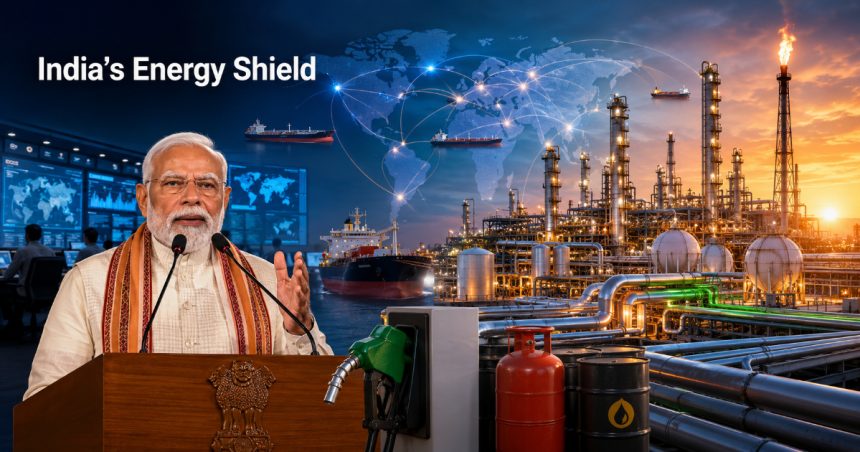
PM Modi Says India Averted Fuel Crisis by Sourcing Energy From Over 40 Countries During West Asia Conflict
When crude oil prices surged and global supply routes came under pressure during the West Asia conflict, many feared India would face fuel shortages. Instead, the country kept petrol, diesel and LPG supplies flowing. Speaking at the inauguration of Rajasthan’s first greenfield refinery, Prime Minister Narendra Modi explained how India managed one of its toughest energy challenges and why the new refinery could play a key role in the country’s long-term energy security.
PM Modi Inaugurates India’s First Greenfield Refinery in Rajasthan
Prime Minister Narendra Modi on Saturday inaugurated the country’s first greenfield integrated refinery-cum-petrochemical complex at Pachpadra in Rajasthan’s Balotra district.
The refinery marks Rajasthan’s first integrated refinery and petrochemical complex. During the visit, the Prime Minister also laid the foundation stone and inaugurated development projects worth nearly ₹1.06 lakh crore spanning petrochemicals, railways, roads, renewable energy, urban transport and power transmission.
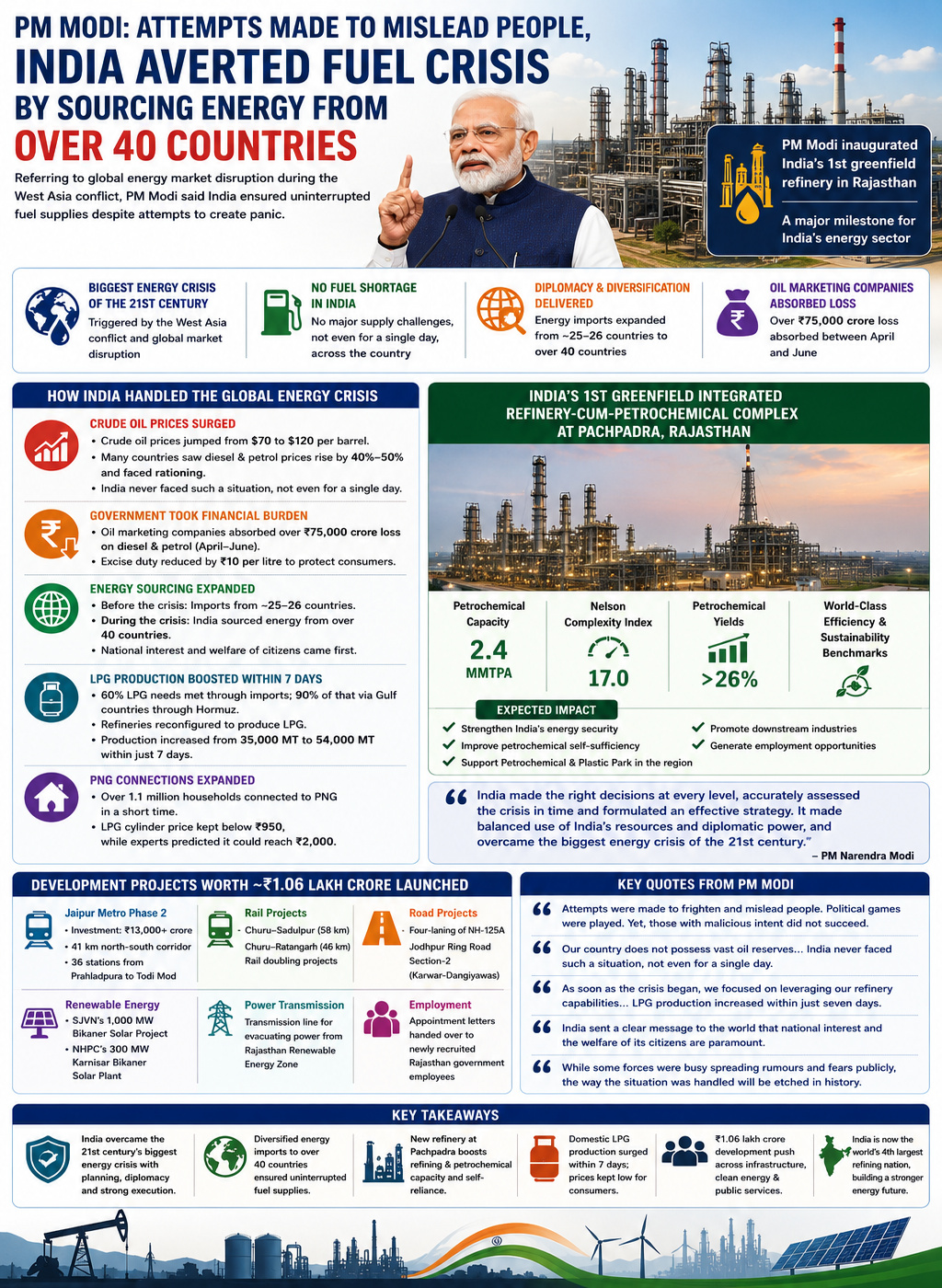
The integrated refinery has a 2.4 MMTPA petrochemical capacity, a Nelson Complexity Index of 17.0 and petrochemical yields exceeding 26%, positioning it among globally competitive refining facilities.
Highlights
- India’s first greenfield integrated refinery-cum-petrochemical complex inaugurated at Pachpadra, Rajasthan.
- Development projects worth ₹1.06 lakh crore launched across petrochemicals, railways, roads, metro, renewable energy and power transmission.
- Refinery features:
- 2.4 MMTPA petrochemical capacity
- Nelson Complexity Index of 17, placing it among the world’s advanced refineries.
- Expected to improve India’s petrochemical self-sufficiency and energy security.
PM Modi Says India Avoided Fuel Shortages During Global Energy Crisis
Addressing the gathering, Modi said India successfully navigated what he described as the “biggest energy crisis of the 21st century” triggered by the conflict in West Asia.
He said attempts were made to create panic over possible fuel shortages, but uninterrupted supplies were maintained across the country.
“Attempts were made to frighten and mislead people. Political games were played. Yet, those with malicious intent did not succeed. Even in remote areas, apart from minor hiccups, there were no major challenges regarding supply,” Modi said.
He noted that global crude oil prices climbed from around $70 to $120 per barrel, while several countries witnessed fuel rationing and retail fuel prices rising by 40% to 50%.
“India never faced such a situation, not even for a single day,” he added.
Read More : Indian Rupee Falls Nearly 1% This Week, Slips Past 95 Per Dollar For First Time In 3 Weeks
India Expanded Energy Imports to More Than 40 Countries
The Prime Minister credited India’s diplomatic efforts for strengthening energy security during the crisis.
According to Modi, India previously sourced fuel from around 25 to 26 countries, but expanded imports to more than 40 countries as global supply chains were disrupted.
“The crisis showcased the prowess of Indian diplomacy. India sent a clear message to the world that national interest and the welfare of its citizens are paramount,” he said.
He added that predictions about India failing to manage the crisis ultimately proved incorrect.
Oil Companies Absorbed ₹75,000 Crore Losses as Government Cut Excise Duty
Modi said oil marketing companies absorbed losses exceeding ₹75,000 crore between April and June because of elevated international crude oil prices.
He added that the government also reduced excise duty by ₹10 per litre to shield consumers from higher fuel costs.
“The burden of covering this loss was borne by the public exchequer. We also reduced the excise duty by Rs 10 per litre, ensuring the public did not face an excessive burden,” he said.
How India handled the energy crisis
According to the Prime Minister:
- Crude oil prices surged from around $70 to $120 per barrel during the conflict.
- Import routes, including those through the Strait of Hormuz, were disrupted.
- India expanded crude and fuel sourcing to more than 40 countries.
- Oil marketing companies absorbed over ₹75,000 crore in losses between April and June.
- The government reduced excise duty by ₹10 per litre to cushion consumers.
- Domestic LPG production increased from 35,000 metric tonnes to 54,000 metric tonnes within seven days by reconfiguring refineries.
- More than 1.1 million households were connected to PNG to reduce dependence on LPG imports.
- Domestic LPG cylinder prices were kept below ₹950, despite market expectations they could rise to around ₹2,000 during the crisis.
Domestic LPG Output Increased Within Seven Days
The Prime Minister also outlined how India tackled disruptions in LPG imports after supplies through the Strait of Hormuz were affected.
He said nearly 60% of India’s LPG demand depended on imports, with 90% of those imports coming through Gulf nations.
To manage the disruption, the government redirected refinery operations to increase domestic LPG production.
According to Modi, domestic LPG production increased from 35,000 metric tonnes to 54,000 metric tonnes within just seven days, while several refineries were reconfigured to produce LPG for the first time.
The government also accelerated piped natural gas (PNG) expansion, connecting more than 1.1 million households in a short period.
Modi said these measures helped keep domestic LPG cylinder prices below ₹950, despite market estimates suggesting prices could have climbed to ₹2,000.
Here’s What Happened Today and Why Traders Reacted
Today’s announcement highlighted India’s continued focus on energy security and refining capacity.
The inauguration of the Pachpadra refinery, combined with the government’s emphasis on diversified crude sourcing and domestic fuel production, reinforces India’s long-term strategy to reduce supply risks during global disruptions.
For markets, the announcement underscores continued policy support for refining, petrochemicals, renewable energy and infrastructure development.
What Could Be the Market Impact?
The refinery is expected to strengthen India’s refining capacity, improve petrochemical self-sufficiency and support downstream manufacturing industries in Rajasthan.
The broader infrastructure projects announced alongside the refinery—including Jaipur Metro Phase 2, railway expansion, national highways, solar power projects and transmission infrastructure—could support long-term investment activity across engineering, construction, renewable energy and industrial sectors.
Companies engaged in refining, petrochemicals, EPC, industrial equipment, renewable energy and infrastructure development may benefit from higher project execution and capital expenditure over the coming years.
For investors, the event reinforces India’s long-term focus on energy security, infrastructure expansion and domestic manufacturing, themes that are likely to remain key drivers for several sectors of the equity market.
Stocks to Watch (Closing prices as of July 4, 2026)
These companies could benefit from India’s long-term focus on expanding refining capacity, strengthening energy security and increasing domestic infrastructure. This is not investment advice.
Track Live : Live Stock Screener for Indian Markets
| Sector | Company | Current Stock Price |
|---|---|---|
| Refining & Oil Marketing | Hindustan Petroleum Corporation (HPCL) | ₹399.25 |
| Indian Oil Corporation (IOC) | ₹141.56 | |
| Bharat Petroleum Corporation (BPCL) | ₹308.15 | |
| Upstream Energy | Oil and Natural Gas Corporation (ONGC) | ₹237.84 |
| Oil India | ₹422.10 | |
| Gas Distribution | GAIL (India) | ₹174.15 |
| Indraprastha Gas (IGL) | ₹153.99 | |
| Mahanagar Gas (MGL) | ₹1,128.60 | |
| Engineering & EPC | Engineers India (EIL) | ₹237.49 |
| Larsen & Toubro (L&T) | ₹4,026.60 | |
| Renewable Energy | SJVN | ₹72.55 |
| NHPC | ₹80.53 |
Why these companies are relevant
- Refining & Oil Marketing: Capacity expansion and new refinery projects could support long-term growth in refining and fuel distribution.
- Upstream Energy: Higher domestic exploration and production can strengthen India’s energy security.
- Gas Distribution: Expansion of PNG and CNG infrastructure supports city gas demand.
- Engineering & EPC: Large refinery, petrochemical and infrastructure projects create execution opportunities for engineering companies.
- Renewable Energy: Solar and power transmission projects announced alongside the refinery support the long-term clean energy transition.