Swiggy Shares Jump 6% as Domestic Ownership Crosses 50%; Instamart Nears Inventory-Led Model
Will Swiggy’s Ownership Milestone Change the Future of Instamart?
Swiggy shares jumped nearly 6% on Tuesday, but the real story isn’t just the stock price. The company has crossed an important ownership milestone that could reshape its quick commerce business over the coming years. While Swiggy clarified that nothing changes immediately, investors are betting this move could eventually unlock greater operational flexibility for Instamart.
Track Live : All Listed Stocks In NSE
Swiggy Shares Jump 6% After Domestic Ownership Crosses 50%
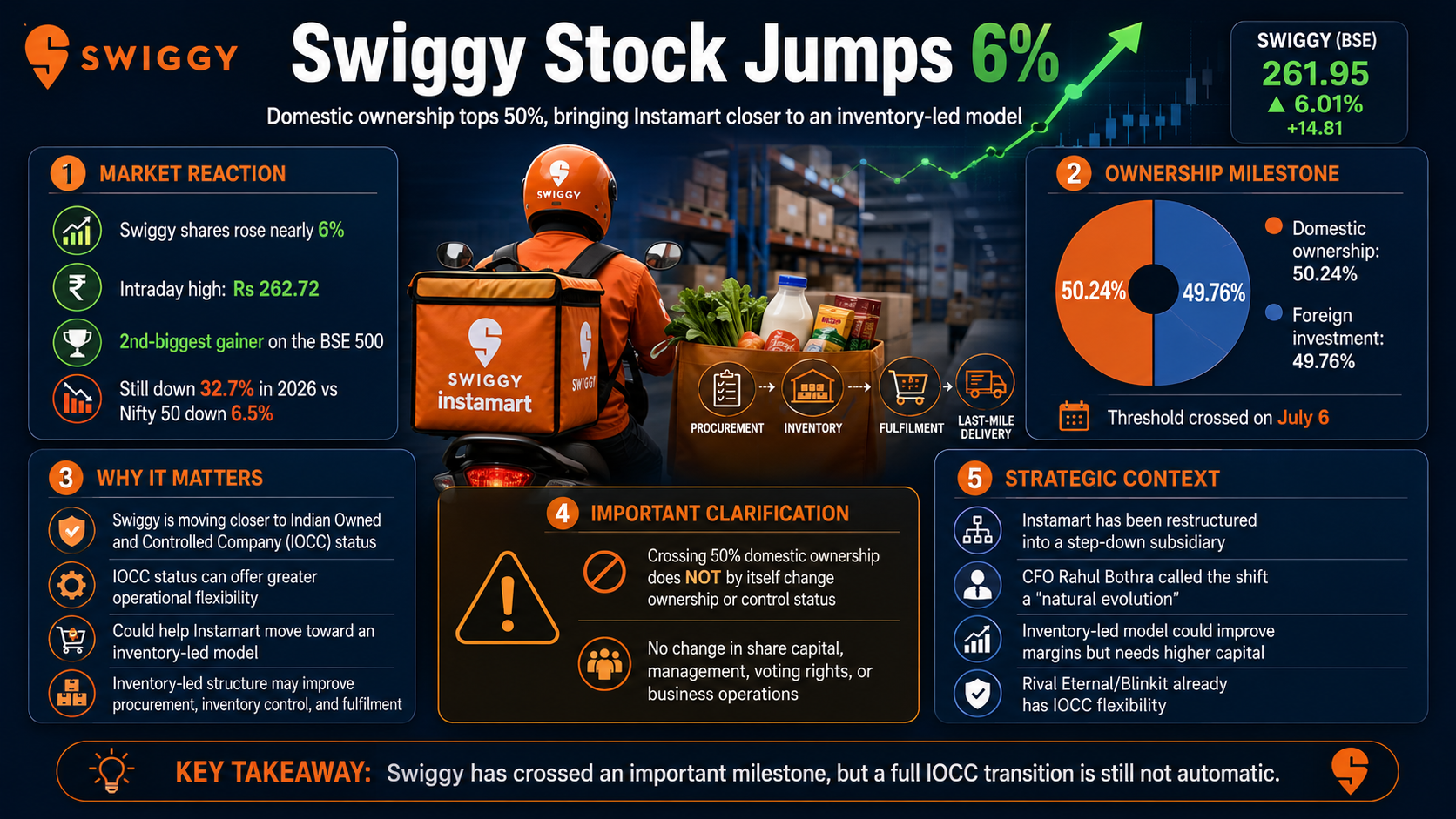
Swiggy shares jumped 6% after the company informed stock exchanges that domestic ownership has increased to 50.24%, while total foreign investment has declined to 49.76% as of July 6.
The stock climbed as much as 5.8% to ₹262.72, making it the second-biggest gainer on the BSE 500 during Tuesday’s session.
The development is viewed as an important milestone in Swiggy’s journey towards becoming an Indian Owned and Controlled Company (IOCC), a status that could provide greater flexibility for its fast-growing quick commerce business, Instamart.
Swiggy Ltd (SWIGGY) Financial Performance Snapshot
- Market Capitalisation: Close to ₹68,787 Cr to ₹71,906 Cr.
- Trading Context: Despite Tuesday’s single-day rally, the company’s equity remains down roughly 32.7% year-to-date in 2026, noticeably underperforming the benchmark Nifty 50’s 6.5% dip over the same period.
- Historical Extremes: The counter recovered roughly 12% from its 52-week low of ₹235.75 established on June 30, 2026, though it still trades well below its 52-week high of ₹474.00.
Here’s What Happened Today and Why Traders Reacted
Investors responded positively because the latest ownership structure moves Instamart one step closer to an inventory-led business model under India’s foreign investment regulations.
Swiggy disclosed that:
- Domestic ownership now stands at 50.24%
- Foreign investment has reduced to 49.76%
- The company is progressing toward IOCC status
- IOCC could allow greater operational flexibility for Instamart
The announcement increased investor optimism that Swiggy may eventually improve the economics of its quick commerce business.
Read More : IT Stocks Surge Up to 4 percent: Infosys, TCS, Tech Mahindra Rally Ahead of Q1 Results — Here’s Why
Swiggy Clarifies That Nothing Changes Immediately
Despite the market rally, Swiggy emphasized that crossing the 50% domestic ownership mark does not automatically change its ownership or control status.
In its exchange filing, the company stated that there has been no change in its management, voting rights, business operations, share capital or rights attached to its equity shares.
Swiggy also said any material developments regarding its ownership or control structure will be disclosed in accordance with regulatory requirements.
This clarification is important because obtaining IOCC status requires more than simply crossing the domestic ownership threshold.
Why IOCC Matters for Swiggy and Instamart
Many retail investors see the 50% domestic ownership milestone as just another corporate announcement. In reality, IOCC (Indian Owned and Controlled Company) status could fundamentally change how Swiggy’s quick commerce business operates. However, it’s important to note that crossing the 50% ownership threshold alone does not make Swiggy an IOCC. Under India’s foreign investment rules, both ownership and effective control must be with Indian residents.
Marketplace vs. Inventory-Led Model
| Foreign-Owned & Controlled Company (FOCC) | Indian-Owned & Controlled Company (IOCC) |
|---|---|
| Can operate a marketplace model | Can operate both marketplace and inventory-led models (subject to applicable regulations) |
| Cannot directly own inventory for e-commerce operations under applicable FDI rules | Greater flexibility to own and manage inventory where permitted |
| Earns mainly commission or marketplace fees | Can earn retail margins on products sold directly |
| Limited control over procurement and inventory | Greater control over sourcing, warehousing and fulfilment |
Swiggy’s long-term objective is to move closer to the flexibility enjoyed by an IOCC, enabling Instamart to operate more efficiently.
Why IOCC Status Could Be a Game Changer
1. Higher Revenue Potential
Today, Instamart largely operates as a marketplace connecting sellers and customers. If it ultimately transitions to an inventory-led model, it could purchase products directly from FMCG brands and sell them to consumers, allowing it to capture retail margins instead of primarily earning commissions.
2. Better Procurement Efficiency
Direct sourcing from manufacturers could reduce dependence on multiple intermediaries, improve purchasing efficiency, strengthen supplier relationships and lower procurement costs.
3. Greater Control Over Inventory
Owning inventory would enable Swiggy to manage:
- Product availability
- Stock replenishment
- Expiry management
- Quality checks
- Dark-store inventory planning
This could reduce stock-outs, cancellations and wastage while improving customer satisfaction.
4. Improved Profitability
Analysts believe greater control over procurement, pricing and inventory management could support better gross margins and long-term operating leverage, although it would also require additional working capital and investment in inventory.
5. Competing on Equal Terms
Swiggy’s rival Blinkit, through its parent Eternal, has already moved toward an Indian-owned structure, giving it greater flexibility in its operating model. Swiggy is pursuing a similar strategic path to narrow the competitive gap.
Management Has Already Indicated the Direction
Swiggy has already restructured Instamart into a step-down subsidiary, a move that analysts believe prepares the business for a future transition once the company completes its IOCC journey.
Earlier, Chief Financial Officer Rahul Bothra described such a transition as a “natural evolution”, suggesting that while capital requirements may increase, the model could eventually improve profitability.
The latest ownership milestone reinforces that long-term strategic direction.
Swiggy Still Faces Challenges Despite Today’s Rally
Although Swiggy shares jumped 6%, the stock has struggled throughout the year.
Even after Tuesday’s gains:
- Swiggy stock remains down 32.7% in 2026
- The Nifty 50 has declined only 6.5% during the same period
This shows investors remain cautious about profitability, execution risks and intense competition in India’s fast-growing quick commerce market.
Competition in Quick Commerce Is Intensifying
Swiggy’s biggest rival, Eternal, has already secured its IOCC status by limiting foreign shareholding to 49.5%.
This allows Blinkit to continue operating with the flexibility available to Indian-owned and controlled companies.
Swiggy’s latest disclosure indicates it is moving in a similar direction, although the company reiterated that its ownership and control status has not yet officially changed.
What Impact Did This Have on the Market Today?
The announcement boosted sentiment around Swiggy, making it one of the top-performing stocks on the BSE 500.
Investors interpreted the ownership milestone as a positive long-term development rather than an immediate earnings catalyst.
The rally also reflects growing optimism that regulatory flexibility could strengthen Swiggy’s competitive position in quick commerce.
What Is an Inventory-Led Model?
An inventory-led model is an e-commerce business model in which the platform purchases, owns, stores and sells products directly to customers. Instead of merely connecting buyers with third-party sellers, the company becomes the seller of record and manages the entire supply chain—from procurement to delivery. This is the operating model Swiggy’s Instamart could eventually adopt if Swiggy qualifies as an Indian Owned and Controlled Company (IOCC).
Marketplace Model vs. Inventory-Led Model
| Marketplace Model | Inventory-Led Model |
|---|---|
| Brands/third-party sellers own the products | The platform owns the products |
| Platform connects buyers and sellers | Platform buys directly from manufacturers or brands |
| Revenue comes mainly from commissions | Revenue comes from the full retail margin |
| Limited control over inventory | Complete control over inventory and fulfilment |
| Sellers manage stock | Platform manages warehouses or dark stores |
How an Inventory-Led Model Works
Marketplace Model
Brands / Sellers
│
▼
Digital Platform
│
▼
Customer
Platform earns a commission
Inventory-Led Model
Brands / Manufacturers
│
Bulk Procurement
│
▼
Platform Warehouses / Dark Stores
│
▼
Customer
Platform earns the retail margin
Why an Inventory-Led Model Matters
If Instamart transitions to an inventory-led model, it could unlock several operational advantages:
- Better inventory control: Swiggy can decide what products to stock, monitor inventory in real time and reduce stock-outs.
- Faster deliveries: Products are already stored in company-operated dark stores, enabling quicker order processing and fulfilment.
- Improved product availability: Direct inventory management helps reduce cancelled orders caused by seller stock shortages.
- Greater pricing flexibility: Swiggy can launch discounts, bundle offers and promotional campaigns without relying on third-party sellers.
- Higher gross margins: Buying directly from brands at wholesale prices allows the company to capture the retail spread instead of earning only marketplace commissions.
- Stronger customer experience: Greater control over storage, quality checks and expiry management can improve order accuracy and customer satisfaction.