Trump says Iran ceasefire is over as Brent crude jumps 6%; what it means for global markets
The fragile calm in global energy markets was shattered on Wednesday after US President Donald Trump declared that the Iran ceasefire was effectively “over,” triggering a sharp rally in crude oil prices and renewing concerns over supply disruptions in the Middle East.
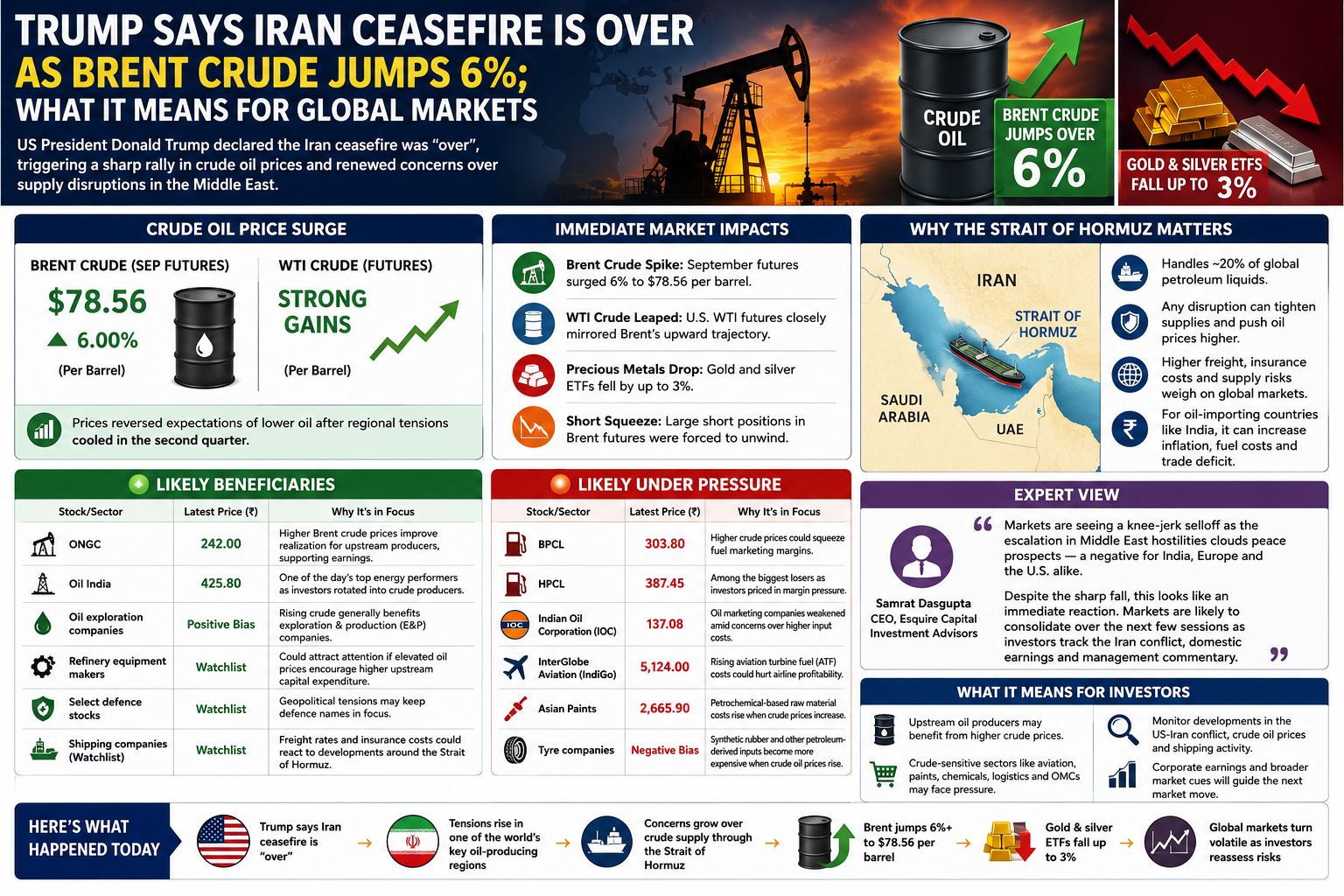
Brent crude futures surged more than 6% to $78.56 per barrel, while West Texas Intermediate (WTI) also posted strong gains as traders priced in the risk of prolonged geopolitical tensions. The move reversed expectations of lower oil prices that had emerged after tensions in the region eased during the second quarter.
Meanwhile, gold and silver exchange-traded funds (ETFs) declined by as much as 3%, tracking weakness in precious metal prices as investors reassessed market positioning.
Brent crude jumps above $78 as supply concerns return
The biggest reaction was seen in the oil market.
ICE Brent Crude September futures climbed over 6% to $78.56 per barrel, while WTI crude also recorded strong gains.
The rally reflected growing fears that renewed hostilities could threaten oil shipments through the Strait of Hormuz, one of the world’s busiest energy trade routes connecting Persian Gulf producers with global consumers.
Any disruption in the region could tighten global crude supplies and keep oil prices elevated in the near term.
Immediate Commodity and Market Impacts
- Brent Crude Spike: September futures surged 6% to $78.56 per barrel during London trading.
- WTI Crude Leaped: U.S. West Texas Intermediate futures closely mirrored Brent’s upward trajectory, aggressively pricing back in a geopolitical risk premium.
- Precious Metals Drop: Gold and silver ETFs fell by up to 3%, suffering a knee-jerk selloff as equity futures slid and investors scrambled to reposition capital.
- Short Squeeze: The surge caught speculative traders off guard, as institutional investors had been heavily accumulation net-short (bearish) wagers at the fastest pace since 2020.
Read More : Sensex Crashes 1,300 Points, Nifty Slips Below 24,000 as Trump’s Iran Remarks Rattle Markets
Why the Strait of Hormuz matters to global energy markets
The Strait of Hormuz is one of the most critical shipping lanes for global crude oil exports.
Even the possibility of renewed conflict increases uncertainty for shipowners, insurers and oil producers operating in the region. Higher geopolitical risk typically leads to increased freight costs, insurance premiums and supply concerns, all of which support higher crude oil prices.
For oil-importing countries like India, sustained higher crude prices could increase inflationary pressure, widen the trade deficit and raise fuel costs.
Key Structural Threat: The Strait of Hormuz
- Transit Disruptions: Renewed hostilities force shipowners and regional oil producers to navigate heightened risks of tanker friction or naval blockades.
- Freight & Insurance Spikes: War risk premiums for commercial shipping lines are expected to skyrocket instantly, squeezing supply chain economics for global refiners.
- Inconsistent Supply Flow: Even if the passage remains structurally open, logjams from nervous transport networks mean physical barrels will take significantly longer to reach destination markets.
Gold and silver ETFs fall despite geopolitical uncertainty
While crude oil rallied sharply, gold and silver ETFs declined by up to 3%, reflecting weakness in underlying precious metal prices.
The move surprised some investors, as gold is generally considered a safe-haven asset during geopolitical uncertainty. Analysts said the decline was largely driven by profit booking and changing investor positioning following recent gains in precious metals.
Oil market positioning added fuel to the rally
The rebound in crude oil prices was amplified by market positioning.
In recent weeks, traders had increasingly bet on lower oil prices after tensions in the Middle East eased and shipping through the Strait of Hormuz resumed. Speculators had built sizeable short positions in Brent crude futures and reduced bullish bets at the fastest pace since 2020.
Track Live : Intraday Booster — Live FNO Breakout Scanner
As geopolitical risks returned, many traders were forced to unwind bearish positions, accelerating the rally in crude prices.
| Stock/Sector | Latest Status | Why It’s in Focus |
|---|---|---|
| ONGC | ₹242.00 | Higher Brent crude prices improve realization for upstream producers, supporting earnings. |
| Oil India | ₹425.80 | One of the day’s top energy performers as investors rotated into crude producers. |
| Oil exploration companies | Positive bias | Rising crude generally benefits exploration & production (E&P) companies through stronger realizations. |
| Refinery equipment makers | Watchlist | Could attract attention if elevated oil prices encourage higher upstream capital expenditure. |
| Select defence stocks | Watchlist | Geopolitical tensions may keep defence names in focus. |
| Shipping companies | Watchlist | Freight rates and insurance costs could react to developments around the Strait of Hormuz. |
Likely Under Pressure
| Stock/Sector | Latest Status | Why It’s in Focus |
|---|---|---|
| BPCL | ₹303.80 | Higher crude prices could squeeze fuel marketing margins. |
| HPCL | ₹387.45 | Among the biggest losers as investors priced in margin pressure. |
| Indian Oil Corporation (IOC) | ₹137.08 | Oil marketing companies weakened amid concerns over higher input costs. |
| InterGlobe Aviation | ₹5,124.00 | Rising aviation turbine fuel (ATF) costs could hurt airline profitability. |
| Asian Paints | ₹₹2,665.90 | Petrochemical-based raw material costs rise when crude prices increase. |
| Tyre companies | Negative bias | Synthetic rubber and other petroleum-derived inputs become more expensive when crude oil prices rise. |
Expert view: Volatility may remain high
According to Samrat Dasgupta, CEO of Esquire Capital Investment Advisors, the initial market reaction reflects heightened uncertainty rather than a shift in long-term fundamentals.
“Markets are seeing a knee-jerk selloff as the escalation in Middle East hostilities clouds peace prospects — a negative for India, Europe and the U.S. alike.”
Dasgupta added that the current correction could stabilise once investors receive greater clarity.
“Despite the sharp fall, this looks like an immediate reaction. Markets are likely to consolidate over the next few sessions as investors track the Iran conflict, domestic earnings and management commentary.”
Here’s what happened today and why markets reacted
Global markets turned volatile after Donald Trump said the ceasefire with Iran was effectively over, raising fears of another escalation in one of the world’s most strategically important oil-producing regions.
Speaking at a press conference in Ankara, Trump said he no longer wanted to negotiate with Iran, although he added that US negotiators would continue talks despite believing that they were “wasting their time.”
The remarks reignited concerns that tensions could disrupt crude oil supplies, sending energy prices sharply higher and prompting investors to reassess global market risks.
What could this mean for investors?
The latest developments have once again highlighted how geopolitical events can quickly influence global financial markets.
If crude oil prices remain elevated, sectors such as aviation, paints, chemicals, logistics and oil marketing companies could face pressure due to higher input costs. On the other hand, upstream energy companies and oil producers may benefit from stronger crude prices.
Investors will now closely monitor further developments in the US-Iran conflict, movement in crude oil prices, shipping activity through the Strait of Hormuz and upcoming corporate earnings, as these factors are likely to shape market sentiment in the coming days.