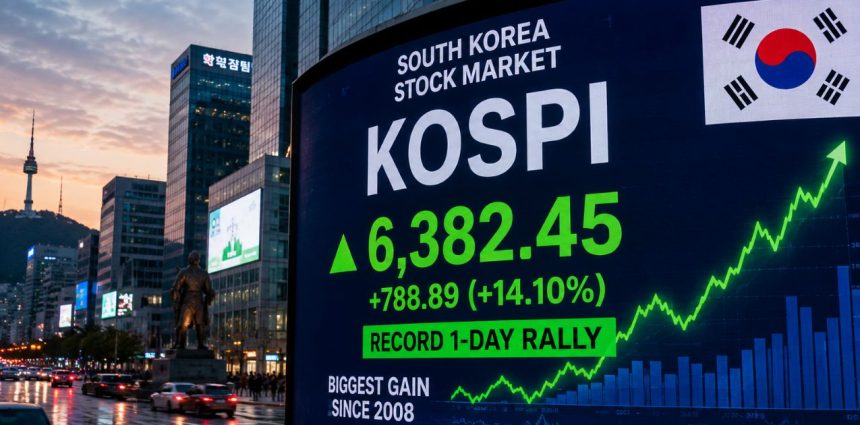
The AI trade wasn’t dead, it was being repriced. In one session, Microsoft, Amazon, Samsung and SK Hynix rewrote a story that started with panic and ended in the record books.
Need to Know
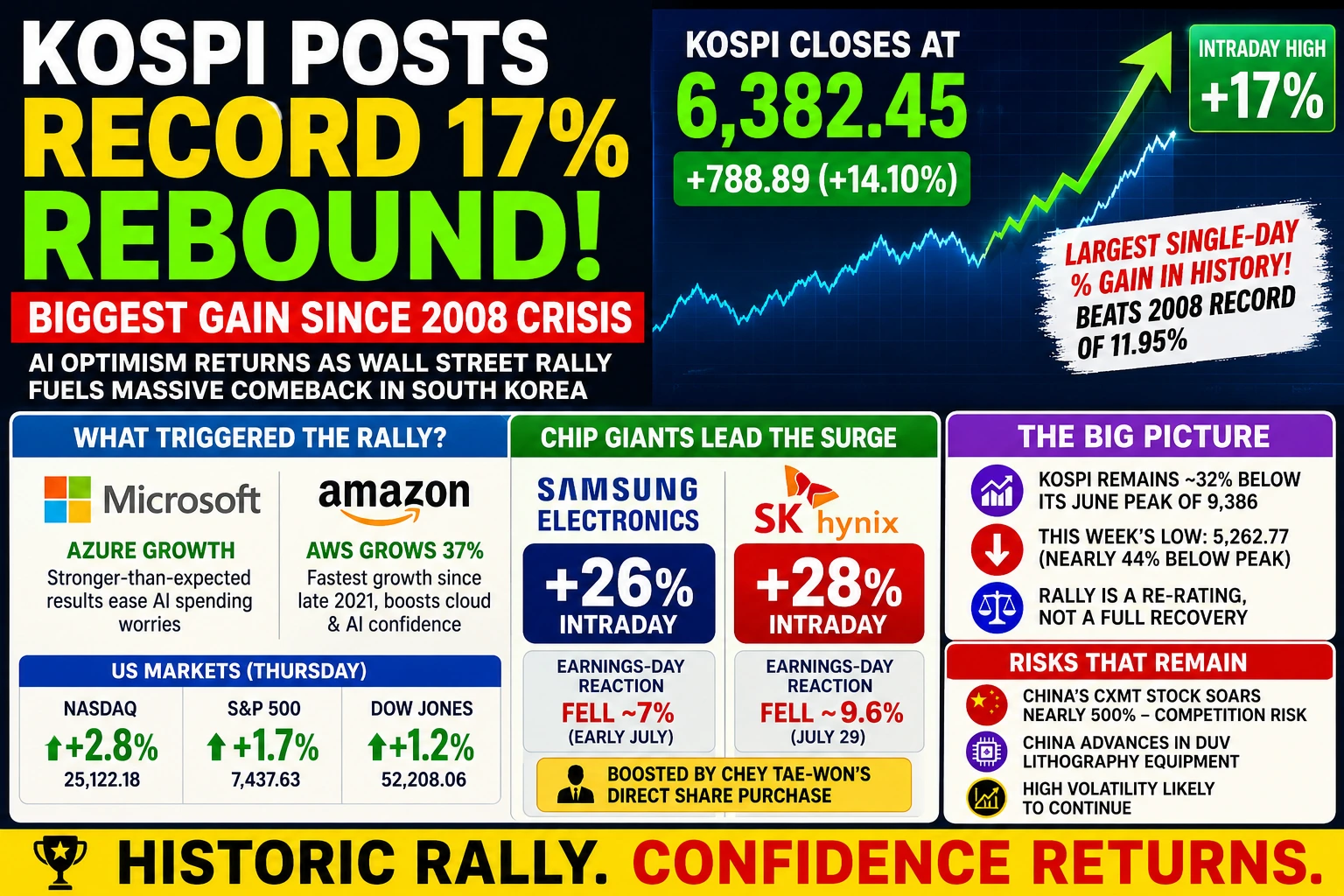
- KOSPI’s 14.10% close Friday is the largest single-day percentage gain in its history, beating the previous record of 11.95% from October 30, 2008
- Samsung surged as much as 26% and SK Hynix as much as 28%, days after both stocks actually fell on their own record-earnings days
- Microsoft’s Azure growth and Amazon’s 37% AWS growth answered the exact question that triggered the original selloff: is AI spending paying off
- KOSPI remains ~32% below its June peak of 9,386, even after the record bounce
- The Korea Exchange triggered its “sidecar” trading halt on both KOSPI and KOSDAQ as the rally accelerated
- China’s CXMT and its near-500% stock debut remain the unresolved long-term threat behind this week’s original crash
For three brutal sessions, South Korea’s stock market looked like proof that the AI trade had finally cracked. Investors dumped semiconductor stocks on fears that Chinese rivals could undercut Samsung Electronics and SK Hynix, wiping out trillions in market value and dragging KOSPI to its lowest levels since June. Then, on Friday, the market delivered the opposite verdict: the AI trade wasn’t dead, it was being repriced. KOSPI’s answer was the loudest kind of reversal on record, the largest single-day percentage gain in KOSPI history, beating a mark that had stood since the depths of the 2008 financial crisis.
Check Live to explore: GIFT NIFTY, NIFTY 50, FII DII DATA |NIFTYTRADER
Why This Matters Today
Friday’s rally suggests investors have regained confidence in the AI theme after a night of strong US tech earnings. But South Korea’s semiconductor sector remains exposed to Chinese competition, elevated valuations, and a market still down nearly a third from its June peak, meaning the volatility that defined this week isn’t over, it’s just paused.
The Record, in Numbers
KOSPI closed up 14.10% at 6,382.45, its first-ever 800-plus-point single-day move, after touching an intraday high near 6,548, a gain of roughly 17%. The Korea Exchange triggered its sidecar mechanism on both KOSPI and the tech-heavy KOSDAQ within minutes of the open, briefly suspending program-buy orders to cool the volatility.
| KOSPI Session Snapshot | Level |
|---|---|
| Thursday’s Close | 5,593.56 |
| Open | 5,657.79 (+1.15%) |
| Intraday High | ~6,548 (+17%) |
| Close | 6,382.45 |
| Change | +788.89 (+14.10%) |
| Record | Largest single-day % gain ever; previous record 11.95% (Oct 30, 2008) |
Why It Happened: The Repricing Started in New York
The repricing began in New York, not Seoul. Thursday’s US session saw tech stocks lead a rebound after the Fed held rates steady, with Microsoft’s stronger-than-expected Azure growth easing worries about AI spending payoffs, and Amazon’s AWS unit growing 37% year-on-year, its fastest pace since late 2021. Those results answered the exact question that had triggered KOSPI’s selloff in the first place: is AI capital spending translating into real revenue.
| US Markets (Thursday) | Move |
|---|---|
| Nasdaq Composite | +2.8% to 25,122.18 |
| S&P 500 | +1.7% to 7,437.63 |
| Dow Jones | +1.2% (+613.92 pts) to 52,208.06 |
Why Samsung and SK Hynix Became the Market’s Biggest Signal
Nowhere was that repricing clearer than inside Samsung and SK Hynix’s own earnings. SK Hynix reported record Q2 2026 results on July 29, revenue of 79.3 trillion won, operating profit of 60.5 trillion won, up 557% year-on-year, yet the stock fell nearly 9.6% that day on a narrow miss versus elevated estimates.
Samsung had the same experience earlier in July, falling nearly 7% despite an all-time-high operating profit of 89.5 trillion won on booming AI memory demand. Both were sell-the-news reactions to numbers already priced in.
Friday flipped the script: SK Hynix surged as much as 28% intraday, helped by a rare direct share purchase from SK Group Chairman Chey Tae-won, while Samsung climbed as much as 26%. This time it wasn’t about the earnings, it was the story around them regaining credibility.
| Company | Q2 2026 Results | Earnings-Day Reaction | Friday’s Rally |
|---|---|---|---|
| Samsung Electronics | Record operating profit ₩89.5T (~$58–62B) | Fell ~7% (early July) | +26% |
| SK Hynix | Record operating profit ₩60.5T, +557% YoY | Fell ~9.6% (July 29) | +28%, boosted by Chey Tae-won’s share purchase |
The Risks That Haven’t Gone Anywhere
That distinction matters for reading this rally correctly: KOSPI’s rebound is a re-rating of conviction in the AI story, not a reversal of the week’s underlying facts. At its lowest point, KOSPI touched 5,262.77 — nearly 44% below its June peak of 9,386, and even after Friday’s record bounce, KOSPI remains roughly 32% below that high.
The original trigger hasn’t gone anywhere either: China’s ChangXin Memory Technologies made a blockbuster stock debut, shares soaring nearly 500%, while reports emerged that a Chinese state-backed firm has begun producing immersion DUV lithography equipment.
A Seoul-based analyst at Mirae Asset Securities told Reuters the bigger worry isn’t CXMT’s current earnings but its potential to scale capacity and challenge Korean players after its listing.
South Korea’s finance ministry has acknowledged that growing concentration in the semiconductor sector is amplifying KOSPI’s volatility. New cash-deposit rules for leveraged ETF investors took effect the same day as Friday’s rally, and analysts cited by CNBC said the timing likely added to the short-covering that amplified the gains.
What It Means for Indian and Global Investors
South Korea is home to two of the world’s largest memory-chip makers, and sharp KOSPI moves in Samsung or SK Hynix ripple into global semiconductor sentiment, including India’s IT and tech-adjacent counters. Track live FII-DII activity on NiftyTrader’s dashboard for how domestic flows are responding to this KOSPI swing.
NiftyTrader Desk View: What’s Next
The bigger story isn’t that KOSPI bounced, it’s that one night of US earnings flipped KOSPI’s read on an entire sector in 24 hours. That tells you sentiment, not fundamentals, is still doing most of the driving. With KOSPI a third below its June high and both chipmakers having sold off on their own numbers days earlier, the next test isn’t whether Friday’s gain holds, it’s whether Nvidia and other Big Tech earnings keep validating the repricing, or send it the other way.
Read Next: Stocks to Watch July 31: Maruti, Sun Pharma, ITC, Vedanta, RIL in Focus as Q1 Earnings Peak
FAQs
Is Friday’s KOSPI rally a record?
Yes, its 14.10% close is the largest single-day percentage gain in KOSPI history, beating the prior record of 11.95% set on October 30, 2008.
Did Samsung and SK Hynix stocks rise after their earnings?
Not immediately. Both fell on their earnings days despite record profits (SK Hynix -9.6%, Samsung -7%). Friday’s surge was a separate, Wall Street-driven rally two to four days later.
Has KOSPI fully recovered this week’s losses?
No. Despite the record bounce, KOSPI remains about 32% below its June peak of 9,386, and the week’s low of 5,262.77 was nearly 44% below that peak.