
Key Takeaways
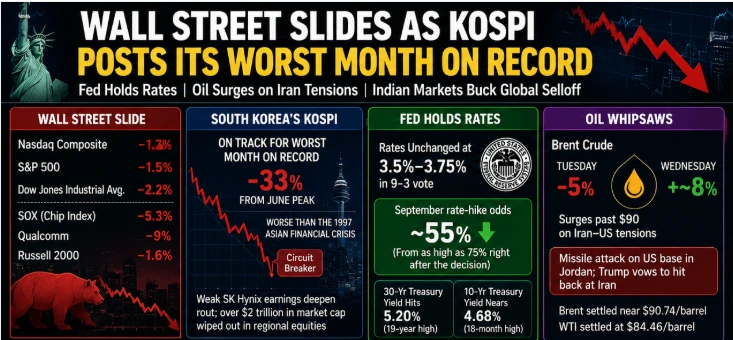
- Wall Street tumbled Wednesday: Nasdaq fell 1.7% into correction territory, Dow shed ~2.2%, S&P 500 lost 1.5%, with chip stocks leading (SOX -5.3%, Qualcomm -9%)
- South Korea’s Kospi is on track for its worst month on record, down roughly a third from its June peak, worse than the 1997 Asian financial crisis, after weak SK Hynix earnings deepened the rout
- Fed holds rates at 3.5%–3.75% in a 9-3 vote; September rate-hike odds eased to ~55% from as high as 75% right after the decision, even as 30-year Treasury yields hit a 19-year high above 5.2%
- Brent crude swung from a 5% drop Tuesday to a near-8% surge past $90 on Wednesday after a missile attack on a US base in Jordan and Trump’s vow to hit back at Iran
- Sensex, Nifty and Nifty IT bucked the global selloff, closing higher Wednesday as FIIs turned net buyers of ₹2,982 crore
Wall Street Slides as Kospi Posts Its Worst Month on Record
Global markets went into risk-off mode on Wednesday as Wall Street logged its worst session in weeks, South Korea’s Kospi headed for its steepest monthly fall on record, and oil whipsawed on fresh Iran-US tensions, even as a divided Federal Reserve held interest rates steady. India was the outlier once again: the Sensex and Nifty 50 extended their rally and Nifty IT decoupled sharply from the global chip-led rout.
Wall Street sold off broadly, with the Nasdaq Composite tumbling 1.7% to a fresh three-month low and slipping into correction territory, the S&P 500 down 1.5% at a one-month low, and the Dow Jones Industrial Average falling roughly 2.2%.
The Philadelphia semiconductor index dropped 5.3% to a three-month low and is now down nearly 30% from its June 22 peak, its worst month since the early 2000s, while Qualcomm slid 9% and the small-cap Russell 2000 fell 1.6% below its 50-day average for the first time since April. Microsoft was a rare gainer, rising as much as 4% after its results, while Meta fell as much as 8%.
The selloff had its roots in South Korea, where the Kospi is on track for its worst month on record, down roughly a third from its June peak and surpassing the decline suffered during the 1997 Asian financial crisis, after chipmaker SK Hynix’s results disappointed and deepened a rout that has already wiped out more than $2 trillion in regional equity value.
The index dived more than 10% on Tuesday alone, triggering a circuit breaker. JPMorgan strategists said deleveraging in the tech and semiconductor space had progressed faster than expected, leaving less room for further unwinding from here.
Fed Holds Rates 9-3 as Rate-Hike Odds Ease to 55%
The Fed held its benchmark rate steady at 3.5%–3.75% on Wednesday in a 9-3 vote, with Cleveland Fed president Beth Hammack, Minneapolis Fed president Neel Kashkari and Dallas Fed president Lorie Logan dissenting in favour of a quarter-point hike.
It was the second policy meeting chaired by Kevin Warsh, who described the internal debate as a healthy one but offered little explicit forward guidance.
Rate futures showed only a 55% probability of a September hike, down sharply from as high as 75% immediately after the decision, while the 30-year Treasury yield jumped to 5.20%, its highest since 2007, and the 10-year approached an 18-month high near 4.68%. T.
Rowe Price economist Blerina Uruci said markets had effectively done the Fed’s tightening work already, while J.P. Morgan’s Kerry Craig flagged that the gap between the Fed’s words and its actions, under a new chair facing a divided committee, could complicate market pricing ahead.
Oil Whipsaws on Iran Tensions, Eases Below $90
Brent and WTI both fell more than 4% on Tuesday as an Omani proposal to manage the Strait of Hormuz raised hopes of easing Gulf tensions, but crude reversed hard on Wednesday after a missile attack on a US base in Jordan and drone strikes on Saudi oil facilities, with President Trump vowing a strong response against Iran.
Brent settled up nearly 8% near $90.74 a barrel and WTI rose 6.6% to $84.46. US and Saudi forces then struck Iran-backed weapons and logistics sites in eastern Iraq. Brent eased back below $90 in Thursday’s Asian trade, even as tankers kept moving through the region.
Nifty IT Bucks the Rout as Sensex, Nifty Extend Gains
Indian markets moved the other way entirely. The Sensex climbed 888.68 points, or 1.16%, to 77,654.60, while the Nifty 50 added 264.85 points, or 1.10%, to close at 24,250.20 on Wednesday.
Nifty IT surged 2.32%, decoupling from the global chip selloff, led by a 4.51% rally in Infosys after its Q1 FY27 commentary.
Bank Nifty added 0.79% to 57,205.90, and India VIX fell 8% to 11.56. FIIs turned net buyers of ₹2,981.87 crore in the cash segment, while DIIs added a further ₹998.02 crore, provisional exchange data showed.
Check Live: NIFTY50, SENSEX, NIFTY IT, FII DII DATA, INDIA VIX
NiftyTrader Desk View
| Stock/Index | Key Technical Trigger | Trader View |
|---|---|---|
| Nifty 50 | Holding above Wednesday’s gap zone of 24,041–24,136 | Sustained strength above this range keeps the path open toward 24,370 |
| Bank Nifty | HDFC Bank reclaiming the ₹750–755 zone with volume | The index-heavy stock’s move will likely set the sector’s near-term direction |
| Nifty IT | Infosys sustaining gains despite SOX-led global chip weakness | Follow-through volumes needed to confirm the sector’s decoupling from Wall Street’s tech rout |
Source: NSE, Bajaj Broking Research
Track live institutional flows on the NiftyTrader FII-DII Tracker.
Microsoft Beats, Meta’s Cash Flow Craters, Samsung Tops Estimates
Microsoft’s Azure cloud revenue grew 43% on a constant-currency basis, comfortably beating its own guidance, and the company guided higher for fiscal Q1 revenue and 2027 capital spending, sending shares sharply higher after hours.
Meta’s revenue beat estimates at $60.8 billion, but free cash flow collapsed 91% to $784 million from $8.55 billion a year earlier, and the company guided slightly lower on Q3 revenue while raising the floor of its 2026 capex range; its shares fell in after-hours trade.
Samsung Electronics, reporting after Wednesday’s close, topped Q2 profit estimates with a record 89.4 trillion won (about $61 billion), a 19-fold jump from a year earlier, even as revenue fell short of forecasts.
What’s Next
Markets now turn to the Bank of England’s rate decision on Thursday, where a hold at 3.75% in a 7-2 vote is widely expected, alongside the US Q2 GDP advance estimate and earnings from Apple and Amazon.
Bottom Line
A divided Fed, an oil-price whipsaw and the worst month on record for South Korean equities have left global markets on edge, but Indian equities, led by IT and banking, have so far held their ground. With the Fed offering no clear signal before September and Middle East tensions still live, near-term direction is likely to hinge on how the AI capex story and the Gulf standoff evolve from here.
This article is for informational purposes only and does not constitute investment advice. Please consult a SEBI-registered financial advisor before making any investment decisions.