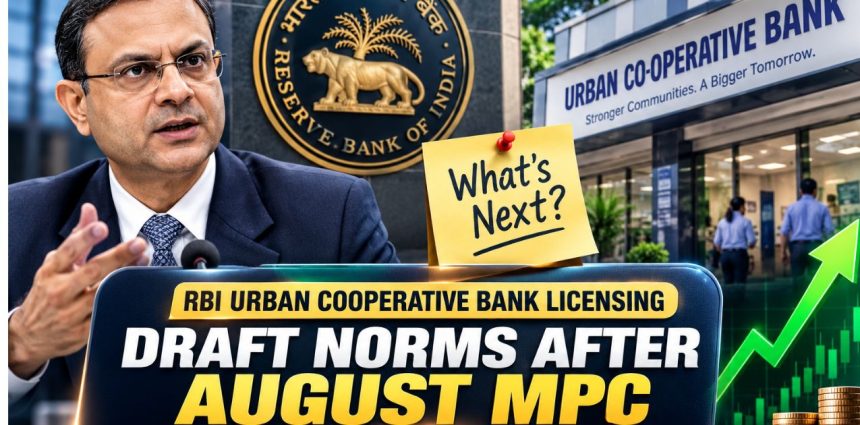
Why Today? While most headlines out of Mumbai on Wednesday focused on the Reserve Bank of India holding the repo rate steady at 5.25% for a third straight review, a quieter line inside the accompanying Statement on Developmental and Regulatory Policies could matter more for India’s cooperative and small-finance banking space. RBI Governor Sanjay Malhotra confirmed the central bank will now move to issue draft guidelines for resuming the licensing of new urban cooperative banks (UCBs), a formal next step after the regulator floated a discussion paper on the subject earlier this year.
RBI’s August MPC: The Headline Numbers
The Monetary Policy Committee, which met from August 3 to August 5, voted to keep the policy repo rate unchanged at 5.25%, retaining its “neutral” stance. Malhotra pegged real GDP growth for FY27 at 6.7%, while CPI inflation for the year is projected at 5%.
Tucked into the same statement, the RBI outlined three linked cooperative-banking measures:
- Draft guidelines for resuming UCB licensing, based on public feedback gathered on the regulator’s earlier discussion paper
- A comprehensive review of the credit monitoring framework for rural cooperative banks, unchanged since 2008
- A proposal to harmonise interest-rate frameworks on advances across all RBI-regulated entities
Also Read: RBI Rate Pause Likely This Week — Here’s What It Means for Your Home Loan EMI
The Backstory: What January’s Discussion Paper Proposed
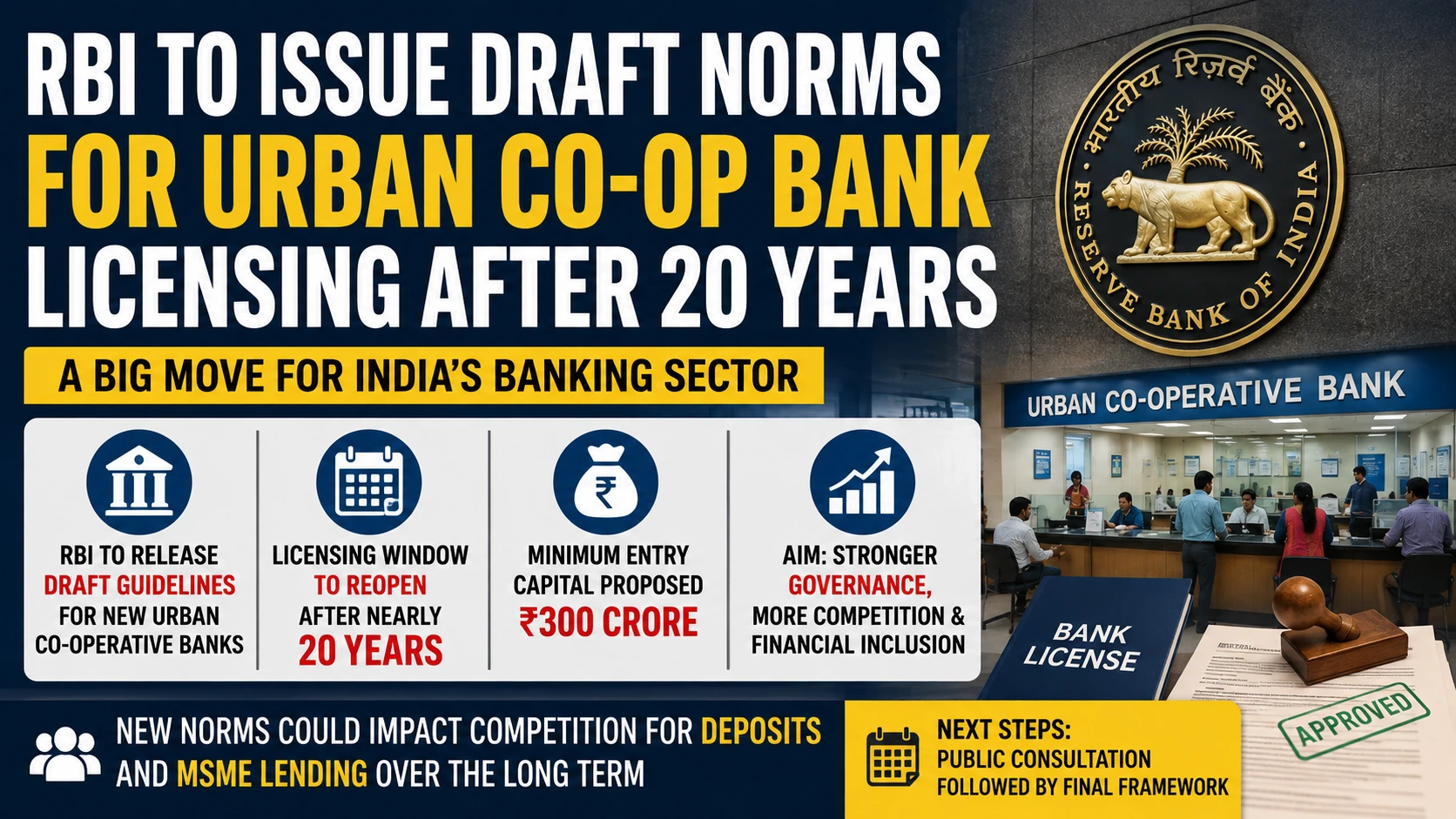
This isn’t RBI’s first move on the subject. In January 2026, the central bank floated a discussion paper to reopen the UCB licensing window after a freeze of roughly 22 years, a pause first imposed in 2004 following a wave of failures among newly licensed small cooperative banks.
Wednesday’s announcement did not restate specific thresholds. But here’s what the original discussion paper proposed, which gives a sense of the bar new entrants may need to clear once formal draft guidelines are out:
| Aspect | During The Pause (2004–2025) | Proposed Framework (Jan 2026 Discussion Paper) |
|---|---|---|
| New licences | Not issued | Reopened, via conversion route |
| Entry route | Window closed | Conversion of large, well-run cooperative credit societies |
| Minimum entry-point capital | Not applicable | ₹300 crore |
| Capital Adequacy Ratio (CAR) | Varied by tier under existing UCB framework | Not less than 12% |
| Net NPA ceiling | Not applicable to new entrants | Not more than 3% |
| Status as of Aug 5, 2026 | — | RBI to issue formal draft guidelines based on public feedback |
Note: “Proposed” figures are from RBI’s January 2026 discussion paper, not restated in Wednesday’s MPC statement. Final draft norms may differ.
Why This Matters For Markets
Why Investors Should Care Although Urban Cooperative Banks are largely unlisted, a reopened licensing framework could gradually reshape competition in deposit mobilisation, MSME lending and regional banking. Investors tracking small finance banks and regional lenders may want to watch the final norms closely.
The proposal is unlikely to move listed bank stocks immediately, UCBs remain a small slice of India’s banking system, and most aren’t listed at all. Over time, though, stronger, better-capitalised cooperative banks could compete more aggressively for retail deposits and MSME borrowers, particularly in cities where small finance banks (SFBs) have expanded fastest. That’s the channel through which this story eventually reaches listed banking stocks, not an immediate one, but a competitive-landscape shift worth tracking.
| Company | Segment | Relevance To UCB Licensing Move |
|---|---|---|
| AU Small Finance Bank | SFB, transitioning toward universal-bank ambitions | Overlapping urban/semi-urban deposit base |
| Equitas Small Finance Bank | SFB | Overlapping MSME and small-ticket lending footprint |
| Ujjivan Small Finance Bank | SFB | Similar urban/semi-urban depositor segment |
| ESAF Small Finance Bank | SFB | Cooperative-heavy geography overlap (South India) |
| Jana Small Finance Bank | SFB | Urban-focused lending and deposit book |
This is a sector-mapping table for context, not a stock recommendation list.
The logic: a new cohort of well-capitalised UCBs, RBI’s stated preference is conversion of large, financially sound cooperative credit societies rather than ground-up licences, would compete for the same depositor base and MSME/self-employed borrower segment that SFBs currently serve.
What Happens Next
As of Wednesday, RBI has confirmed only that draft guidelines are coming, it has not yet released the actual draft text, a public-comment timeline, or confirmation that the January paper’s proposed thresholds will carry through unchanged. Based on RBI’s usual process for such reforms, the remaining steps look like this:
- Draft guidelines published for public consultation
- Feedback window (typically a few weeks, based on RBI’s past practice)
- Final licensing framework issued
- Applications invited from eligible cooperative credit societies
- RBI evaluates applications and licenses the first new UCBs
RBI has not confirmed a timeline for any of these steps. Treat this as a regulatory-intent signal for now, not a finalised policy.
NiftyTrader Desk View
This is a policy-direction story, not an immediate trading trigger. The near-term market-moving element from Wednesday remains the core MPC outcome, an unchanged repo rate and steady policy stance, rather than the UCB licensing line item, which will take months to move from draft to enforceable norms.
That said, sector watchers tracking small finance banks, cooperative-linked NBFCs, and rural credit plays may want to keep this thread on their radar as the draft guidelines take shape, since the eventual competitive landscape in urban deposit mobilisation could shift once new entrants clear RBI’s bar. This is not investment advice, treat it as a regulatory-tracking cue, not a buy or sell signal.
Read Next: Q1 Results Today: PB Fintech, Biocon, Power Grid Among 130 Stocks in Focus After RBI Verdict
Frequently Asked Questions
What are Urban Cooperative Banks (UCBs)?
Cooperative banks registered under state cooperative laws that accept deposits and lend mainly in urban and semi-urban areas, regulated jointly by RBI and state Registrars of Cooperative Societies.
Why did RBI stop issuing new UCB licences in 2004?
A wave of failures among newly licensed small UCBs raised concerns about capital adequacy and governance, prompting RBI to pause fresh licensing.
Why is RBI reopening licensing now?
RBI’s January 2026 discussion paper cited improved sector-wide capital strength and governance standards as the basis for considering new entrants after more than two decades.
Which banking stocks could be affected?
No listed bank is directly affected today. Small finance banks such as AU, Equitas, Ujjivan, ESAF and Jana operate in overlapping urban and semi-urban segments and could see gradual competitive shifts if new UCBs are eventually licensed.
When will RBI release the draft guidelines?
RBI has not announced a specific date. On August 5, 2026, it confirmed only that draft guidelines are being prepared based on feedback on the January 2026 discussion paper.
What happens after the draft guidelines are published?
Based on RBI’s usual process, the draft will be opened for public consultation, followed by a final licensing framework and then formal applications from eligible cooperative credit societies.
Disclaimer: This article is for informational purposes only and does not constitute investment advice. NiftyTrader does not recommend buying or selling any security based on this content. Investors are advised to consult a SEBI-registered financial advisor before making investment decisions. Stock market investments are subject to market risks.