RBI Rate Pause MPC Meeting Begins: Will Crude Oil and Inflation Keep Repo Rate Unchanged?
The RBI MPC meeting began its three-day deliberations on Monday, putting interest rates, inflation and bond yields back in focus for investors. While expectations largely favour no change in the repo rate, the bigger question for markets is what the Reserve Bank of India signals about the months ahead.
Economists believe the RBI Monetary Policy Committee (MPC) is unlikely to rush into a rate action in August. Instead, policymakers are expected to closely assess domestic inflation, liquidity conditions and economic growth as crude oil prices and global uncertainties complicate the outlook.
For stock and bond market investors, therefore, the policy commentary could matter almost as much as the repo rate decision itself.
Get More Update for Results : Results Calendar — NSE & BSE
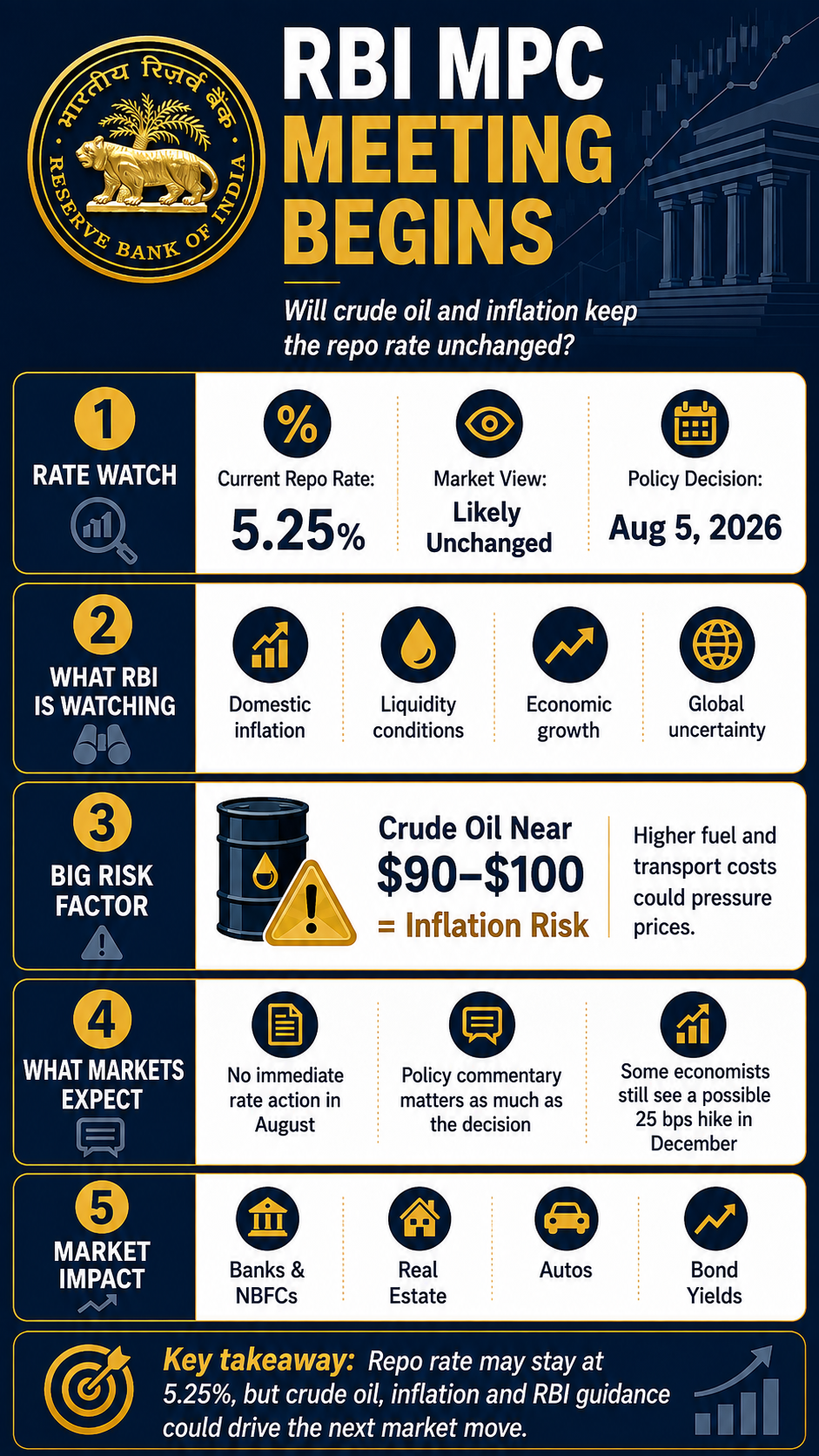
RBI Rate Pause MPC meeting begins as markets expect rates to stay unchanged
The three-day RBI MPC meeting began on Monday, with economists and market participants largely expecting the central bank to maintain the status quo on the benchmark repo rate.
The policy meeting comes at a sensitive time. Inflation risks have started attracting attention again, while higher crude oil prices and global monetary policy uncertainty could influence India’s inflation and liquidity outlook.
Experts, however, believe the RBI is more likely to wait for clearer economic signals before changing interest rates.
RBI Repo Rate in August 2026: What Borrowers Need to Know
The RBI repo rate currently stands at 5.25% as of August 3, 2026. The Reserve Bank of India is widely expected to keep the rate unchanged at its August MPC meeting.
The repo rate, however, is not the interest rate customers directly pay on loans. Home, car, personal and other loan rates are set by individual lenders based on their benchmark, spread, credit risk and borrower profile.
Current RBI Repo Rate and Loan Rates in August 2026
There is only one RBI policy repo rate of 5.25%. Different loan categories do not have separate RBI repo rates.
| Loan Type | RBI Repo Rate | Indicative Loan Rate* |
|---|---|---|
| RBI Policy Repo Rate | 5.25% | Not a retail loan |
| Home Loan | 5.25% | Around 7% onward |
| Car Loan | 5.25% | Around 7.5%–10%+ |
| Personal Loan | 5.25% | Around 10%–15%+ |
| Education Loan | 5.25% | Varies by lender |
| Gold Loan | 5.25% | Varies by lender |
*Indicative lending rates only. Actual rates vary according to the bank, credit score, loan amount, tenure and borrower profile.
Track Live : Nifty Levels Today
Domestic inflation and growth could decide RBI’s next move
Vinay Pai, MD & Head of Fixed Income at Equirus Capital, believes domestic economic conditions will remain at the centre of the RBI’s decision-making.
“The upcoming monetary policy will primarily be guided by domestic inflation, liquidity conditions and economic growth rather than mirroring global monetary policy developments,” Pai said.
That distinction is important for investors. Even if major global central banks maintain a hawkish stance, the RBI may not automatically follow unless India’s inflation-growth balance demands such action.
The central bank’s assessment of liquidity could also influence bond yields and rate-sensitive segments of the equity market.
Read More : Maruti Suzuki July Sales Hit 2,00,123 Units Domestically, Overall Volumes Cross 2.4 Lakh
Why Are Loan Rates Higher Than the 5.25% Repo Rate?
A 5.25% repo rate does not mean borrowers can get loans at 5.25%. Banks add their applicable spread and other pricing components to determine the final lending rate.
Borrowers with stronger credit scores and repayment profiles generally have a better chance of securing lower rates, while unsecured loans such as personal loans typically carry higher interest rates.
Crude oil near $90-$100 could change the rate outlook
Mandar Pitale, Head of Financial Markets at SBM Bank (India) Ltd., said current growth-inflation dynamics suggest risks to growth while inflation remains manageable in the immediate term.
“This coupled with elevated global uncertainties, may result in MPC not considering the ‘rate hike’ option in a hurry during the forthcoming MPC meeting in August,” Pitale said.
However, crude oil remains a major risk.
Pitale said crude prices and monsoon progress will be important monitorables for future RBI policy decisions. A sustained rise in crude oil towards $90-$100 per barrel could intensify inflation risks and strengthen the case for rate hikes later in the fiscal year.
For India, persistently expensive crude can increase input and transportation costs, creating broader inflationary pressure across the economy.
US bond yields add another challenge for Indian markets
Global bond markets are another factor investors cannot ignore.
Pai noted that a hawkish US Federal Reserve has pushed Treasury yields higher, narrowing the yield differential between Indian and US bonds.
While the impact on India’s domestic bond market has remained limited so far, persistently elevated US yields could moderate foreign portfolio flows into Indian debt.
That could create mild upward pressure on Indian government bond yields, making the RBI’s policy commentary particularly relevant for fixed-income investors.
Inflation pressures keep December rate hike possibility alive
Maulik Patel, Head of Research at Equirus Securities, also expects the RBI MPC to leave policy rates unchanged in August.
“We expect the MPC keep policy rates unchanged in the August meeting. We are seeing an uptick in wholesale and retail inflation due to petrol and diesel pump price increases, second order effects, and impact on food due to weather disturbances,” Patel said.
Equirus Securities expects a 25-basis-point rate hike in the December policy review, suggesting that an unchanged August repo rate should not automatically be interpreted as the end of monetary tightening risks.
Here’s what happened today and why traders reacted
The RBI MPC meeting has brought monetary policy expectations back into focus, but the current consensus does not point toward an immediate rate hike.
Instead, traders are watching three major variables: inflation, crude oil and the RBI’s assessment of economic growth.
Higher crude prices following the Iran conflict have increased concerns about imported inflation. At the same time, movements in food prices due to weather disturbances could influence the inflation trajectory.
This means traders may pay particularly close attention to the RBI’s language on inflation risks and future policy flexibility rather than simply the headline repo rate decision.
RBI Repo Rate History
| Effective Date | Repo Rate | Change |
|---|---|---|
| August 2026 (Current) | 5.25% | Unchanged so far |
| December 5, 2025 | 5.25% | ↓ 25 bps |
| June 6, 2025 | 5.50% | ↓ 50 bps |
| April 9, 2025 | 6.00% | ↓ 25 bps |
| February 7, 2025 | 6.25% | ↓ 25 bps |
| December 2024 | 6.50% | Unchanged |
| February 8, 2023 | 6.50% | ↑ 25 bps |
| December 7, 2022 | 6.25% | ↑ 35 bps |
| September 30, 2022 | 5.90% | ↑ 50 bps |
| August 5, 2022 | 5.40% | ↑ 50 bps |
| June 8, 2022 | 4.90% | ↑ 50 bps |
| May 2022 | 4.40% | ↑ 40 bps |
| May 22, 2020 | 4.00% | ↓ 40 bps |
| March 27, 2020 | 4.40% | ↓ 75 bps |
The RBI reduced the repo rate to 5.25% in December 2025 after cutting rates by a cumulative 125 basis points beginning in February 2025.
Will RBI Change the Repo Rate in August 2026?
Economists broadly expect the RBI to keep the repo rate unchanged at 5.25% in August. Retail inflation rose to 4.38% in June but remains within the RBI’s tolerance band.
The bigger focus will be on what the RBI says about inflation, crude oil prices and future rate hikes. Markets are already pricing the possibility of monetary tightening over the coming year.
For borrowers, any future repo-rate increase could eventually make some floating-rate loans more expensive, depending on the loan’s benchmark and reset mechanism.
Bottom line: The RBI repo rate is currently 5.25%, but this should not be confused with the interest rate borrowers actually pay on home, car, personal or other loans. The RBI’s next policy announcement is scheduled for August 5, 2026.
What could the RBI policy mean for investors?
For equity investors, an unchanged repo rate could provide near-term stability to interest-rate-sensitive sectors. Banks, NBFCs, real estate and automobiles may remain particularly sensitive to any change in the RBI’s inflation and rate outlook.
Bond investors should watch the RBI’s inflation assessment, liquidity commentary and signals on future rates, especially as US Treasury yields remain elevated.
Crude-sensitive businesses could face a different challenge. If oil remains elevated for an extended period, companies exposed to higher fuel, transportation or raw-material costs may see pressure on margins.
The monsoon will be equally important because weather-related disruptions can affect food inflation and ultimately influence the RBI’s policy calculations.
For traders, therefore, the key question is no longer simply whether the RBI repo rate remains unchanged. The bigger trigger could be whether the central bank sounds comfortable with inflation—or begins preparing markets for tighter policy later in the year.