SpaceX Natural Gas Trading Team to Fuel Rockets and Power Chip Factory
SpaceX is moving deeper into the energy business as its power and manufacturing ambitions grow.
Elon Musk’s space company is hiring a trader to build and lead a natural gas trading team, signalling that securing fuel and electricity is becoming an increasingly important part of its expansion strategy.
The move could have implications beyond rocket launches. SpaceX is planning gas-fired power plants, pipelines and potentially even natural gas production to support its growing operations.
Track Live : NSE Option Chain — Live
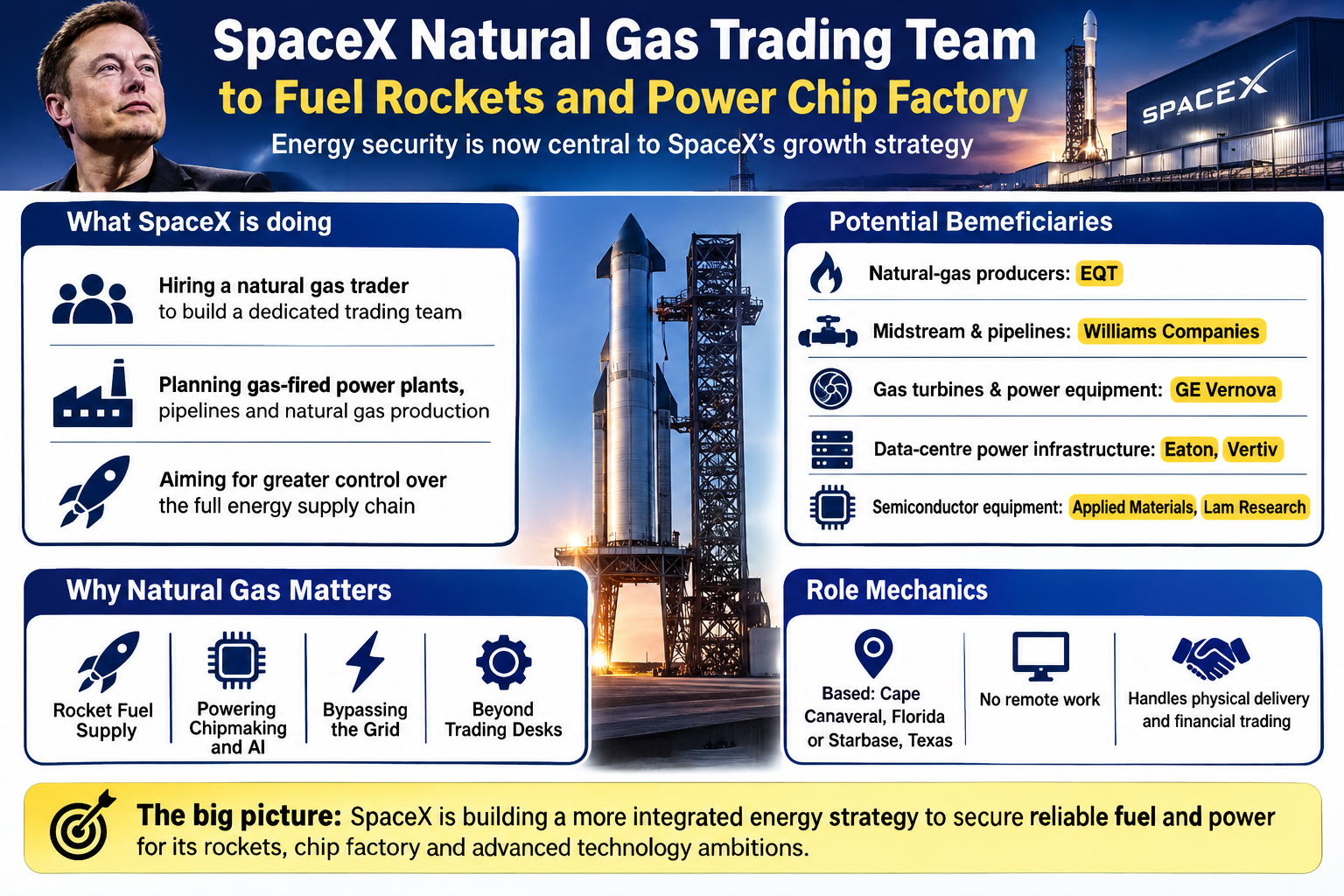
SpaceX Natural Gas is hiring a trader to build its natural gas team
Job postings show SpaceX is looking for a trader whose role will focus on “physical and financial natural gas trading.”
The position will help the company manage its growing natural gas requirements as it expands manufacturing and power infrastructure.
Unlike traditional energy companies, SpaceX is looking to build this capability around its own operations rather than relying entirely on external suppliers.
The role is listed for Cape Canaveral, Florida, or Starbase, Texas, rather than established natural gas trading hubs such as Houston, Calgary or Stamford.
Remote work will not be considered, according to the postings.
SpaceX needs more power for its Texas expansion
SpaceX’s interest in natural gas comes as the company expands its energy-intensive operations in Texas.
Earlier this month, SpaceX said it plans to build its own gas-fired power plants to support the electricity requirements of a massive semiconductor manufacturing facility being developed in Texas with Tesla.
The facility is part of Musk’s broader push into chipmaking and advanced technology infrastructure.
Growing electricity demand from data centres and new factories has already increased interest in natural gas-fired power generation.
For SpaceX, controlling access to that energy could become strategically important as its operations scale.
SpaceX is also planning gas pipelines and drilling
The natural gas trading role is only one part of a much larger energy strategy.
SpaceX President and Chief Operating Officer Gwynne Shotwell told CNBC in June that the company plans to build its own gas pipelines and is even considering drilling for natural gas.
She described the plans as “huge investments to develop our own propellant and bring it to the rocket.”
That points towards a highly vertically integrated model.
Instead of simply buying fuel and electricity from outside suppliers, SpaceX appears to be exploring greater control over the entire energy chain.
Why natural gas matters to SpaceX’s Starship rocket
There is also a direct connection between natural gas and SpaceX’s rocket programme.
The company’s massive Starship rocket uses super-chilled methane as propellant, combined with liquid oxygen.
Methane is the primary component of natural gas.
That means the company’s growing interest in natural gas is not only about powering factories and infrastructure. It could also be connected to securing the fuel needed for future rocket launches.
This makes the SpaceX natural gas strategy particularly significant.
Read More : Gold Surges 35% as Stocks Fall — But Long-Term Data Tells a Different Story
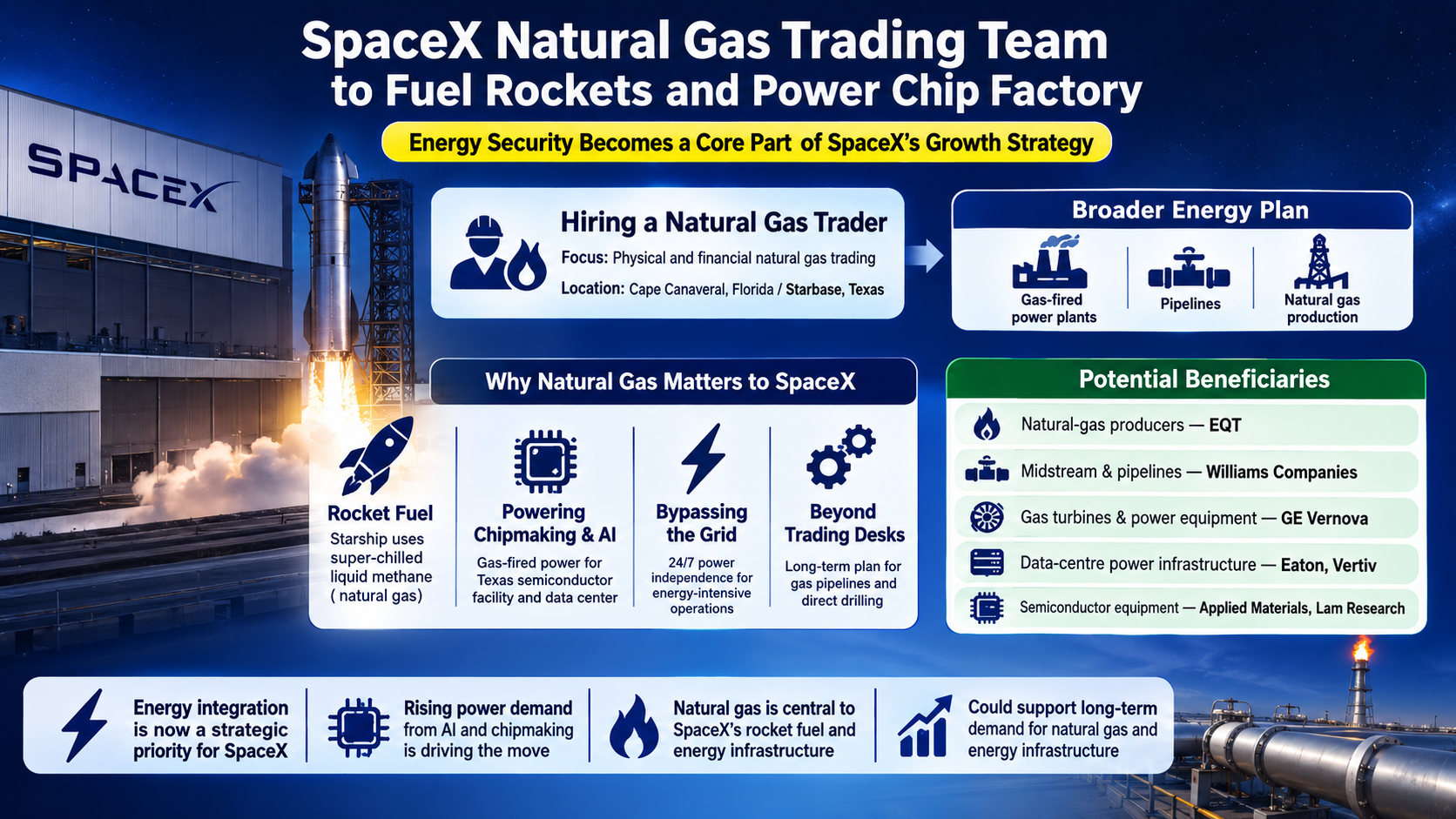
- Rocket Fuel Supply: SpaceX’s Starship rocket runs on super-chilled liquid methane, which is the primary component of natural gas.
- Powering Chipmaking and AI: The company plans to build its own gas-fired power plants in Texas to supply dedicated electricity to a massive semiconductor manufacturing facility and data center project being developed alongside Tesla.
- Bypassing the Grid: Surging energy demand from new factories and artificial intelligence infrastructure has strained traditional power grids. By adopting a vertical integration strategy, SpaceX can secure 24/7 power independently and rapidly.
- Beyond Trading Desks: Leadership notes that the company’s long-term energy strategy even involves building private gas pipelines and exploring direct drilling operations to optimize propellant costs.
SpaceX follows a broader technology-sector energy trend
SpaceX is not the only technology company looking more closely at energy markets.
Other major technology companies, including Meta and OpenAI, have recently indicated plans to enter or explore power trading as their energy requirements increase.
The shift reflects a broader problem facing the technology industry.
Large-scale data centres, semiconductor plants and advanced manufacturing facilities require huge amounts of reliable electricity.
As demand grows, technology companies may increasingly look to secure power directly rather than depend entirely on traditional utilities.
The Broader Tech Trend: Tech Giants as Power Traders
- Meta and OpenAI have actively indicated similar plans to venture into power trading to lock down the vast electricity pools needed for next-generation artificial intelligence arrays.
- By trading physical gas contracts, these companies ensure they have the exact molecule volume delivered to their power plants when needed, while financial trading helps hedge against sudden weather or regulatory spikes
What SpaceX’s energy strategy could mean for investors
SpaceX is private, so investors cannot directly trade its shares on the public market.
However, its growing energy requirements could have implications for listed companies involved in natural gas production, pipelines, power generation and energy infrastructure.
The strategy also highlights the potential long-term demand for natural gas as companies build their own power infrastructure.
For energy investors, the development is another signal that electricity demand from technology, manufacturing and data centres could become an increasingly important driver of natural gas consumption.
Role Mechanics: Not Your Typical Trading Hub
- Non-Traditional Locations: The roles are strictly anchored on-site at Cape Canaveral, Florida, or Starbase, Texas—completely bypassing standard global gas trading hubs like Houston, Calgary, or Stamford.
- Zero Remote Work: Reflecting Musk’s strict corporate operational mandates, the company explicitly rules out remote work for this division.
- Operational Scope: The mandate requires handling physical delivery logistics alongside financial derivatives to keep launch pads, rocket factories, and chip fabrication running non-stop.
Here’s what happened today and why traders reacted
The biggest takeaway is that SpaceX is treating energy as a strategic input rather than simply an operating expense.
By hiring a natural gas trader and exploring its own power plants, pipelines and gas production, the company is moving closer to controlling its energy supply chain.
For the wider energy market, the development highlights how rapidly growing technology and manufacturing companies are becoming major consumers of electricity and natural gas.
The trend could support demand for gas-fired power generation as companies seek reliable electricity for energy-intensive operations.
Why the natural gas move matters beyond SpaceX
SpaceX’s decision to hire a natural gas trader may look like a niche recruitment move.
But it reveals something much larger.
The company is preparing for an environment where rockets, semiconductor manufacturing and advanced technology infrastructure will require enormous amounts of energy.
With plans involving gas-fired power plants, pipelines, natural gas trading and potentially drilling, SpaceX appears to be building an increasingly integrated energy strategy.
The immediate financial impact remains difficult to quantify, and SpaceX did not immediately respond to a request for comment.
But the direction is clear: as SpaceX expands its ambitions, natural gas and energy security are becoming central to the company’s growth strategy.
Stocks and Sectors in Focus
SpaceX’s move into natural-gas trading, pipelines and gas-fired power generation highlights a broader energy-infrastructure theme driven by rising power demand from technology and manufacturing.
Potential beneficiaries:
- Natural-gas producers: EQT
- Midstream & pipelines: Williams Companies
- Gas turbines & power equipment: GE Vernova
- Data-centre power infrastructure: Eaton, Vertiv
- Semiconductor equipment: Applied Materials, Lam Research