
Twenty of India’s biggest consumer-facing companies just pulled off something unusual: together, they earned more dollars than they spent, even as tariff wars and a wobbly global economy pressured trade worldwide.
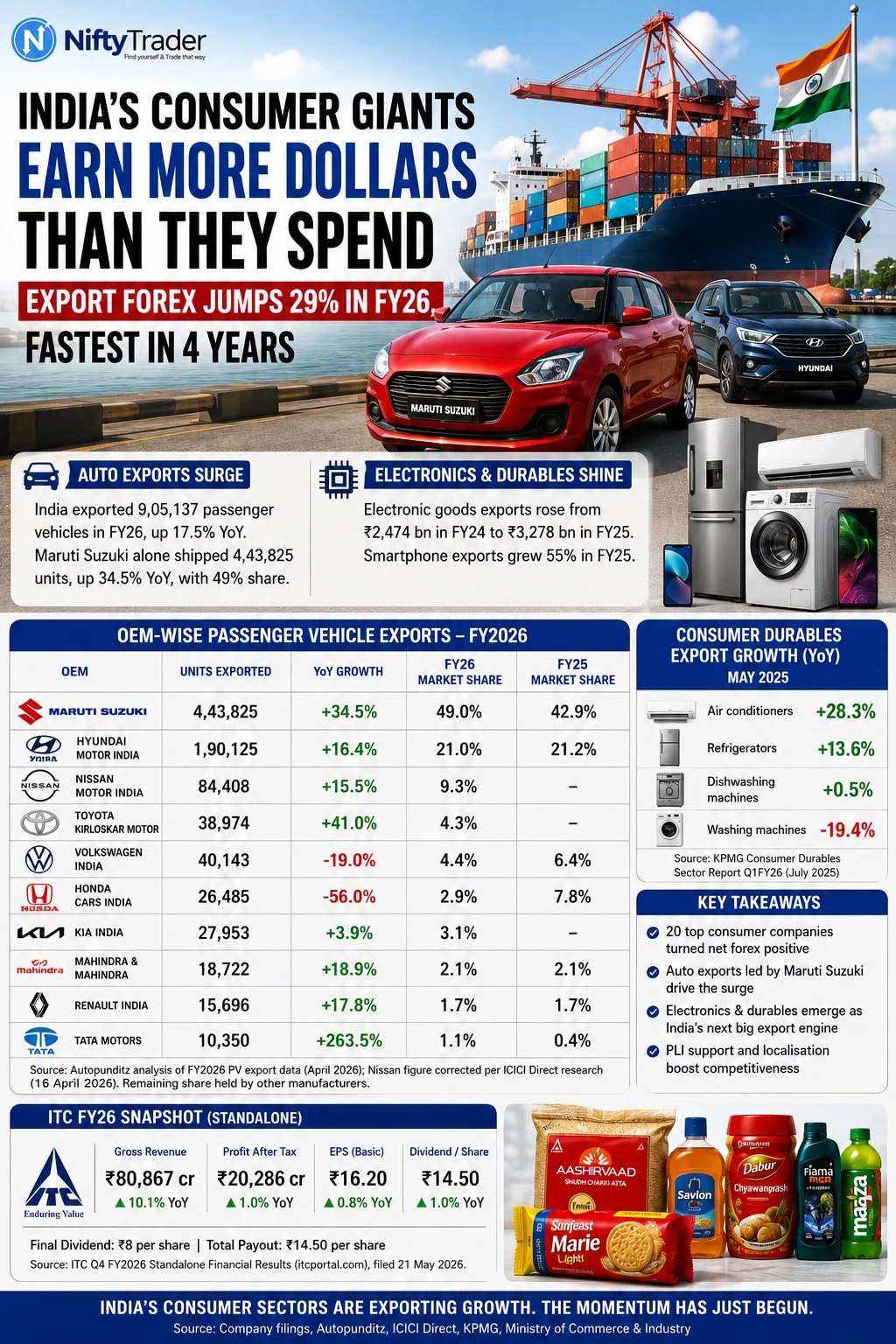
Their combined export forex earnings rose 29% in FY26, the fastest pace in four years, pushing the group into net forex-positive territory despite hefty import bills. Two datasets help explain how: a surge in passenger vehicle exports led by Maruti Suzuki, and a consumer durables and electronics sector that is quietly becoming India’s next big export story.
The Forex Turnaround: What Changed
The 20-company sample includes ITC, Maruti Suzuki, Hyundai, LG Electronics, Dabur, Tata Consumer, United Spirits, Marico and Godrej, among others, covering everyday essentials, vehicles, appliances and spirits.
Their combined export forex earnings growth of 29% this fiscal was the strongest since FY22, when earnings had jumped 55%. Companies largely got there by leaning harder into localisation, sourcing more inputs domestically to blunt rising import costs while pushing overseas volumes higher — a combination that helped protect margins even as global demand stayed uneven.
Check Live: ITC Options Chart | Nifty Trader
Auto Exports: Maruti Suzuki Extends Its Lead
Passenger vehicle exports are one of the clearest drivers behind this turnaround. India shipped out 9,05,137 passenger vehicles in FY2026, up 17.5% from 7,70,296 units in FY2025.
Maruti Suzuki alone exported 4,43,825 units, up 34.5% year-on-year, lifting its share of India’s total PV exports to 49.0% from 42.9% a year earlier, nearly half of every car shipped out of India now wears a Maruti badge, driven largely by demand from Latin America, Africa and neighbouring markets.
Tata Motors posted the sharpest growth in the pack, with overseas shipments surging 263.5% to 10,350 units, though its overall share remains small at 1.1%. On the other side, Honda Cars India saw shipments plunge 56.0% to 26,485 units, cutting its market share from 7.8% to 2.9%.
Also Check: MARUTI SUZUKI INDIA Options Chart | Nifty Trader
OEM-wise Passenger Vehicle Exports, FY2026
| OEM | Units Exported | YoY Growth | FY26 Market Share | FY25 Market Share |
|---|---|---|---|---|
| Maruti Suzuki | 4,43,825 | +34.5% | 49.0% | 42.9% |
| Hyundai Motor India | 1,90,125 | +16.4% | 21.0% | 21.2% |
| Nissan Motor India | 84,408 | +15.5% | 9.3% | — |
| Toyota Kirloskar Motor | 38,974 | +41.0% | 4.3% | — |
| Volkswagen India | 40,143 | -19.0% | 4.4% | 6.4% |
| Honda Cars India | 26,485 | -56.0% | 2.9% | 7.8% |
| Kia India | 27,953 | +3.9% | 3.1% | — |
| Mahindra & Mahindra | 18,722 | +18.9% | 2.1% | 2.1% |
| Renault India | 15,696 | +17.8% | 1.7% | 1.7% |
| Tata Motors | 10,350 | +263.5% | 1.1% | 0.4% |
Source: Autopunditz analysis of FY2026 PV export data (April 2026); Nissan figure corrected per ICICI Direct research (16 April 2026). Remaining share held by other manufacturers.
Consumer Electronics and Durables Add a Second Export Engine
Alongside autos, consumer durables and electronics are emerging as a parallel export growth engine, per KPMG’s Q1FY26 sector report. India’s exports of electronic goods climbed from ₹2,474 billion in FY24 to ₹3,278 billion in FY25, while smartphone exports alone grew 55% in FY25.
Among white goods, export performance was mixed in May 2025: air conditioner shipments rose 28.3% year-on-year and refrigerator shipments grew 13.6%, even as washing machine shipments fell 19.4%.
Consumer Durables Export Growth (YoY, May 2025)
| Product | Export Growth |
|---|---|
| Air conditioners | +28.3% |
| Refrigerators | +13.6% |
| Dishwashing machines | +0.5% |
| Washing machines | -19.4% |
Source: KPMG, “The Indian Consumer Durables Sector – Q1FY26,” citing Ministry of Commerce and Industry trade statistics, July 2025.
KPMG projects India’s refrigerator market to grow at a 9.4% CAGR through FY33 and the AC market at 7.8% CAGR through FY32, with the broader appliance and electronics industry expanding at 7.7% CAGR to FY33.
Electronics exports have compounded at roughly 26% annually between FY16 and FY25, aided by ₹67.7 billion in PLI incentives for white goods (FY22-29). KPMG projects the consumer durables market reaching ₹3 trillion by FY29, with India becoming the world’s fourth-largest market for the category by FY27.
Headwinds: Tariffs, Aluminium and an Early Monsoon
KPMG flags escalating trade and tariff tensions as a source of financial market volatility and a drag on near-term global growth expectations, with aluminium shipments down 8% year-on-year in May 2025 amid international market uncertainty.
Closer to home, an early monsoon dented cooling-appliance demand, with secondary sales of room air conditioners and air coolers potentially declining 20-25% for the quarter, a reminder that even export-facing categories stay exposed to domestic weather swings.
ITC’s FY26 Scorecard: One of the Twenty Companies in Focus
ITC, one of the companies in the forex sample, had its own busy stretch. For FY 2025-26, the company’s standalone gross revenue came in at ₹80,867.49 crore, up 10.1% from ₹73,466.61 crore, while standalone profit after tax (continuing operations) was nearly flat at ₹20,286.42 crore against ₹20,093.29 crore a year earlier. Basic EPS was ₹16.20 versus ₹16.07.
The board recommended a final dividend of ₹8 per share, taking the total payout to ₹14.50 per share, up from ₹14.35 the previous year. ITC’s 115th AGM was held on July 23, 2026.
Separately, ITC has been reported to be planning an 8-10% hike on cigarette pack prices, per an ET Now report cited by ScanX, a domestic pricing move distinct from its export or forex performance.
ITC FY26 Snapshot (Standalone)
| Metric | FY 2025-26 | FY 2024-25 | Change |
|---|---|---|---|
| Gross Revenue | ₹80,867.49 cr | ₹73,466.61 cr | +10.1% |
| Profit After Tax | ₹20,286.42 cr | ₹20,093.29 cr | +1.0% |
| EPS (Basic) | ₹16.20 | ₹16.07 | +0.8% |
| Total Dividend/Share | ₹14.50 | ₹14.35 | +1.0% |
Source: ITC Q4 FY2026 Standalone Financial Results (itcportal.com), filed 21 May 2026.
Key Takeaways
- India’s export forex turnaround is broad-based, spanning FMCG, autos, consumer electronics and liquor across the 20-company sample, not one sector.
- Maruti Suzuki’s export dominance (49% share) makes it the single biggest swing factor in India’s auto export numbers going forward.
- Consumer electronics shipments, up nearly a third in a year, are becoming a genuine second engine alongside autos.
- Tariff tensions, aluminium shipment weakness and weather-linked demand swings remain the key risks to watch through the rest of FY26.
- PLI-driven manufacturing capacity and KPMG’s FY29 market-size projections suggest the durables export story still has runway left.
Read Next: HUL Hits 52-Week Low as 7 Nifty Giants Lose Money in 5 Years
Frequently Asked Questions
Which company leads India’s passenger vehicle exports in FY2026?
Maruti Suzuki leads with 4,43,825 units shipped, a 49.0% share of India’s total PV exports.
Which sectors drove the 29% jump in export forex earnings among India’s consumer giants in FY26?
The gains came from a mix of automobiles, FMCG, consumer electronics and liquor companies, across a 20-company sample.