Need to Know
- Avaada Electro, the Brookfield-backed solar manufacturer, filed an updated DRHP with Sebi on Wednesday for a Rs 7,600-crore IPO, sharply lower than the Rs 9,000-10,000 crore it had planned when it first went the confidential route in October 2025.
- Of the total offer, Rs 6,000 crore (79%) is an offer for sale by promoter Avaada Ventures; only Rs 1,600 crore is a fresh issue, and Rs 1,200 crore of that is earmarked for loan repayment, not expansion.
- Revenue jumped nearly 5x and profit after tax rose over 4x in FY26, though both are growing off a small FY25 base.
- Avaada plans to almost double module capacity to 13.60 GW and quadruple cell capacity to 12 GW by FY28, while entering ingot-and-wafer manufacturing, energy storage, and third-party EPC for the first time.
- The filing lands weeks after the US imposed anti-dumping and countervailing duties totalling roughly 234% on Indian solar exports, a headwind that appears to matter less for Avaada than for export-heavy peers, based on its disclosures so far.
Avaada Electro Ltd, the solar cell and module manufacturing arm of the Brookfield-backed Avaada Group, filed an updated draft red herring prospectus (UDRHP) with the Securities and Exchange Board of India on Wednesday for a proposed Rs 7,600-crore initial public offering. The issue comprises a fresh issue of equity shares worth Rs 1,600 crore and an offer for sale of Rs 6,000 crore by promoter Avaada Ventures Pvt Ltd.
On paper, that is still one of the largest IPOs to come out of India’s solar manufacturing sector. But the more telling number is how much smaller this filing is than what was originally planned, and what that shrinkage, plus the fresh-issue-versus-OFS mix, tells prospective investors.
The IPO Just Got Smaller — And That’s The Real Story
Avaada Electro first filed for this IPO through Sebi’s confidential route in October 2025, when reports pegged the raise at Rs 9,000-10,000 crore and implied a valuation of roughly Rs 1.10-1.30 lakh crore. Sebi cleared the issue in April 2026, giving the company an 18-month window to launch. Two days before Wednesday’s filing, Bloomberg reported Avaada was preparing to publicly file for an IPO of up to $800 million, at current rates of around Rs 95.5 to the dollar, Rs 7,600 crore works out to almost exactly that figure, confirming the size cut rather than a change of plan. The roughly 20-24% reduction from the original range suggests either a more conservative valuation ask in a choppier market for newly listed solar stocks, or a deliberate scaling back of the OFS component, worth flagging before anchoring expectations to the bigger numbers that circulated for nearly a year.
Where The Rs 7,600 Crore Is Actually Going
The split between fresh issue and OFS matters because it determines how much capital actually reaches the company versus how much simply cashes out existing shareholders.
| Component | Amount (Rs crore) | Share of Total Issue |
|---|---|---|
| Fresh Issue | 1,600 | 21% |
| Offer for Sale (Avaada Ventures) | 6,000 | 79% |
| Total Issue Size | 7,600 | 100% |
| — of which, loan/LC repayment | 1,200 | 16% of total issue |
| — of which, general corporate purposes | ~400 | ~5% of total issue |
Only Rs 1,600 crore of the Rs 7,600-crore offer is new capital for Avaada Electro; the rest goes straight to the promoter. Of that fresh issue, Rs 1,200 crore, three-quarters, is earmarked for repaying or prepaying loans and letter-of-credit obligations, leaving a comparatively modest pool of discretionary growth capital even as the company talks up an ambitious capacity roadmap. Not unusual for a promoter-backed issuer monetising a stake, but a distinction worth keeping in mind when weighing the “growth story” pitch.
Check Live: IPO – Latest & Upcoming IPOs List 2026 | Check Live BSE NSE IPOs
Inside The Manufacturing Footprint
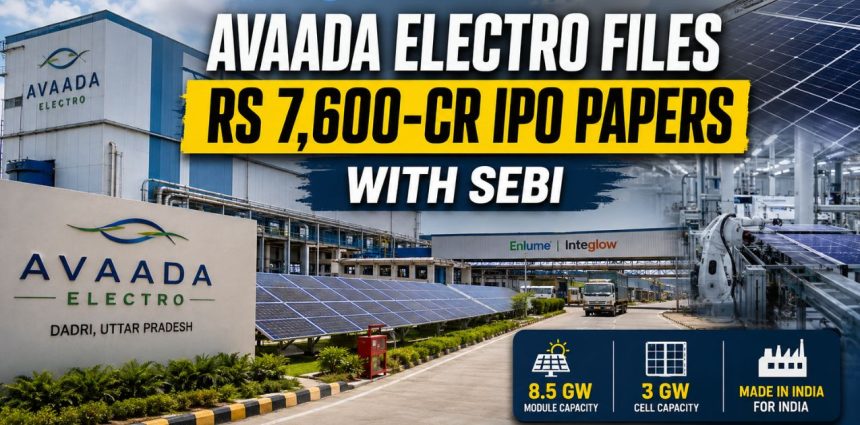
Avaada Electro operates out of Dadri in Uttar Pradesh and the Butibori Super Factory near Nagpur in Maharashtra, making solar modules under the Enlume and Integlow brands. As of July 31, 2026, it had 8.5 GW of operational module capacity and 3 GW of TOPCon cell capacity, both on the government’s Approved List of Models and Manufacturers. Module capacity has grown from 1.5 GW to 8.5 GW in a single year, and the order book has expanded roughly 7.5x, from 2,555 MW to 19,106 MW.
By FY28, the company is targeting 13.60 GW of module capacity, 12 GW of cell capacity, and, notably, 3 GW of ingot-and-wafer capacity, a segment where India remains heavily import-dependent; wafer imports rose 86% year-on-year in the first five months of 2026 as domestic cell-makers scaled up faster than upstream supply. Avaada is also entering energy storage under a new “Avaada Halo” brand and moving into third-party EPC and O&M work.
The Growth Numbers Behind The Pitch
| Metric | FY25 | FY26 | YoY Change |
|---|---|---|---|
| Revenue from Operations | Rs 911.62 cr | Rs 5,303.52 cr | +482% |
| Profit After Tax | Rs 173 cr | Rs 888.74 cr | +414% |
These are striking numbers, but they’re growing off a small base as capacity came online through the year; the more useful test will be whether margins and utilisation hold as capacity roughly doubles again by FY28.
Also Check: Latest IPO GMP Today (Live IPO Grey Market Premium)
How Avaada Would Stack Up Against Listed Solar Peers
India’s two listed solar manufacturers offer a useful reference point, compiled by NiftyTrader Desk from public exchange data. Waaree Energies raised Rs 4,321 crore in its October 2024 IPO at Rs 1,503 a share, listed at a 66-70% premium, and traded around Rs 2,650 as of August 25, 2026 — up roughly 76% over issue price, though down about 15% over the past year after peaking near Rs 3,865. Premier Energies raised Rs 2,830 crore in September 2024 at Rs 450 a share, listed at more than double that price, and traded near Rs 1,053 as of August 21, 2026, up roughly 134% from issue. [INTERNAL LINK: NiftyTrader’s Waaree Energies stock page] Both suggest investor appetite for solar manufacturing IPOs has generally been rewarded, even if not in a straight line.
A Tariff Wall Avaada May Not Need To Worry About As Much
This filing lands against a difficult backdrop for Indian solar exporters. The US Department of Commerce imposed a preliminary anti-dumping duty of around 123% on Indian solar cells and modules in April 2026, which combined with earlier countervailing duties takes the total tariff burden for many Indian manufacturers to roughly 234% — effectively shutting Indian products out of the US market. Waaree Energies, for context, is responding by targeting 50-60% export growth by FY28 through Europe, Australia and New Zealand while building its own US capacity.
Avaada Electro’s disclosures so far lean the other way: its order-book growth and capacity build-out are tied to the Dadri and Nagpur facilities feeding India’s own solar build-out, on track for a record 25-27 GW of annual additions under the ALMM-II domestic-sourcing mandate. That doesn’t make Avaada immune to sector-wide swings, but it suggests comparatively lower direct exposure to the US tariff wall than export-heavy manufacturers — a distinction worth watching for when the RHP is filed.
Part Of A Bigger Renewable IPO Wave
Avaada is not filing in isolation. Brookfield-backed CleanMax Enviro Energy Solutions launched a Rs 3,100-crore IPO in February 2026, the first renewable-energy listing of the year, while Emmvee and Vikram Solar together raised close to Rs 5,000 crore through separate issues, and Hero Future Energies is reportedly planning one worth Rs 3,000-4,000 crore.
That queue of clean-energy paper is itself a signal of how much supply Indian investors are being asked to absorb in this cycle, the backdrop against which Avaada’s trimmed Rs 7,600-crore ask should be read.
What Comes Next
ICICI Securities, Axis Capital, BofA Securities India, HSBC Securities and Capital Markets (India), SBI Capital Markets and IIFL Capital Services are the book-running lead managers. Price band, subscription dates and listing timeline are yet to be announced; Sebi’s April 2026 approval stays valid for 18 months from that date. The RHP, when filed, should clarify the valuation and peer-comparison basis that the confidential route kept under wraps.
Read Next: Cipla Faces FDA Heat, Hindustan Copper OFS Opens: 7 Stocks in Focus
Disclaimer: This article is for informational purposes only and does not constitute investment advice or a recommendation to buy, sell, or hold any security. IPO investments are subject to market risk; readers should read the red herring prospectus and consult a registered investment advisor before making investment decisions.