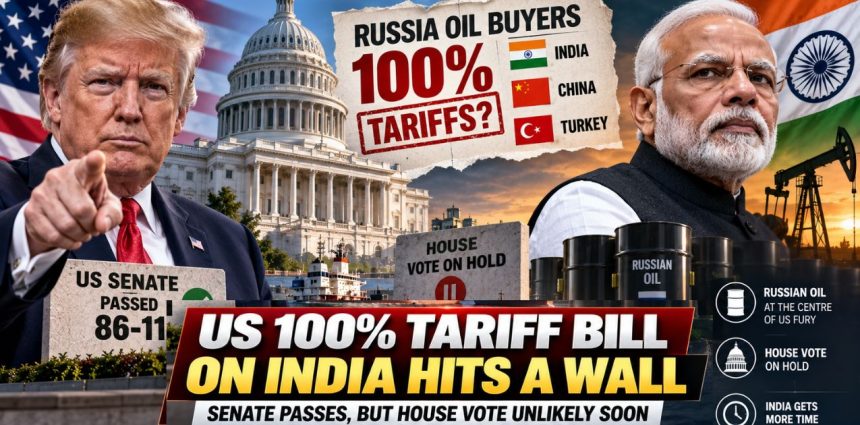
A Senate-passed bill threatening 100% tariffs on India, China, and Turkey for buying Russian oil has hit a wall in the House, buying New Delhi time, but not certainty, as a parallel legal fight reshapes Washington’s tariff playbook.
NEED TO KNOW
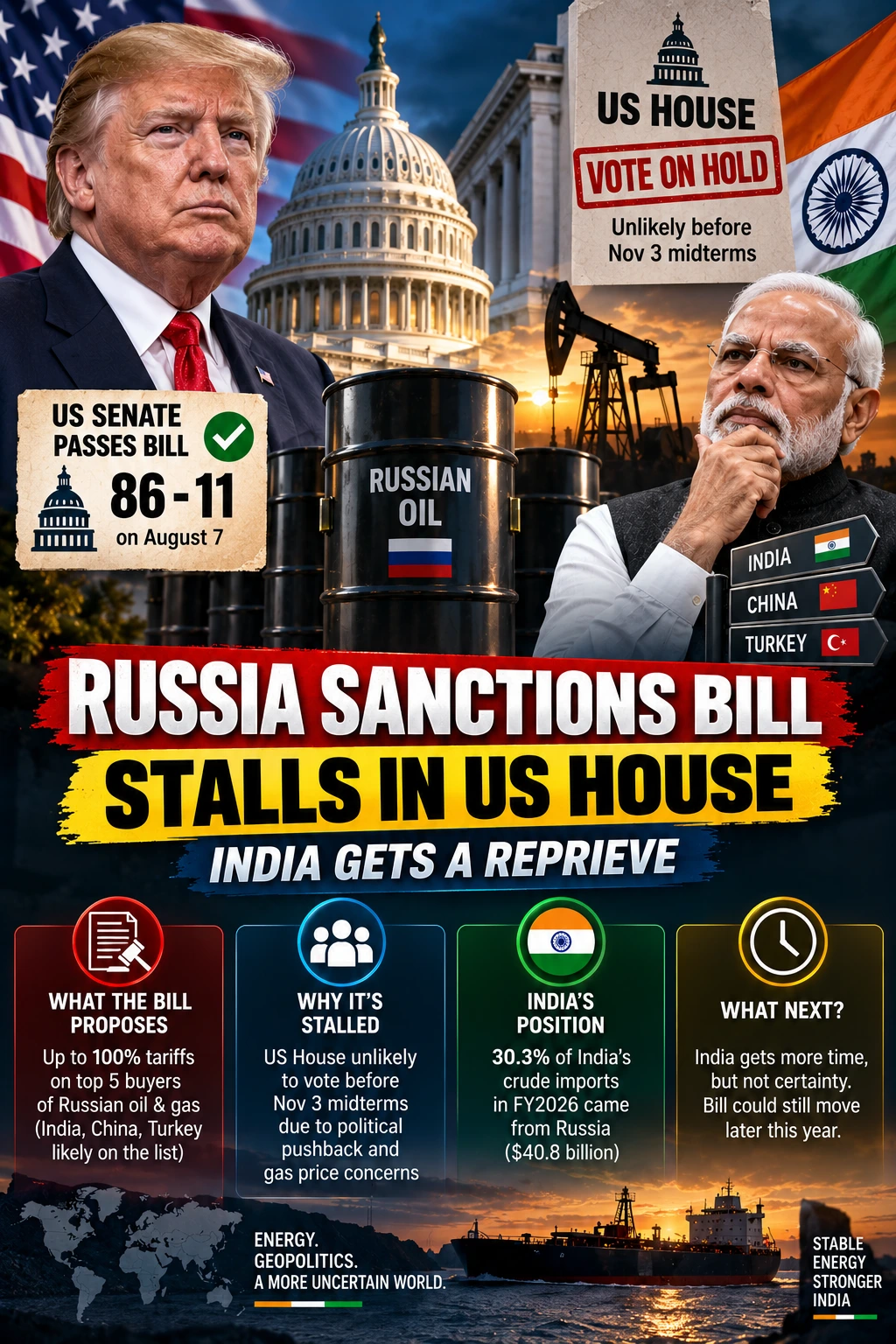
- The Russia sanctions bill named for the late Senator Lindsey Graham passed the Senate 86-11 on August 7 but remains stuck as the House returns from recess.
- It would let Trump impose tariffs up to 100% on the five biggest buyers of Russian oil and gas; India, China, and Turkey are expected to top that list, plus a flat 500% tariff on Russian-origin goods.
- Speaker Mike Johnson says a House vote before the November 3 midterms is unlikely, citing Democratic and Republican pushback over gas prices and expanding tariff powers.
- India sourced 30.3% of its FY2026 crude imports ($40.8 billion) from Russia, per GTRI, even after a February 2026 trade deal tied lower US tariffs to curbing those purchases; Jaishankar told Ukraine’s foreign minister in Kyiv this week that India’s energy security won’t bend to a buy-or-don’t-buy ultimatum.
- A February Supreme Court ruling gutting Trump’s emergency-powers tariffs is why this bill, not another executive order, is Washington’s cleanest legal route to a Russia-oil tariff.
For the second time in three years, Washington has built a tariff weapon aimed squarely at India’s Russian oil habit, and for the second time, it is stuck in traffic. The Russia sanctions bill that cleared the Senate 86-11 on August 7 was meant to be Congress’s parting gift to its author, the South Carolina senator who died in July, days after his own trip to Kyiv.
Instead, it has run into a House far less sentimental about handing President Donald Trump fresh tariff authority and far more worried about what a trade fight with India, China, and Turkey over cheap Russian barrels could do to gas prices five weeks before the midterms.
Also Read: Russia Sanctions Bill Clears US Senate: India Faces 100% Tariff Risk
What The Bill Actually Threatens
Stripped of its politics, the bill is a tariff mechanism wearing a sanctions label: discretionary power for the President to impose tariffs up to 100% on the top five importers of Russian crude and gas over the preceding 12 months, plus the top five countries helping Moscow evade existing sanctions. A separate clause orders a flat 500% tariff on goods originating in Russia itself.
The target list isn’t named in the bill; the USTR recalculates it every six months, but the likely candidates are no mystery. China and India have consistently ranked as the two largest buyers of Russian crude, per the Centre for Research on Energy and Clean Air, while Turkey, Hungary, Slovakia, and Azerbaijan round out the usual suspects.
Gas importers get an exit ramp: countries sourcing under 15% of their gas from Russia, or actively cutting that share, can claim exemption.
The bill also folds in the Shadow Fleet Sanctions Act targeting tankers that move sanctioned crude around the price cap, plus fresh sanctions on Vladimir Putin, Kremlin officials, and Russian banks.
KEY PROVISIONS AT A GLANCE
| Provision | Detail |
|---|---|
| Secondary tariff | Up to 100% on top 5 Russian oil/gas buyers |
| Evasion tariff | Up to 100% on top 5 sanctions-evasion facilitators |
| Direct tariff | Flat 500% on Russian-origin imports |
| Gas exemption | Under 15% Russia-sourced gas, and reducing further |
| Target list | Recalculated by USTR every 6 months |
| Senate vote | Passed 86-11 on August 7, 2026 |
Why The House Won’t Move
The Senate’s 86-11 margin flattered the bill’s chances; much of it was tribute to Graham, who died of a suspected aortic tear a day after sealing a White House-backed deal with Senator Richard Blumenthal.
The House, a tougher room, is unlikely to vote before November 3, Speaker Johnson said this week, given how few working days remain before Americans vote.
He cited opposition from the top Democrats on the Foreign Affairs and Ways and Means committees, plus scattered Republican resistance.
Foreign Affairs Chairman Brian Mast has raised a sharper worry: pushing India and other buyers out of the Russian crude market could send gasoline prices higher at home, a politically awkward outcome weeks before an election.
Retailers and the US Chamber of Commerce have lobbied hard too, wary the tariff language sets a template for future trade fights. Nebraska Republican Don Bacon has called the delay misplaced, given the lopsided Senate vote.
India’s Russian Oil Math
Russia supplied 30.3% of India’s crude imports in FY2026, worth $40.8 billion of a $134.7 billion total bill, per GTRI, up sharply from under 1% before the war, when steep post-2022 discounts drew Indian refiners in.
That discount is shrinking fast: Reuters has reported the Urals-Brent gap narrowed to roughly $2.50 a barrel, down from $20-25 when the war began, squeezing the economics that made the tariff risk worthwhile.
Volumes have followed: Kpler data cited by Axios put India’s Russian oil intake near 1.2 million barrels a day earlier this year, down from close to 2 million in mid-2025. Reliance Industries and Rosneft-backed Nayara Energy account for most of these purchases; state refiners are far less exposed since they typically buy through intermediaries.
INDIA’S RUSSIA OIL EXPOSURE
| Metric | Figure |
|---|---|
| Share of FY26 crude imports from Russia | 30.3% |
| Value of Russian crude imports, FY26 | $40.8 billion |
| Pre-war Russian share of crude basket | Under 1% |
| Urals-Brent discount, then vs now | $20-25/bbl vs about $2.50/bbl |
| Daily Russian oil intake, mid-2025 vs now | About 2 mbd vs about 1.2 mbd |
The Twist: Trump’s Cleanest Tariff Weapon
Here’s the part easy to miss: a congressional Russia sanctions bill matters because Trump’s usual tariff tool just got taken away by the courts.
In February 2026, days after Trump and PM Modi unveiled a deal cutting US tariffs on Indian goods from 50% to 18%, tied explicitly to India curbing Russian oil purchases, the Supreme Court ruled the emergency-powers law behind Trump’s “reciprocal tariffs” unconstitutional, stripping him of the freewheeling executive-order authority he had used to threaten tariffs unilaterally.
A statute Congress passes carries no such vulnerability; if this bill becomes law, Trump gains tariff power explicitly authorised by Congress, far harder to challenge in court than the tariffs just struck down, the real reason this bill outranks an average sanctions push.
It also makes India’s FY26 numbers awkward. New Delhi’s February pledge to wind down Russian purchases came with tariff relief attached; GTRI’s 30.3% figure suggests that wind-down has, at best, been gradual, and Jaishankar’s comments this week in Kyiv read less like a new position than a line New Delhi never fully walked back.
What It Means For Indian Markets
For Indian equities, this is a headline risk, not an active one, for now. Reliance Industries, among the largest single buyers of Russian crude, has shown how sensitive the stock is to sanctions chatter: shares fell over 4% in a single January session after a later-denied report tied Russian cargoes to its Jamnagar refinery, compounding profit-booking after a record high.
Nayara Energy, half-owned by Rosneft, carries even more direct exposure. The scale has a precedent: when Washington sanctioned Rosneft and Lukoil directly in October 2025, a narrower step than this bill’s economy-wide tariff, analysts estimated the fallout at an extra $2.7 billion, or about ₹23,490 crore, on India’s annual oil import bill.
A full 100% regime would dwarf that, rippling through refining margins, the rupee and FII positioning in energy and PSU stocks well before any tariff takes effect.
What Happens Next
For now, the calendar favours India. The House has only a few working days scheduled before the midterms, and Johnson has offered no timeline beyond conceding that talks with Democratic leaders continue.
Blumenthal insists the bill will eventually pass with Trump’s backing, and Ukraine’s President Volodymyr Zelenskyy has offered to lobby House members directly.
But the bill is dormant, not dead: the USTR’s twice-yearly recalculation of the “top five” list keeps India’s exposure on a rolling clock even without a vote. A ceasefire breakthrough, a shift in Trump’s posture toward Putin, or a fresh US-India trade flashpoint could revive the bill well before November 3.
Read Next: Jio IPO Is Finally Closing In: India’s Biggest-Ever Share Sale Could Arrive This Festive Season
Frequently Asked Questions
What is the Russia sanctions bill and how does it affect India?
Senate-passed legislation letting Trump impose tariffs up to 100% on the top five buyers of Russian oil and gas, a list India is expected to top, plus a flat 500% tariff on Russian goods.
Why has the Russia sanctions bill stalled in the US House?
Speaker Johnson cites too little legislative time before the midterms, plus opposition from top Democrats on key committees and Republicans worried about gas prices and expanding tariff powers.
How exposed is India to Russian oil right now?
Russia supplied 30.3% of India’s crude imports in FY2026, worth $40.8 billion, per GTRI, even after a February 2026 trade deal linked lower US tariffs to cutting those purchases.
Will the 100% tariff definitely hit India if the bill passes?
Not automatically. The President retains discretion over enforcement, and the USTR recalculates the target list every six months based on trade data.
What should Indian markets track next?
Any House floor schedule announcement, shifts in Trump-Putin diplomacy, and India’s own Russian oil import volumes, since all three move the odds of enforcement.