
Brent Crude at $100: Analysts Warn of Inflation Risk as Middle East War Widens
Brent crude oil has crossed the $100-a-barrel mark for the first time since July 24, putting global investors on alert as intensifying conflict in the Middle East raises fresh concerns over oil supplies, inflation and interest rates.
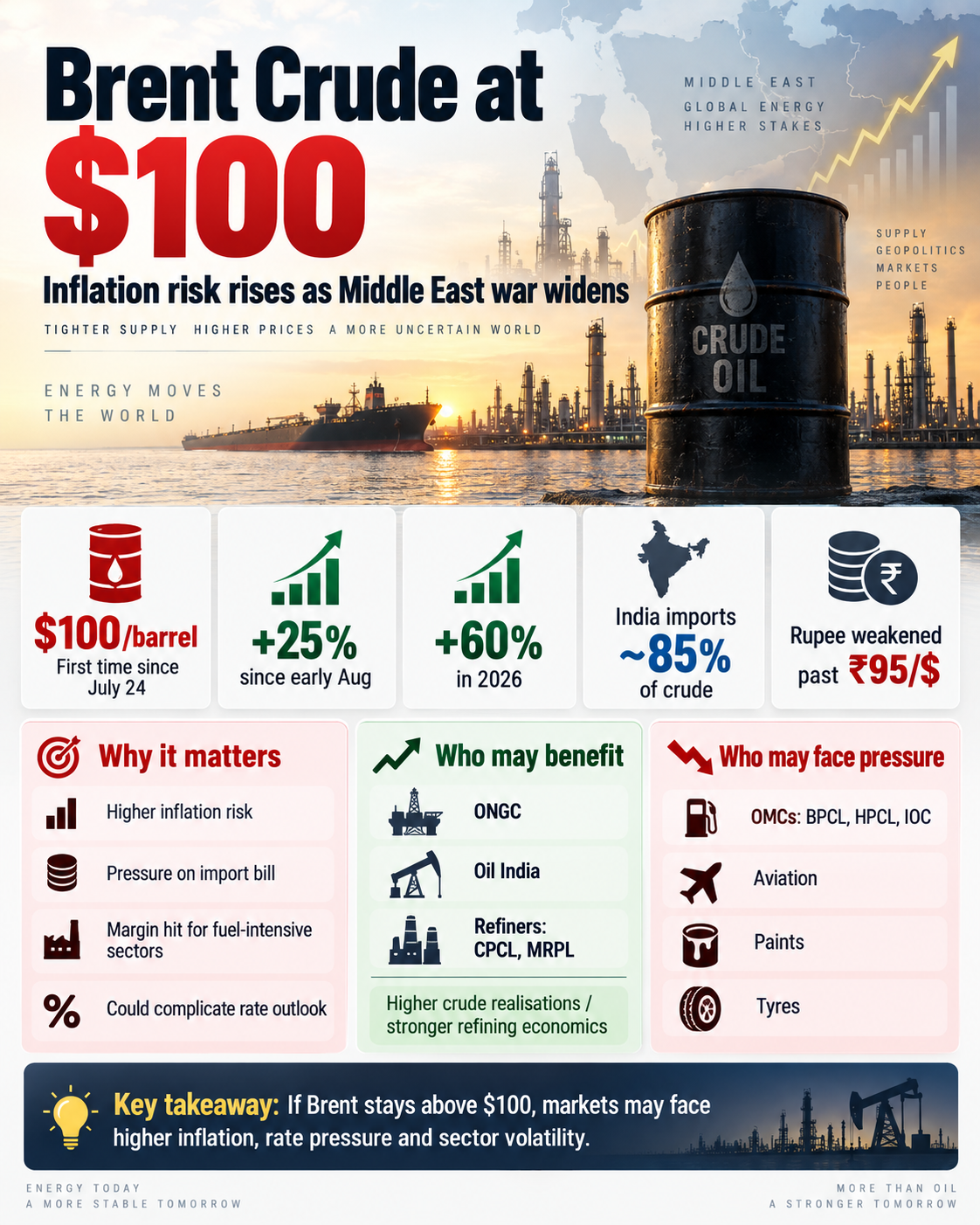
The global crude benchmark has risen by roughly 25% since early August as hopes of a permanent resolution to the six-month-old war have faded and fighting has intensified again. Brent is now up more than 60% this year, highlighting the scale of the rally.
The latest surge comes as attacks involving the United States, Iran and Iran-backed groups raise concerns about potential disruptions around some of the world’s most important oil-supply routes.
Track Live : GIFT Nifty Live – Today Price, Chart, Timings and Nifty Opening Signal
Why the $100 Brent milestone matters for investors
Crossing $100 is more than a psychological event for financial markets.
Higher crude prices directly increase energy costs for economies that rely heavily on imported oil. That makes the development particularly important for countries across Asia, where oil imports play a major role in transportation, manufacturing and household consumption.
“$100 Brent should not be viewed simply as a psychological milestone. It is a warning level for the broader economy,” Sachdeva said.
For investors, this creates a difficult combination of higher input costs and renewed inflation risks.
If crude remains elevated, companies dependent on fuel and energy could face margin pressure, while businesses with stronger pricing power may be better positioned to absorb higher costs.
Middle East attacks raise fears of a prolonged oil supply disruption
The latest developments have changed the market’s assessment of how long the oil shock could last.
OCBC analysts said, “Iran’s attacks on Saudi energy facilities and the subsequent destruction of five Iranian tankers raised concerns about another prolonged disruption to oil supplies.”
The market will now closely track whether further attacks target oil production, storage facilities, pipelines or shipping infrastructure.
Any sustained disruption could push crude prices significantly higher, particularly if supply losses coincide with strong global demand.
At the same time, a de-escalation could quickly remove some of the geopolitical premium currently embedded in oil prices.
Read More : Nifty Briefly Falls Below 23,400 Before Rebounding in Wild Closing Auction
Who Benefits From $100 Oil?
The impact of $100 Brent is not uniformly negative for Indian stocks. While oil-consuming sectors face higher input costs, upstream producers can benefit from higher crude realisations.
Potential Beneficiaries
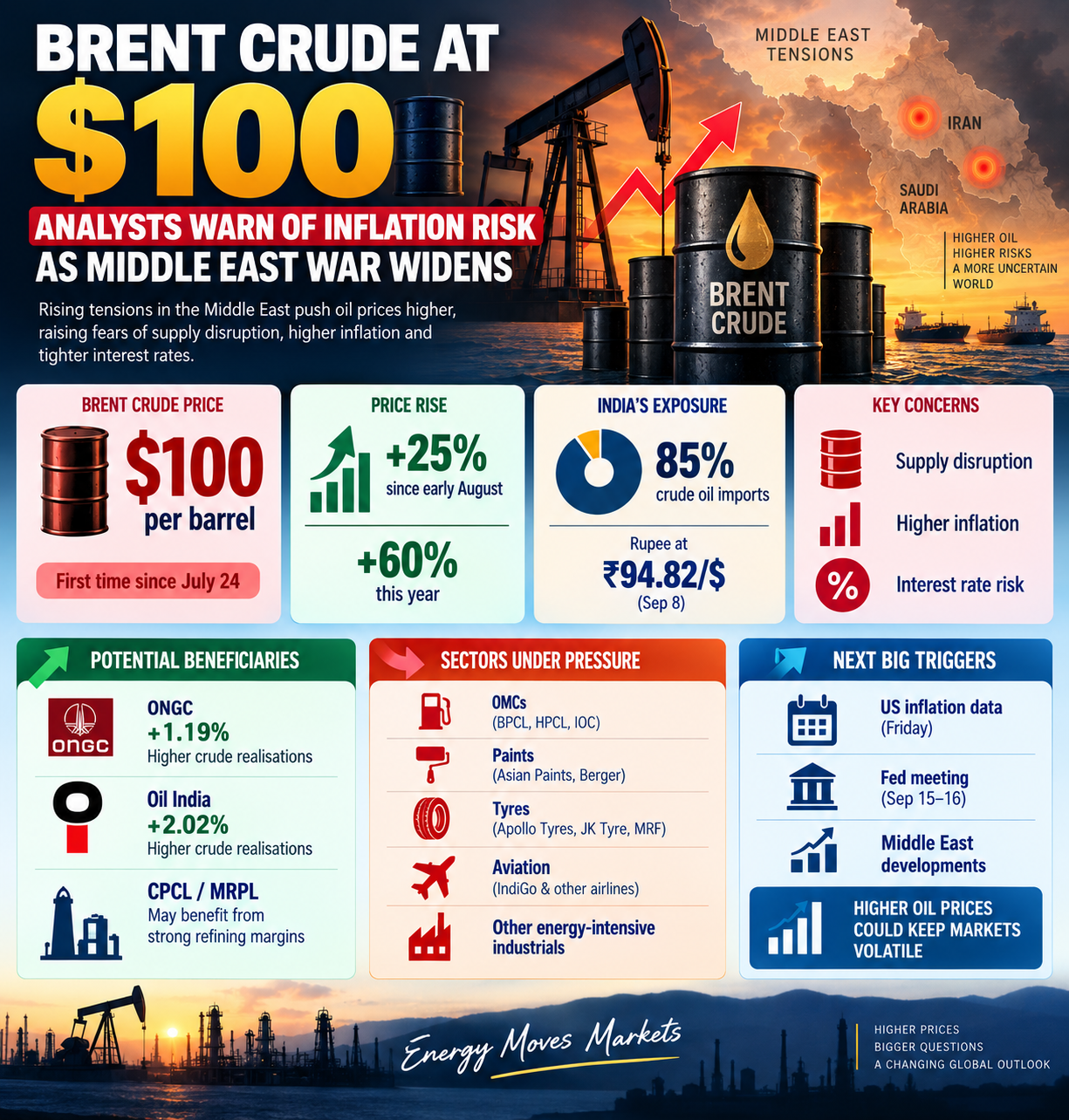
- ONGC: Higher crude prices can improve oil realisations and support revenue and profitability. ONGC gained 1.19% as Brent approached $100 on September 8.
- Oil India: The upstream producer gained 2.02% in the same session as investors factored in stronger crude realisations.
- Refiners such as CPCL and MRPL: These companies can potentially benefit from strong refining margins even as higher crude raises feedstock costs. CPCL and MRPL shares also gained as Brent neared $100.
Why higher crude prices could complicate the Federal Reserve’s rate outlook
The oil rally is also creating a fresh problem for central banks.
Higher energy prices can feed into consumer inflation, making it harder for policymakers to bring inflation back toward target levels.
The next major market test will come with the US consumer-price index data due Friday. Investors will assess whether rising energy costs are beginning to influence inflation expectations and how that could affect the Federal Reserve’s policy decision at its September 15-16 meeting.
A stronger-than-expected inflation reading combined with $100-plus crude could push markets to reassess expectations for US interest rates.
That could support the US dollar and create additional pressure on emerging-market currencies and equities.
Track Live : NSE Option Chain — Live
Why $100 Brent Matters for India
India is highly exposed to crude prices because it imports around 85% of its crude oil requirement. A sustained move toward $100 Brent can therefore affect the economy well beyond the fuel market.
- Higher import bill: Expensive crude raises India’s dollar-denominated energy bill and can widen the trade deficit.
- Rupee pressure: More dollars are needed to pay for imports. The rupee fell to around ₹94.82/$ on September 8 as Brent approached $100. It subsequently weakened past ₹95 on September 9.
- Inflation risk: Higher crude can feed into transport, fuel, petrochemical and other input costs, particularly if elevated prices persist.
- Corporate margins: Airlines, transport companies, petrochemicals and other energy-intensive businesses can face higher costs.
- Current-account pressure: Oil is a major component of India’s trade deficit, so a sustained price surge can worsen the external balance.
- Interest-rate risk: Persistent oil-driven inflation could complicate the outlook for monetary policy, especially if global rates also remain elevated.
Stocks & Sectors Under Pressure
- OMCs: BPCL, HPCL and IOC — higher crude can pressure marketing margins and raise procurement costs.
- Paints: Asian Paints and Berger Paints — crude-linked raw materials can become more expensive.
- Tyres: Apollo Tyres, JK Tyre and MRF — petroleum-linked inputs can pressure margins.
- Aviation: IndiGo and other airlines — higher jet-fuel costs can weigh on profitability.
- Oil-sensitive industrials: Companies with significant petroleum or energy-linked inputs could face margin pressure if Brent stays elevated.
What could happen to markets in the coming days
The direction of crude prices will remain closely tied to developments in the Middle East.
If attacks continue to threaten oil infrastructure or shipping routes, Brent could remain above $100 and potentially move higher. That would increase pressure on inflation expectations, interest-rate outlooks and risk assets.
If tensions ease and supply disruption fears decline, some of the geopolitical premium could unwind quickly.
For traders, the immediate focus should be on Brent crude, developments around the Strait of Hormuz, US inflation data and Federal Reserve rate expectations.
For long-term investors, the key question is whether $100 crude becomes a temporary spike or the beginning of a sustained period of higher energy prices.
The distinction matters because a short-lived oil rally may have limited earnings consequences, while prolonged $100-plus crude could reshape inflation, interest rates, currency markets and corporate margins.