Wall Street Under Pressure as Treasury Yield Tops 5%, Highest in Nearly 20 Years
Wall Street is heading for a weak open, and investors have two numbers firmly in focus: $108 oil and a 5% US Treasury yield.
Dow Jones futures fell nearly 350 points on Tuesday as a fresh jump in crude prices and surging bond yields revived concerns about inflation and interest rates. The pressure is also spilling into Indian markets, with GIFT Nifty falling sharply.
Track Live : GIFT Nifty Live – Today Price, Chart, Timings and Nifty Opening Signal
Why the 5% US Treasury yield is worrying Wall Street
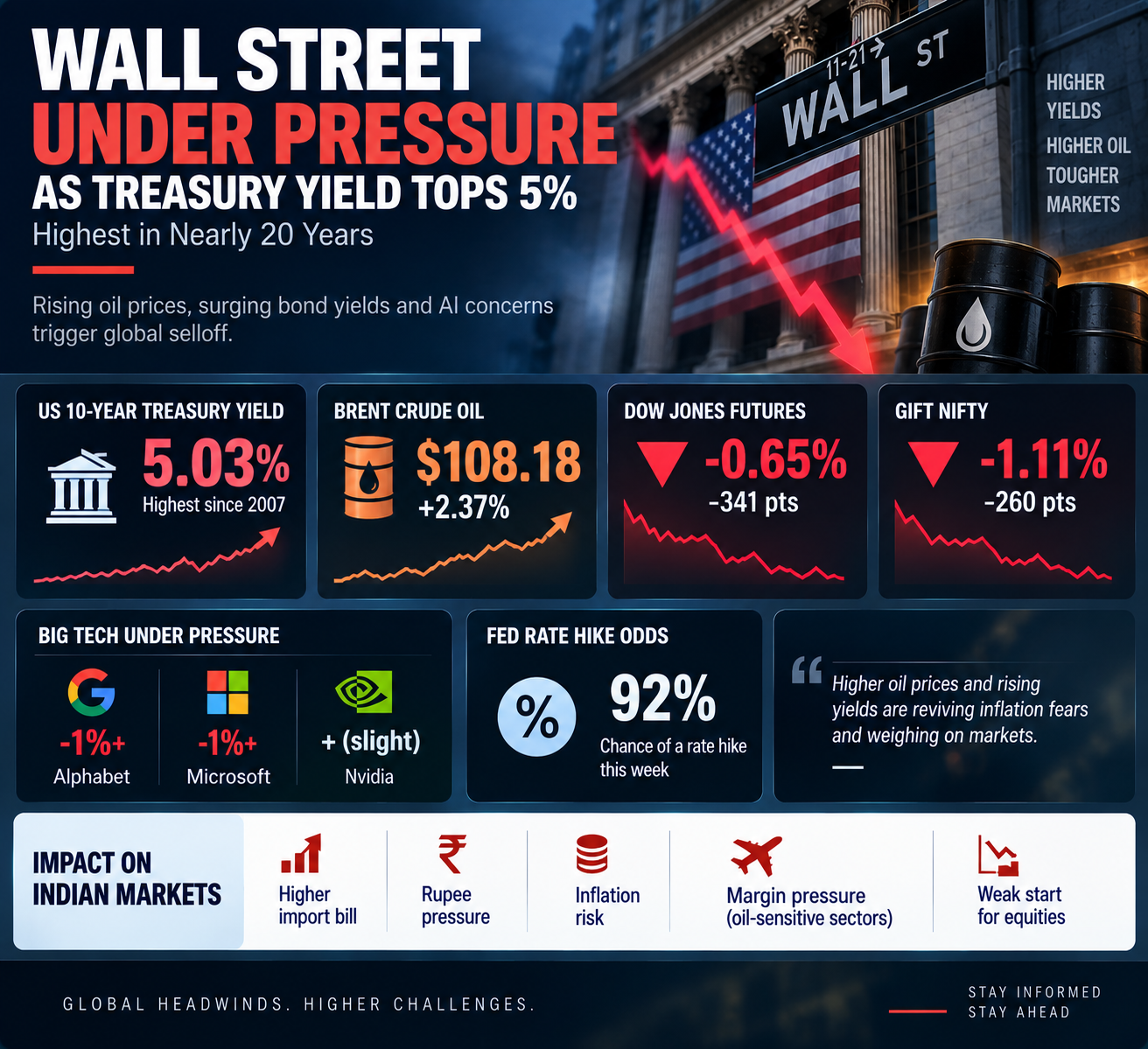
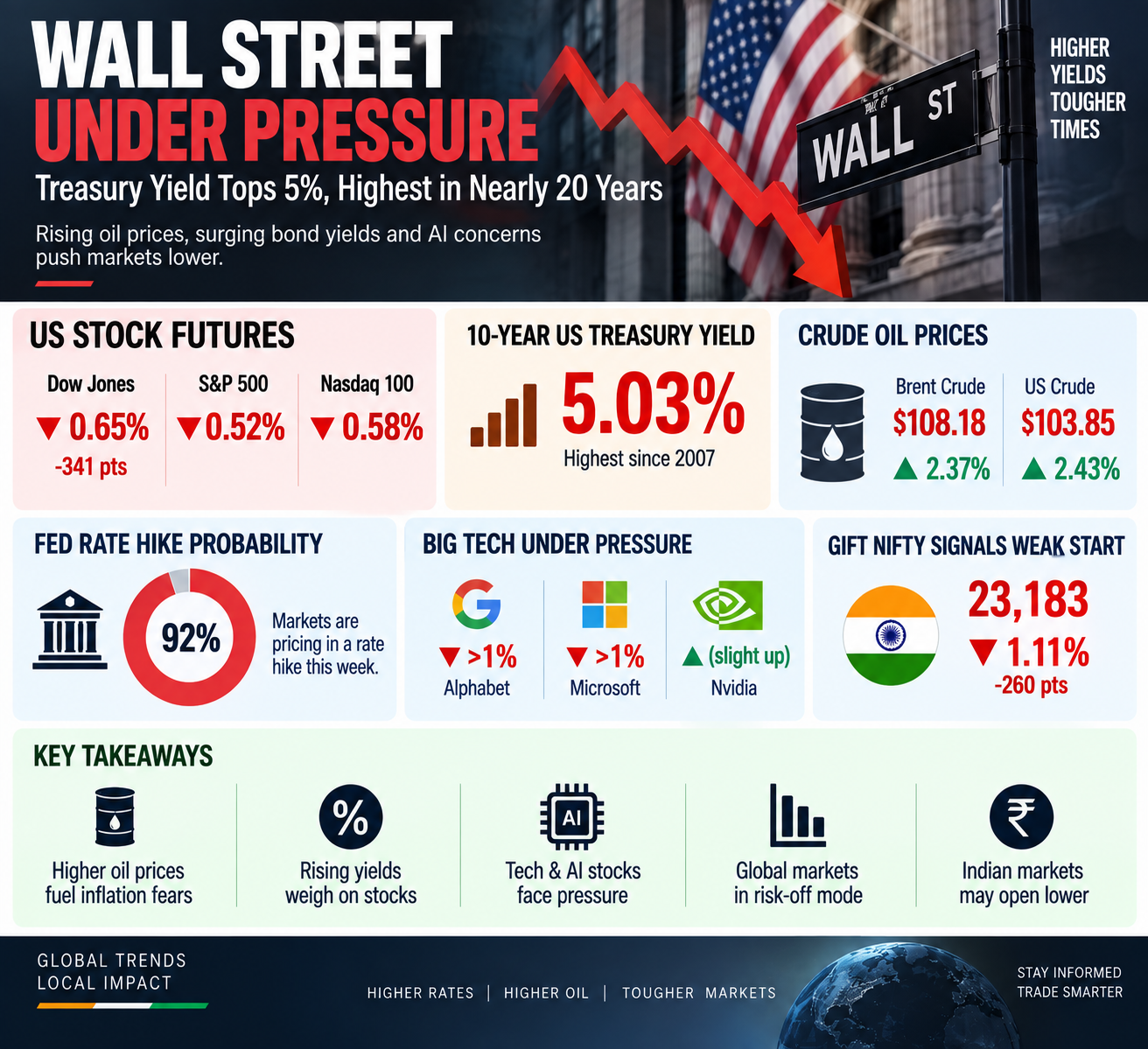
The US 10-year Treasury yield has reached levels not seen since 2007.
When Treasury yields rise sharply, government bonds become more attractive relative to equities. Higher yields can also put pressure on stock valuations because future corporate earnings are discounted at a higher rate.
Growth and technology stocks can be particularly sensitive to this move.
The latest jump in yields comes just before the Federal Reserve’s interest-rate decision on Wednesday.
Markets are currently pricing in about a 92% probability of a rate increase, according to Reuters.
The possibility of tighter monetary policy has strengthened after August US consumer prices accelerated, while underlying inflation posted its biggest monthly increase in four months.
Why crude oil above $108 is creating another problem
Oil is adding a second layer of pressure to the market.
Brent crude rose 2.37% to $108.18 a barrel, while West Texas Intermediate climbed 2.43% to $103.85.
The latest surge followed attacks on Saudi Arabian energy infrastructure that reportedly left its East-West pipeline offline.
For investors, the concern goes beyond the immediate rise in crude prices.
A prolonged disruption to energy infrastructure could keep oil prices elevated, increasing inflationary pressure at a time when the US Federal Reserve is already considering tighter monetary policy.
That creates a difficult environment for both stocks and bonds.
Track Live : NSE Option Chain — Live
- Higher import bill: Expensive crude can widen India’s trade deficit and increase dollar demand.
- Rupee pressure: Rising oil prices and higher US yields can weigh on the rupee.
- Inflation risk: Sustained crude above $100 could push up inflation expectations.
- Margin pressure: Airlines, paints, chemicals, logistics and other oil-sensitive businesses could face higher costs.
- RBI outlook: Persistent oil-driven inflation could reduce the RBI’s room for monetary easing and increase rate-hike expectations.
- Market sentiment: Falling Dow futures and higher US Treasury yields can reinforce a risk-off mood in Indian equities.
Alphabet and Microsoft fall as AI concerns add to the pressure
Technology stocks are facing another headwind after Monday’s selloff.
Alphabet and Microsoft were down more than 1% each in premarket trading, while Nvidia edged higher. Chipmakers remained relatively subdued after taking heavy losses in the previous session.
The latest weakness comes amid concerns over the pace and safety of artificial intelligence development.
Calls from executives at leading AI companies to slow AI development have raised questions about future investment and demand across the sector.
That matters because technology and AI stocks have been among the biggest drivers of US equity-market gains.
The Core Drivers of the Selloff
- Middle East Energy Shock: Brent crude jumped over 2% to breach $108 a barrel following drone and shipping infrastructure attacks in Saudi Arabia and the Strait of Hormuz. The unexpected shutdown of Saudi Arabia’s East-West pipeline has immediately revived global inflation fears right as the central bank meets.
- Yield Curve Pressure: The benchmark 10-year US Treasury yield surged past 5.03%, its highest level since 2007. When “risk-free” government bond yields skyrocket, they weigh heavily on corporate equity valuations and drain liquidity away from stocks.
- The “AI Slowdown” Shock: Tech behemoths like Alphabet and Microsoft fell over 1% in premarket trade. Sentiment cracked after prominent AI executives, including Anthropic CEO Dario Amodei, publicly called for a developmental slowdown over safety concerns. This has stoked intense uncertainty over whether the multi-billion-dollar artificial intelligence capital expenditure boom is hit by structural headwinds.
Global markets are feeling the same risk-off pressure
The weakness is not limited to Wall Street.
MSCI’s main world stocks index fell 0.28% on Tuesday after dropping 0.65% in the previous session.
The combination of higher oil prices, rising Treasury yields, inflation concerns and uncertainty around AI demand is pushing investors towards a more defensive stance.
Indian markets could feel the impact when Wall Street opens
The global selloff is already visible in Indian market indicators.
GIFT Nifty fell 260 points, or 1.11%, to 23,183 in afternoon trade, signalling a weak start for Indian equities if the pressure persists.
The biggest concern for India is the combination of expensive crude and a stronger US yield environment.
Higher crude prices can increase India’s import bill and put pressure on inflation, the rupee and corporate margins.
Oil-sensitive sectors could therefore remain under pressure, while banks, IT stocks and high-valuation growth companies may also react to the global risk-off mood.
Here’s what happened today and why traders reacted
In afternoon trade in India, Dow E-minis were down 341 points, or 0.65%, while S&P 500 E-minis fell 0.52% and Nasdaq 100 E-minis declined 0.58%.
The selling came as Brent crude moved above $108 a barrel following fresh attacks on Saudi Arabian energy infrastructure.
At the same time, the benchmark US 10-year Treasury yield crossed 5%, reaching 5.0328% before easing slightly to around 5.0286%.
That combination is particularly uncomfortable for equity investors.
What this means for traders and investors
For traders, the next major triggers are clear: Fed policy, Brent crude, US Treasury yields and Wall Street’s opening trend.
A sustained move in Brent above $108 could keep pressure on global equities, particularly if it raises expectations of prolonged inflation.
For Indian investors, the opening gap signalled by GIFT Nifty will be important, but chasing panic selling may carry additional risk.
Investors should watch whether crude prices remain elevated and whether the US 10-year yield stays above 5%. A reversal in either could quickly change market sentiment.
For now, the message from global markets is clear: oil is rising, yields are climbing and investors are becoming increasingly cautious just as the Federal Reserve prepares to make its next move.