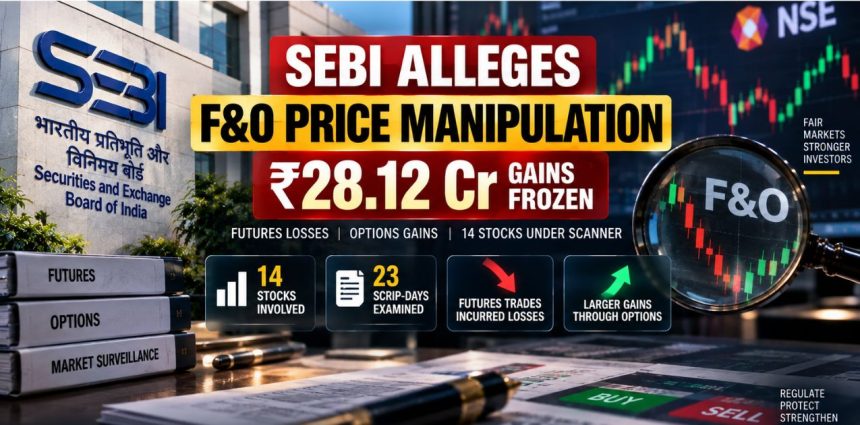
SEBI alleges two linked entities accepted losses in stock futures to influence prices temporarily while seeking larger gains through pre-positioned options orders across 14 NSE stocks.
KEY TAKEAWAYS
- SEBI froze ₹28.12 crore in alleged wrongful gains and barred two companies and four individuals from the securities market, subject to the conditions in its interim order.
- The futures leg allegedly incurred losses as part of the strategy, while the larger economic benefit was sought through stock options.
- SEBI examined 23 scrip-days involving 14 underlying stocks in the detailed sample reported from December 2025 to June 2026.
- The regulator said the entities focused predominantly on stocks among the bottom 100 by market capitalisation of roughly 211 stocks with equity derivatives.
- SEBI said the ₹28.12 crore represents gains identified in the sample so far, while a wider investigation remains under way.
A Futures Trade That Was Built to Lose
A futures position normally has one obvious purpose: make money from a directional move.
SEBI alleges that was not the purpose of the trades at the centre of its latest enforcement action.
In an ex parte interim order, whole-time member Kamlesh Chandra Varshney said Prrsaar Sampada Private Limited and Chaubara Eats Private Limited used single-stock futures and options in what the regulator described as a cross-segment price-manipulation strategy. SEBI alleged that the entities accepted losses in futures while seeking a larger economic benefit from options positions on the same underlying stocks.
The regulator directed that ₹28.12 crore of alleged wrongful gains be impounded and barred the two entities and four individuals, Ved Prakash Gupta, Priti Gupta, Saroj Gupta and Gaurav Tomar, from the securities market under the terms of the interim order. Business Standard reported that the restriction on Prrsaar applies to its proprietary account, while the entity is also registered as a depository participant and research analyst.
SEBI described the alleged conduct as a “novel manipulative, fraudulent and unfair trade practice.”
The allegations are not a final finding. The matter remains subject to the parties’ response and further proceedings.
How the Alleged Mechanism Worked
SEBI’s order describes a strategy built around the relationship between stock futures and stock options.
| Stage | Alleged action | Intended effect |
|---|---|---|
| 1 | Place large near-the-money options orders above and below the market | Keep potentially favourable orders waiting in the book |
| 2 | Aggressively net-buy or net-sell stock futures in different intraday periods | Influence the underlying futures price |
| 3 | Futures price moves in the required direction | Affect the corresponding option premium |
| 4 | Options orders are executed at the desired levels | Create the intended options position |
| 5 | Futures losses are outweighed by the options economics | Produce an overall gain |
SEBI’s illustration uses a hypothetical stock trading at ₹100 with a call option priced at ₹5.
Under the example, a futures-led decline to ₹98 could reduce the call premium to ₹4, allowing a buy order to execute at the lower option price. A subsequent move towards ₹102 could raise the call premium to ₹6, allowing an earlier sell order to execute at the higher level.
The key feature is size asymmetry.
SEBI alleged that the options positions were much larger than the futures trades used to influence prices. As a result, the futures leg could incur losses while the options leg generated a disproportionately larger economic benefit.
This describes SEBI’s alleged mechanism. Cross-segment futures-options trading itself is not inherently manipulative.
The 14 Stocks — And Why Liquidity Matters
SEBI examined 23 scrip-days in detail, involving 13 instances associated with Prrsaar and 10 associated with Chaubara, according to the reported details of the order. The underlying stocks included Bharat Dynamics, Godrej Consumer Products, Godrej Properties, 360 ONE, KFin Technologies, Prestige Estates, Mphasis, Waaree Energies, Torrent Power, Marico, Swiggy, Lodha, Jio Financial Services and Hindustan Zinc.
The detailed examination covered trades from December 2025 to June 2026, while later reporting on the interim order says a similar pattern at Chaubara continued as recently as August 2026. Those are different dates: one refers to the detailed sample, while the other refers to the later activity alleged by SEBI.
Important: These companies were the underlying securities in trades examined by SEBI. The allegations concern the trading conduct of the named entities, not the businesses, managements or disclosures of the listed companies.
The selection of stocks is one of the more significant details in the case.
Reuters reported that SEBI alleged the entities targeted predominantly the bottom 100 stocks by market capitalisation among roughly 211 stocks with equity derivatives, where prices could be influenced with relatively less capital because of lower liquidity.
That creates a direct market-structure angle.
SEBI’s August 2024 framework tightened the eligibility criteria for stocks entering or remaining in the derivatives segment. The Median Quarter Sigma Order Size (MQSOS) threshold was raised from ₹25 lakh to ₹75 lakh, the Market Wide Position Limit (MWPL) from ₹500 crore to ₹1,500 crore, and the Average Daily Delivery Value (ADDV) requirement from ₹10 crore to ₹35 crore. SEBI’s framework was designed around market depth, liquidity and position-limit safeguards for stock derivatives.
The latest order puts renewed attention on how that liquidity framework performs when relatively smaller F&O stocks become the focus of unusual cross-segment trading activity.
Traders can also monitor institutional flows through the FII-DII Tracker on NiftyTrader.
Not a Jane Street by Size — But a Different Kind of Case
The phrase “desi Jane Street” has been used to describe the case, but the comparison is more useful for structure than scale.
SEBI’s July 2025 interim order concerned index manipulation by Jane Street Group. The regulator’s action involved alleged unlawful gains of approximately ₹4,844 crore.
Jane Street subsequently created an escrow account with ₹4,843.57 crore, as reflected in an exchange notice reproducing SEBI’s direction.
Against that figure, ₹28.12 crore is about 0.58%.
The more important distinction is the market being examined.
The Jane Street case involved index-related trading, while the September 16 action focuses on single-stock futures and options. The present case therefore concerns a different cross-segment trading structure rather than another Bank Nifty-scale enforcement action.
The Surveillance Timeline
The sequence is one of the most consequential details in the order.
NSE and SEBI surveillance identified an unusual pattern involving abnormally high profits in stock options alongside losses in stock futures in the Prrsaar account. After NSE sought clarifications in February and March 2026, Prrsaar allegedly stopped the activity in its own account.
SEBI then said a similar pattern surfaced at the related entity Chaubara Eats.
Business Standard reported, citing the ex parte interim order, that the similar activity at Chaubara continued as recently as August 2026.
The sequence is therefore:
surveillance alert → activity stops in the original proprietary account → similar activity allegedly appears at a related entity → SEBI takes interim action.
SEBI also flagged possible deceptive orders, coordinated or synchronised trading and the use of multiple entities and contracts. The regulator said the conduct warranted urgent preventive action while the wider investigation continued.
A Previous Illiquid-Stock Case Offers Context
There is an older SEBI precedent involving alleged manipulation in stock options.
In 2016, the regulator restrained 22 entities over alleged reversal trades in stock options. Contemporary reporting put the total losses at about ₹1,273 crore and profits at roughly ₹1,303 crore.
The current case involves a different alleged mechanism: SEBI says the entities used stock futures to influence prices while benefiting from linked options positions.
The common thread is the regulator’s concern over trading structures in which price formation and the execution of derivative positions can interact in ways that may disadvantage other market participants.
The Retail F&O Backdrop
The case also arrives amid heightened scrutiny of retail derivatives trading.
SEBI’s August 20, 2026, study on individual traders in equity derivatives is part of the regulator’s latest research on participation, profitability and trading behaviour in the segment.
The profitability study found that individual traders recorded aggregate net losses of ₹91,685 crore in FY26, with 87.7% ending the year in loss. SEBI also reported that options accounted for around 92% of individual traders’ aggregate losses.
Proprietary traders recorded the highest gross trading profit among the major participant categories in the study. That figure is a gross trading-profit measure, so it should not be directly compared with the ₹91,685 crore aggregate net loss without recognising the difference in methodology.
The broader point is more straightforward: options continue to dominate the risk and loss profile of individual participation in India’s equity derivatives market. That makes enforcement involving complex futures-options interactions particularly relevant to market participants.
The present SEBI action does not establish that retail investors were counterparties to, or directly harmed by, the alleged trades.
What Happens Next
The ₹28.12 crore figure may not be the end of the matter.
SEBI said the amount represents the alleged gains identified in the sample examined so far, while a more detailed investigation remains under way. The regulator is also examining possible coordination between the two entities and other aspects of the trading activity.
The six parties have a response and hearing opportunity under the interim proceedings.
The investigation could therefore expand beyond the transactions already examined. That is the principal uncertainty for the parties involved and for the wider derivatives market.
Bottom Line
The headline number is ₹28.12 crore. The more important detail is how SEBI says the alleged economics worked.
One derivatives leg allegedly absorbed losses while a much larger options position captured the benefit of the resulting price moves.
That makes the case more than another enforcement headline. It shows why regulators increasingly need to examine related contracts, price movements and linked trading accounts together, rather than treating each transaction in isolation.
SEBI calls the conduct novel.
The more useful question for the market is whether it was rare.
Read Next: India-New Zealand FTA: NZ Parliament Passes Bill, Cuts 95% Tariffs
Disclaimer: The information in this article is based on allegations and observations contained in SEBI’s interim order. The allegations are not a final finding and remain subject to the parties’ responses, hearings and further proceedings.