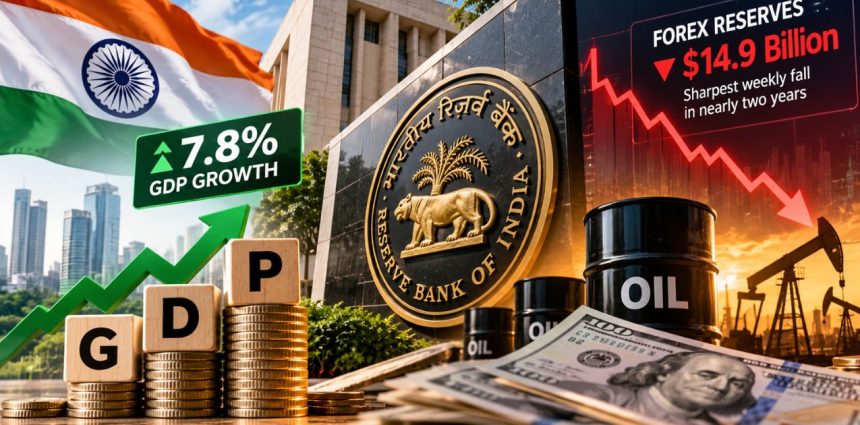
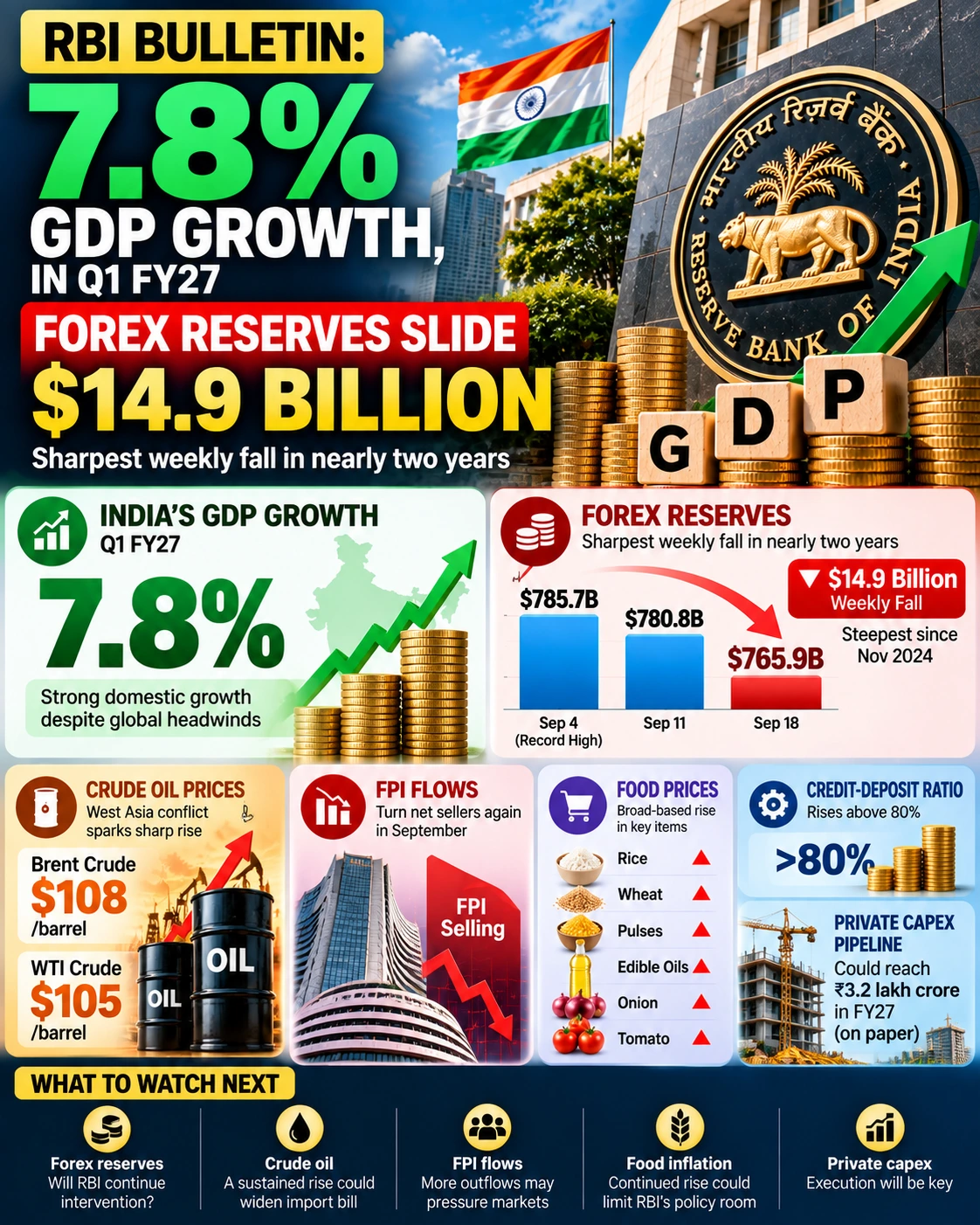
India’s economy grew 7.8% in the first quarter of FY27, but its foreign exchange reserves just posted their sharpest weekly fall in nearly two years, a sign that even a well-buffered economy is starting to feel the strain of surging oil prices and renewed foreign investor selling.
The Reserve Bank of India’s September Bulletin, released Friday, highlighted strong domestic growth and external-sector resilience even as it flagged rising geopolitical, energy and inflation risks; separate RBI data released the same day showed just how fast that external buffer can move.
Strong growth, robust FDI inflows and a still-substantial reserve stockpile are helping India absorb a worsening external environment, the central bank said in the Bulletin’s ‘State of the Economy’ article. But the risks, it added, are becoming harder to ignore.
Also Read: India’s 7.8% GDP Has One More Test: Can the New Data Earn Trust?
WEST ASIA CONFLICT PUSHES UP OIL, REVIVES INFLATION FEARS
The escalation of the West Asia conflict in September triggered a sharp rise in crude oil prices, reviving fears of supply-chain disruption and fresh inflationary pressure, the RBI said.
Brent crude climbed towards $108 a barrel, and West Texas Intermediate neared $105 in mid-September trade after drone attacks forced Saudi Arabia to shut down its East-West pipeline, a key export route that bypasses the Strait of Hormuz.
A sustained rise in oil prices works through the economy on more than one front: a wider trade deficit if exports don’t keep pace, pressure on the rupee that raises the cost of everything priced in dollars, and a direct feed into inflation.
Rising sovereign bond yields in several advanced economies are compounding the strain by pushing up government borrowing costs, while weather-related uncertainty remains a separate downside risk, the central bank said.
FOREX RESERVES SLIDE FROM RECORD AS RBI DEFENDS THE RUPEE
RBI’s own weekly reserve data, released the same Friday, tells a sharper story than the Bulletin’s tone alone suggests. Reserves hit a lifetime high of $785.7 billion in the week ended September 4 — a record single-week jump of $44.9 billion, driven largely by inflows under the RBI’s concessional FCNR(B) swap window, which has now mobilised $143.6 billion since June.
They then slipped to $780.8 billion on September 11 and fell a further $14.9 billion to $765.9 billion in the week ended September 18, the steepest weekly drop since November 2024, as the rupee came under pressure from crude above $105 a barrel and US Treasury yields above 5%, prompting RBI intervention in the currency market.
Of that latest week’s $14.8 billion decline in foreign currency assets, $10.9 billion reflected actual dollar sales, according to Gaura Sen Gupta, chief economist at IDFC FIRST Bank, with the remainder coming from valuation effects.
Reserves remain historically large by any measure, but the nearly $20 billion round trip in three weeks shows how quickly the buffer can move when oil and yields turn against it together.
GROWTH, FDI AND EXTERNAL BUFFERS PROVIDE THE CUSHION
For now, the domestic economy is absorbing the shock. High-frequency indicators pointed to continued resilience through August, the RBI said, even as the global backdrop worsened.
The external sector added to the buffer. The current account deficit stayed moderate in the first quarter, supported by robust services exports and remittance inflows. Net FDI hit its highest monthly level in five years in July, while inflows under non-resident deposit schemes also rose sharply, according to the Bulletin.
NOT ALL CAPITAL INFLOWS ARE EQUALLY RELIABLE
The quality of that external cushion matters as much as its size. Services exports, remittances and FDI are relatively sticky sources of foreign exchange, tied to long-term business decisions rather than short-term sentiment.
Portfolio money behaves differently, it can reverse quickly when global bond yields rise or risk appetite fades, which is exactly what has played out through September.
LIQUIDITY HOLDS, CREDIT-DEPOSIT RATIO CROSSES 80%
System liquidity stayed in surplus through August and rose further in the first half of September as banks tapped the RBI’s FCNR(B) swap facility, before easing on tax-related outflows, the Bulletin said. Credit growth held its pace even as deposit growth picked up.
A separate Bulletin article examined the banking system’s credit-deposit ratio, which has climbed above 80%. That, by itself, does not signal funding stress, the RBI said, since banks have adjusted their liabilities, capital and asset mix to keep pace with credit demand, though a ratio that keeps climbing would eventually push banks to compete harder for deposits.
FPI SELLING RETURNS AS EQUITIES STAY UNDER PRESSURE
Indian equities stayed subdued through August and September as geopolitical tension and elevated global bond yields weighed on sentiment, the RBI said. Foreign portfolio investors turned net sellers again in September after buying through August, with the renewed West Asia crisis and rising global yields cited as the key triggers.
Track daily FII/DII activity in real time on NiftyTrader’s FII-DII Tracker: niftytrader.in/fii-dii-data
FOOD PRICES EDGE HIGHER, CPI TICKS UP
High-frequency data through September 21 showed a broad-based sequential rise in food prices, with rice, wheat, pulses and edible oils all climbing, the Bulletin said. Onion prices rose sharply, and tomato prices picked up after two months of easing, though potato prices fell.
Headline CPI inflation had already ticked up in August, a trend that narrows the RBI’s room to lean on an accommodative stance if oil and food pressures persist together.
PRIVATE CAPEX PIPELINE SIGNALS MOMENTUM — ON PAPER
A third Bulletin article pointed to strengthening private corporate investment in FY26. The project pipeline suggests envisaged private capital expenditure could reach ₹3.2 lakh crore in FY27, the RBI said.
The caveat is execution: announced investment intentions don’t automatically become spending on the ground, and companies can delay or scale back projects if energy costs, financing conditions or global demand turn against them.
WHAT TO WATCH NEXT
- Forex reserves: whether the RBI keeps selling dollars to defend the rupee, or the swap window reloads the buffer
- Crude oil: a brief spike is manageable; a sustained climb raises both the import bill and inflation risk
- FPI flows: further outflows could pressure equities, bonds and the rupee together, even with FDI holding up
- Food inflation: a longer run-up in cereals, pulses and vegetables would complicate the RBI’s policy trade-off
- Private capex: the ₹3.2 lakh crore pipeline matters only once it turns into actual construction and spending
BOTTOM LINE
The RBI’s own assessment is of an economy with genuinely strong fundamentals, growth, FDI, a still-large reserve stockpile that is nonetheless starting to feel a more hostile external environment in real time.
The reserves swing of the past three weeks is the clearest evidence yet: a record build in early September, then the sharpest weekly drawdown in nearly two years as the RBI leaned on the buffer to protect the rupee.
Whether that pattern continues will depend largely on how far crude oil and global bond yields move from here. The central bank clarified that views expressed in the Bulletin’s articles are those of the authors and do not represent the RBI’s official position.
Read Next: US 30-Year Treasury Yield Briefly Hits 5.53%: Why Markets Are Rethinking Rates
Disclaimer: This article is for informational and educational purposes only and does not constitute investment advice. NiftyTrader.in is not a SEBI-registered investment adviser; readers should consult a registered financial advisor before making investment decisions. Data and views are drawn from the RBI’s September Bulletin and RBI’s weekly reserve data and are subject to revision.