India’s Industrial Growth Hits 8% as Manufacturing Surges
India’s industrial recovery picked up pace in August, with factory activity showing stronger momentum across several key segments. India’s Index of Industrial Production (IIP) grew 8% year-on-year in August, accelerating from 6.7% in July and pointing to improving industrial demand and investment activity.
The headline number is encouraging, but the details matter. Manufacturing drove the improvement, while electricity output strengthened sharply. Mining, however, remained a drag on overall industrial growth.
Track Live : Nifty 50 Contributors Today | Bank Nifty Contributors Today (Top Bank Nifty Stocks)
India’s Industrial Growth: Manufacturing Expansion Spreads Across Key Industries
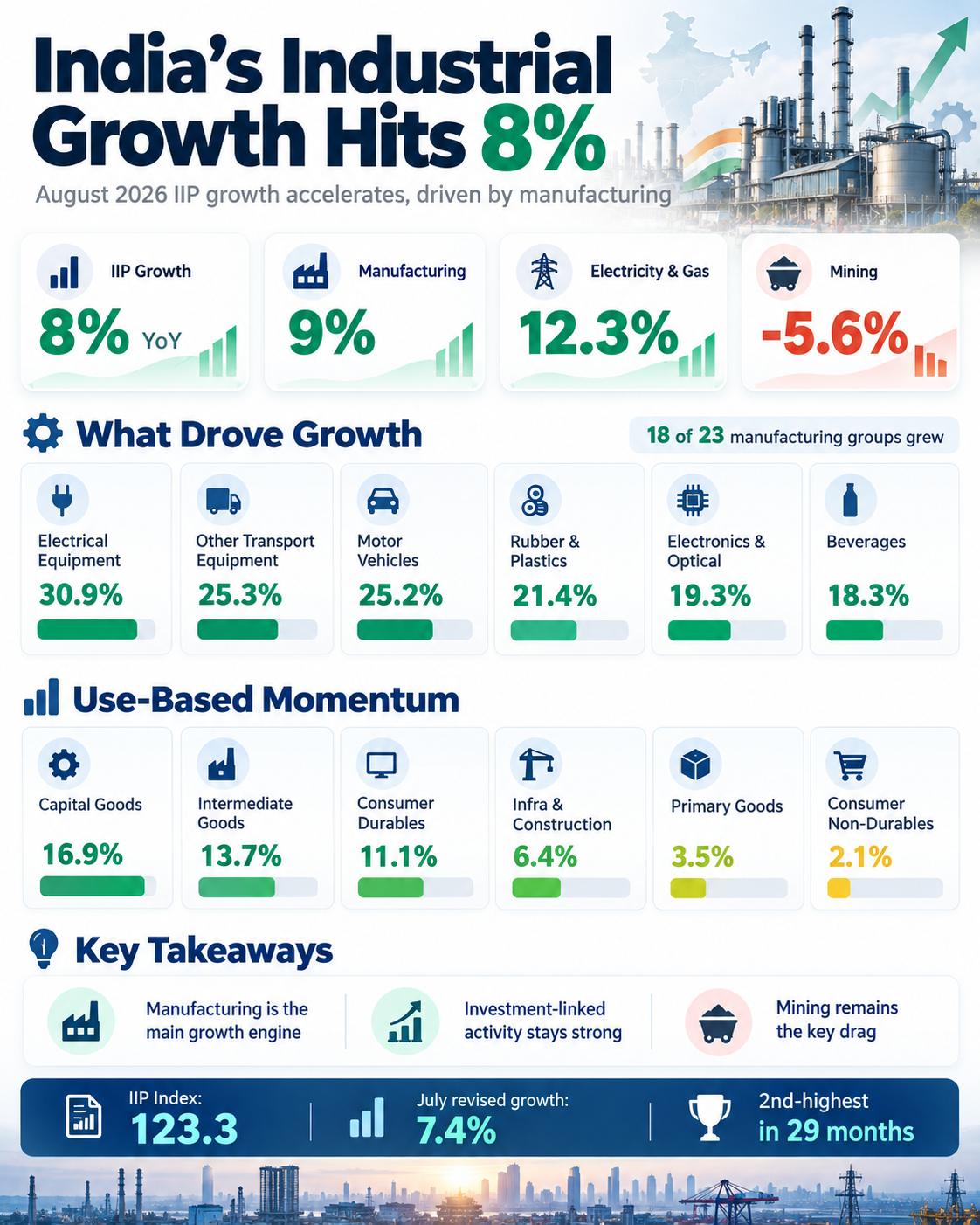
The manufacturing recovery was spread across most industry groups. Eighteen of 23 manufacturing groups recorded year-on-year growth in August.
Electrical equipment posted the strongest growth among major categories, increasing 30.9%. Other transport equipment rose 25.3%, while motor vehicles, trailers and semi-trailers grew 25.2%.
Rubber and plastic products increased 21.4%, computer, electronic and optical products climbed 19.3%, and fabricated metal products rose 16.9%.
The automobile sector also contributed strongly, supported by higher production of auto components, passenger vehicles and commercial vehicles.
Electrical equipment growth was supported by products including switching and circuit-protection equipment, optical-fibre connectors, UPS systems and solid-state drives.
India IIP August 2026: Key details
India’s industrial production accelerated 8% year-on-year in August 2026, according to the latest data from the National Statistics Office (NSO). The August reading followed a revised 7.4% growth in July, while manufacturing growth strengthened to 9%.
The August IIP index stood at 123.3, compared with 114.2 in August 2025. The latest reading was the second-highest in 29 months, after 8.8% growth in June.
The strongest performers included:
- Electrical equipment: 30.9%
- Other transport equipment: 25.3%
- Motor vehicles, trailers and semi-trailers: 25.2%
- Rubber and plastics products: 21.4%
- Computer, electronic and optical products: 19.3%
- Beverages: 18.3%
The automobile sector benefited from stronger production of auto components, passenger cars and commercial vehicles.
Capital goods and consumer durables signal stronger activity
The use-based classification provided another positive signal for investors. Capital goods output jumped 16.9% in August, following a 19% increase in July.
Intermediate goods production increased 13.7%, while consumer durables grew 11.1%. These three categories were the biggest positive contributors to overall IIP growth during the month.
The strength in capital goods is particularly relevant because it points to continued investment-linked activity. Meanwhile, consumer durable growth suggests demand for products such as vehicles, electronics and household equipment remained supportive.
Infrastructure and construction goods increased 6.4%, while primary goods grew 3.5%.
Consumer non-durables remained comparatively weak, rising only 2.1%.
Track Live : NSE F&O Lot Size
Capital goods and intermediate goods show strong momentum
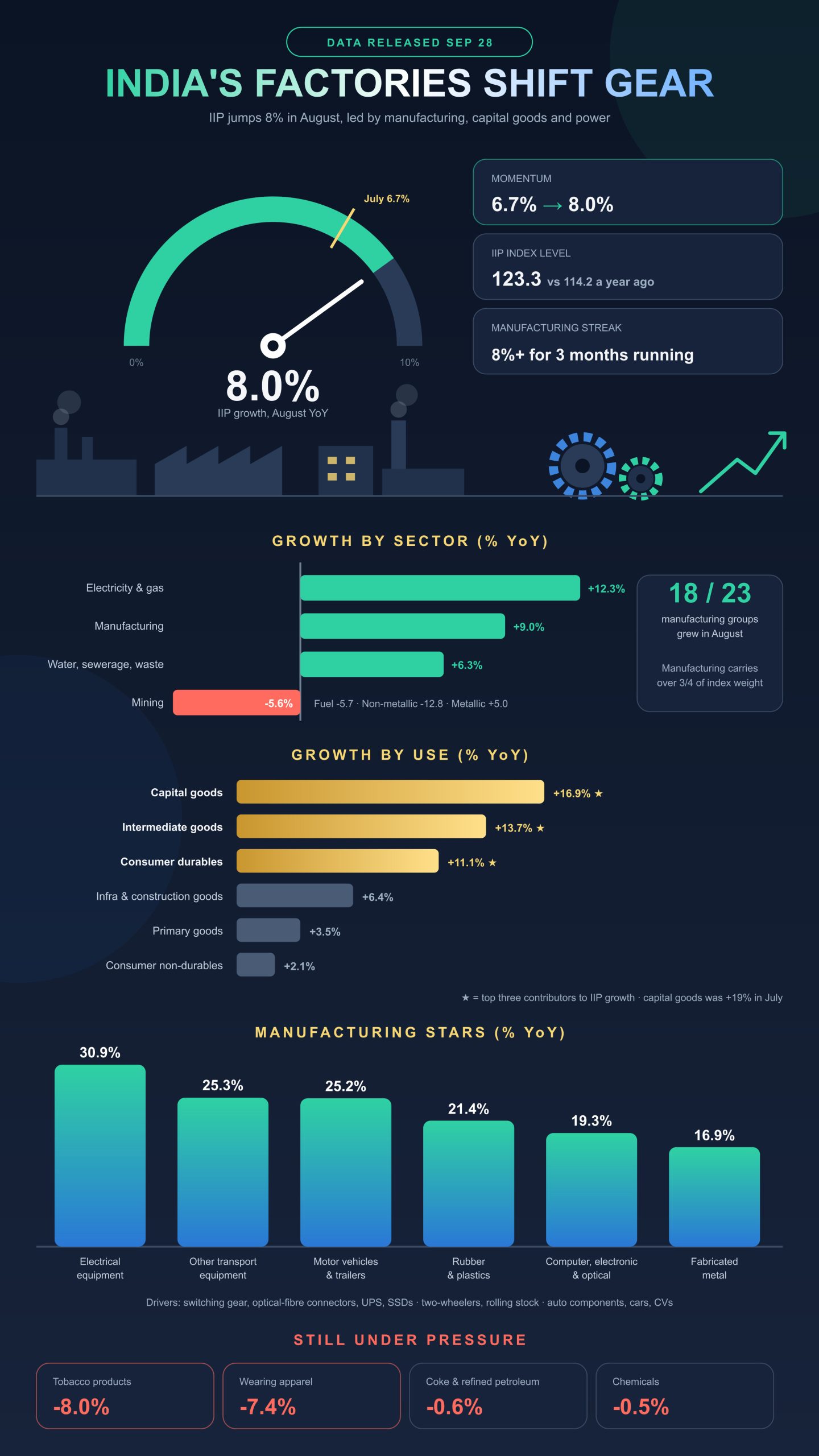
The use-based classification shows particularly strong growth in investment-linked categories.
| Category | August 2026 growth |
|---|---|
| Capital goods | 16.9% |
| Intermediate goods | 13.7% |
| Consumer durables | 11.1% |
| Infrastructure & construction goods | 6.4% |
| Primary goods | 3.5% |
| Consumer non-durables | 2.1% |
Capital goods growth, although strong at 16.9%, moderated from 19% in July. Intermediate goods accelerated to 13.7% from 10.4%, while consumer durables increased 11.1%.
Electricity and gas output jumps 12.3%
Electricity and gas supply recorded 12.3% growth in August, up from 8.7% in July. This was its strongest growth since May 2024.
Renewable electricity generation increased 15.4%, while non-renewable generation grew 12.3%. Gas supply, however, contracted 2.4%.
Water supply, sewerage and waste-management activity grew 6.3%, compared with 7.4% in July.
Mining remains the key weakness in industrial output
Despite the strong manufacturing performance, mining continued to weigh on India’s industrial output.
Mining contracted 5.6% year-on-year in August. Fuel minerals declined 5.7%, while non-metallic minerals fell 12.8%. Metallic minerals, however, recorded 5% growth.
Some manufacturing categories also remained under pressure. Wearing apparel output fell 7.4%, tobacco products declined 8%, while coke and refined petroleum products and chemicals fell 0.6% and 0.5%, respectively.
Read More : SEBI May Revisit Stock Exchange Self-Listing Rules; BSE Shares Fall 2%
Mining and quarrying contracted 5.6% in August, compared with a 0.9% decline in July.
Within mining:
- Fuel minerals: -5.7%
- Non-metallic minerals: -12.8%
- Metallic minerals: +5%
The weakness in mining is an important offset to the stronger manufacturing and electricity numbers.
Some manufacturing segments remain under pressure
The August improvement was broad but not universal.
Five of the 23 manufacturing groups contracted. The biggest declines were:
- Tobacco products: -8%
- Wearing apparel: -7.4%
- Coke and refined petroleum products: -0.6%
- Chemical products: -0.5%
- Paper products: -0.1%
Here’s what happened today and why traders reacted
Data released on September 28 showed that manufacturing output rose 9% in August, compared with 3.6% a year earlier. Manufacturing carries more than three-fourths of the IIP weight, making its performance particularly important for the overall industrial output number.
Manufacturing growth has now remained at 8% or higher for three consecutive months, indicating that the improvement is becoming more broad-based.
Electricity and gas supply increased 12.3%, while water supply, sewerage and waste management expanded 6.3%.
The overall IIP index rose to 123.3 in August from 114.2 a year earlier.
What the IIP data means for investors and markets
The 8% IIP growth provides a positive signal for India’s industrial and investment cycle, particularly because manufacturing, capital goods and consumer durables all recorded strong expansion.
For traders and investors, sectors linked to capital goods, industrial equipment, automobiles, electronics and infrastructure could remain in focus as markets assess whether the stronger production trend continues.
At the same time, investors will watch mining activity and consumer non-durables for signs of weakness.
Overall, the August IIP data shows that India’s industrial output is gaining momentum, with manufacturing emerging as the principal growth engine while mining remains the major constraint.