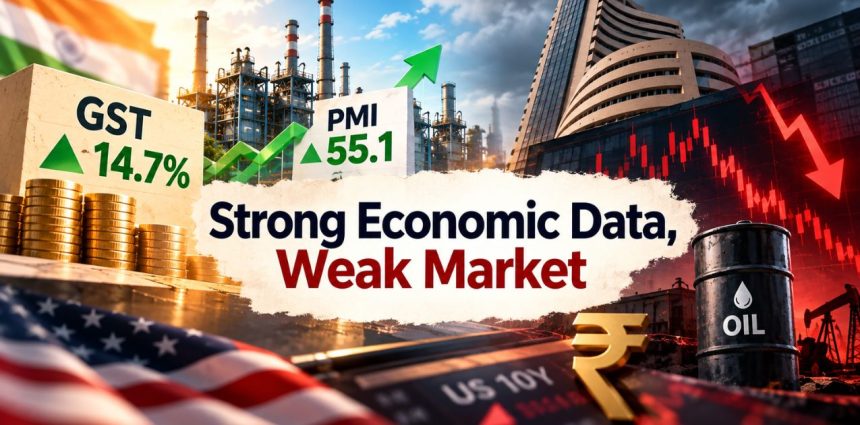
India’s GST collections jumped 14.7% and factory activity hit a seven-month high, yet foreign selling, elevated US yields, near-$97 Brent and rupee pressure are keeping equities under stress.
India’s economic data improved in September. The stock market did not move in the same direction.
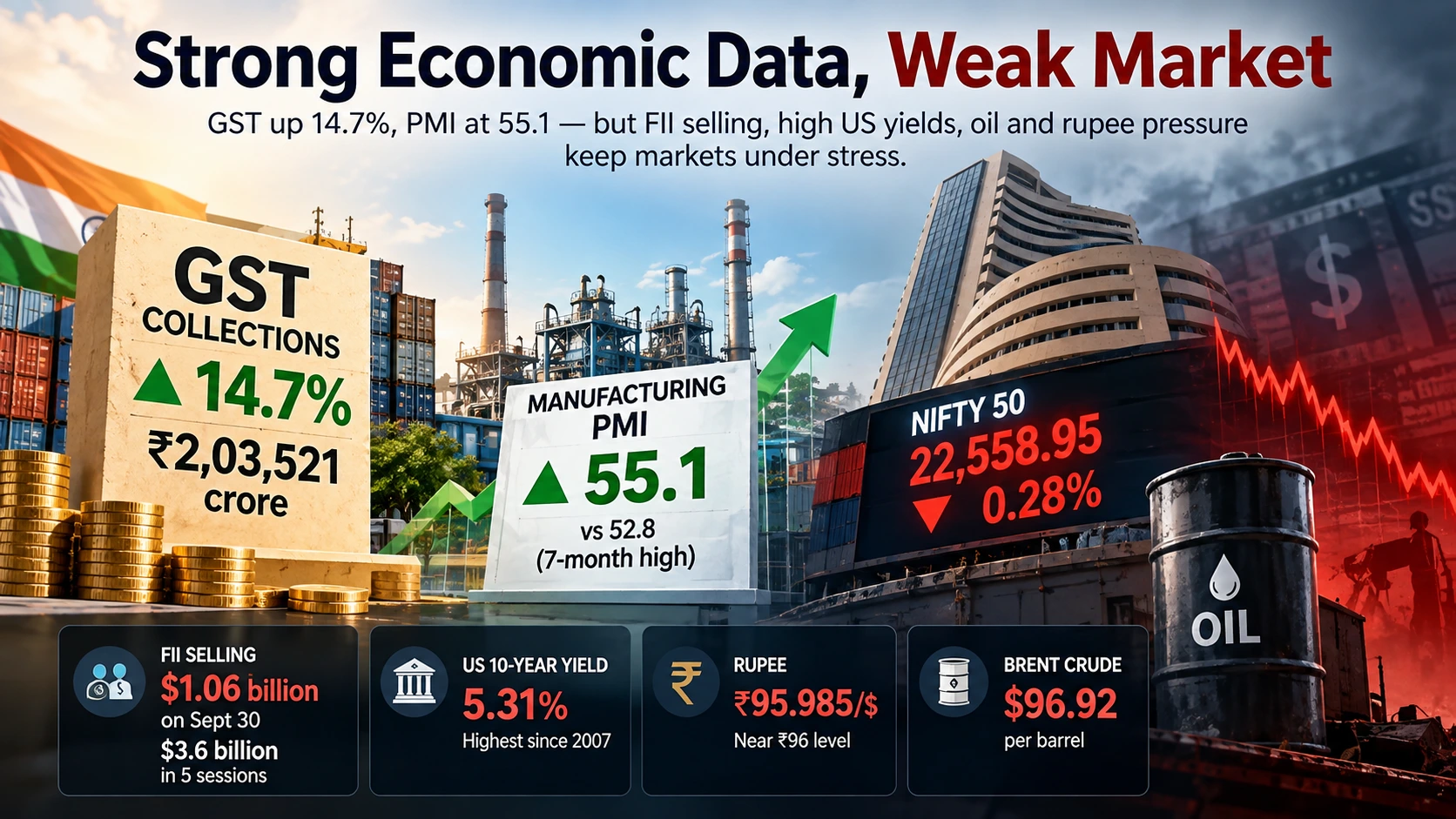
Gross GST collections rose 14.7% to ₹2,03,521 crore, while the HSBC India Manufacturing PMI climbed to 55.1 from 52.8, its highest level in seven months.
Yet the Nifty 50 was down 0.28% at 22,558.95 at 9:44 a.m. IST on October 1 and was on course for an eighth straight weekly decline. Reuters reported that foreign investors sold $1.06 billion of Indian equities on September 30 and about $3.6 billion over the previous five sessions, taking 2026 outflows to a record $27.8 billion on its measure.
The result is a clear expectation gap: domestic activity indicators are showing resilience, but global financial conditions, foreign flows, oil and currency pressure are still dominating the market’s reaction.
The RBI’s October 5-7 policy meeting adds another layer of uncertainty. A Reuters poll showed 35 of 61 economists expected a 25-basis-point rate hike to 5.50%, although the outcome remains uncertain.
Track Live: GIFT NIFTY, NIFTY50, SENSEX
Need to Know
- Gross GST collections rose 14.7% to ₹2.04 lakh crore in September. Domestic GST growth was slower than the headline pace, while import-linked collections grew faster, making the composition important when judging domestic demand.
- Manufacturing PMI rose to 55.1 from 52.8, a seven-month high, but the final reading was below the preliminary estimate of 55.7.
- The Nifty is heading towards an eighth consecutive weekly fall, its longest such losing run in 25 years, according to Reuters.
- Foreign investors sold $1.06 billion on September 30 and about $3.6 billion over five sessions. Reuters said 2026 outflows had reached a record $27.8 billion.
- The US 10-year Treasury yield touched 5.31%, its highest since 2007, after rising 87.1 basis points in the September quarter.
- The rupee weakened to ₹95.985 per dollar, remaining just below the ₹96 level with likely RBI intervention limiting the decline.
- Brent crude eased to around $96.92 a barrel on October 1 as recovering Gulf exports and higher US inventories reduced some immediate supply concerns.
- The RBI meets on October 5-7, with 35 of 61 economists in the Reuters poll expecting a 25-bps hike to 5.50%.
The Scoreboard: Strong Data, Weak Market
| Signal | Latest reading | What it means |
|---|---|---|
| Gross GST, September | ₹2.04 lakh crore, +14.7% | Strong headline collection growth |
| Manufacturing PMI, September | 55.1 vs 52.8 | Seven-month high |
| Nifty 50, October 1 | 22,558.95, -0.28% at 9:44 a.m. | Eighth weekly loss in sight |
| FII selling, September 30 | About $1.06 billion | Fifth straight session of selling |
| US 10-year yield | 5.31% | Highest since 2007 |
| Rupee | ₹95.985/$ | Near the ₹96 pressure zone |
| Brent crude | About $96.92 | Lower on easing supply concerns |
Is the 14.7% GST Jump as Strong as It Looks?
Gross GST collections rose to ₹2,03,521 crore in September from ₹1,77,365 crore a year earlier.
The composition matters. Domestic GST grew 10.1%, while import-linked collections increased much faster. That means the headline 14.7% growth captures both domestic economic activity and taxes linked to imported goods.
As a result, the 14.7% headline should not be treated as a standalone measure of domestic demand.
The domestic component remains healthy, but it is materially below the headline growth rate. For equity investors, that distinction matters because the market ultimately needs evidence that stronger tax collections are translating into sustained consumption, earnings and corporate cash flows.
Also Check: NiftyTrader Prime Plans — Pricing & Features
PMI at 55.1: A Real Rebound, Not Yet a Full Recovery
India’s manufacturing sector regained momentum in September.
The HSBC India Manufacturing PMI climbed to 55.1 from 52.8, marking the strongest improvement in seven months. New orders grew at their fastest pace since February, output expanded at its strongest pace since May and manufacturing employment recovered after a marginal decline in August. Business confidence also rose to a four-month high.
However, the improvement needs context.
The final PMI was below the 55.7 flash estimate, while the broader quarter still reflected a slowdown from the stronger April-June period. Input-price pressures also remained a concern, with manufacturers reporting higher costs for several inputs.
So the PMI is a positive signal, but it does not yet establish a broad acceleration in growth.
Why Is the Nifty Falling When the Data Are Improving?
The market is currently responding more strongly to four pressures than to the latest domestic data.
1. Foreign Selling and Bearish Positioning
Foreign investors sold about $1.06 billion of Indian equities on September 30, while Reuters reported roughly $3.6 billion of selling over five sessions. The report put their 2026 selling at a record $27.8 billion.
Foreign index-futures shorts also rose to approximately 267,000 contracts from 184,000 at the previous expiry, according to Nuvama data cited by Reuters.
That creates a near-term market tension: even if domestic data remain resilient, persistent foreign selling can continue to weigh on index-heavy stocks and limit the immediate impact of positive macroeconomic numbers.
2. US Yields Are Raising the Cost of Capital
The US 10-year Treasury yield touched 5.31%, its highest level since 2007, after an 87.1-basis-point increase during the September quarter. Reuters described the quarterly rise as the biggest since 1994.
Higher US yields can make dollar assets relatively more attractive and increase the cost of capital for global investors.
For Indian equities, that creates a difficult backdrop: companies can report improving domestic activity while valuations remain under pressure from a higher global cost of capital.
The forward-looking risk is that long-term US yields stay elevated even if the Federal Reserve’s immediate policy path changes. That could keep global financial conditions tighter for longer.
3. Oil Is Still an Inflation Risk, Even After Easing
Brent crude fell about 1% to $96.92 a barrel on October 1 as Gulf exports recovered and US inventories unexpectedly increased. The decline offers some near-term relief, but Brent had already risen about 14% during September.
For India, elevated crude prices matter through the trade balance, currency and inflation channels.
The Finance Ministry’s September Monthly Economic Review also highlighted high crude prices, geopolitical tensions and tighter global financial conditions as risks to imported inflation.
So the oil story has two sides: the latest decline reduces some immediate pressure, but prices remain high enough to matter for India’s inflation and external-balance outlook.
4. The Rupee Is Testing the ₹96 Zone
The rupee weakened 0.16% to ₹95.985 per dollar on October 1, with state-run banks selling dollars to limit losses around the ₹96 level, according to Reuters.
A weaker rupee can increase the local-currency cost of imported commodities and reduce dollar-denominated returns for foreign investors.
That makes currency moves particularly important when oil and US yields are already elevated.
Latest Stock Action: Autos Become the Clearest Drag
The latest October 1 stock action strengthens the article’s expectation-gap angle.
Auto stocks were among the biggest losers after September sales figures from several manufacturers missed market expectations. By late morning, the Nifty Auto index was down more than 3%, while Bajaj Auto fell as much as 8% and M&M declined about 2.6%, according to market reports. Hyundai Motor India moved in the opposite direction after its sales exceeded expectations.
Bajaj Auto’s September total sales rose 5% to 5,38,443 units, but domestic two-wheeler sales fell 12% to 2,39,771 units from 2,73,188 a year earlier.
That is an important distinction: the headline sales number improved, but the domestic component was weaker.
The broader tape is also not uniformly negative. Reuters reported the Nifty IT index up 0.9% as softer-than-expected US inflation reduced expectations of an imminent October Fed hike, while Kotak Mahindra Bank rose about 3% after Anup Kumar Saha was appointed its next CEO.
Company-specific triggers remain covered separately in NiftyTrader’s Stocks to Watch October 1.
Track Live: Nifty Auto Analysis — Live Performance, Constituents & What Moves the Index
Monsoon Ends 12.6% Below Normal: The Inflation Wildcard
India’s 2026 monsoon ended with rainfall around 12.6% below the long-period average.
The core monsoon zone performed better than the national figure, providing some cushion, but the weather outlook remains a risk. The Finance Ministry has highlighted the possibility that a strong El Niño could affect winter crops, while energy-price volatility could add to inflation pressures.
That does not mean the monsoon alone determines RBI policy. But it adds another layer to the inflation outlook at a time when August CPI inflation was already 4.82%, above the RBI’s 4% medium-term target.
The forward-looking risk is therefore two-sided: stronger domestic demand could support growth, while oil, food and weather shocks could keep inflation elevated.
RBI October 5-7: Why It Matters for Stocks
The RBI’s upcoming October 5-7 meeting is becoming a major market event.
In the latest Reuters poll, 35 of 61 economists expected the Monetary Policy Committee to raise the repo rate by 25 basis points to 5.50%. That would be the first increase since February 2023.
Markets are pricing a more aggressive path. Reuters’ October 1 rupee report said one-year overnight index swaps were pricing about 100 basis points of tightening over the next year.
But the outcome is not certain.
The RBI will have to weigh broadening inflation pressures and currency weakness against growth momentum and the potential effect of higher borrowing costs on demand.
For equities, the expectation gap matters. A policy outcome that differs from what markets have priced could change the reaction across rate-sensitive sectors, while a more restrictive signal could keep pressure on valuations.
What to Watch Next
- Nifty’s weekly close: The index is on course for an eighth consecutive weekly decline. A ninth next week would match the nine-week losing run recorded in 2001.
- Foreign flows: Whether the pace of FII selling slows after roughly $3.6 billion of outflows in five sessions.
- US 10-year yield: Whether the 5.31% level proves temporary or becomes a sustained feature of global markets.
- Brent crude: Whether the latest move towards $97 develops into a sustained easing trend or reverses as geopolitical risks evolve.
- Rupee: Whether the currency remains below the ₹96-per-dollar zone with RBI intervention.
- Auto stocks: Whether the September sales weakness remains concentrated in a few companies or broadens across the sector.
- RBI policy: The October 5-7 decision and, importantly, the guidance on the path beyond the immediate meeting.
For now, the market is trading the cost of capital, foreign flows and inflation risk more aggressively than the latest growth indicators.
That explains why a 14.7% GST increase and a 55.1 PMI reading have not been enough to reverse the Nifty’s decline. The key question for October is whether external pressures ease quickly enough for stronger domestic activity to regain influence over equity valuations.
Read Next: Stocks to Watch Oct 1: NCC ₹1,577 Cr Orders, IRFC 2nd GST Notice
FAQs
Why is the Nifty falling despite strong GST and PMI data?
The market is being influenced by heavy foreign selling, elevated US Treasury yields, high crude prices, rupee weakness and expectations of tighter monetary policy. These factors can outweigh positive domestic economic indicators in the short term.
How long is the Nifty’s weekly losing streak?
The Nifty is on course for an eighth consecutive weekly decline, which would be its longest such losing run in 25 years, according to Reuters.
Does the 14.7% GST rise mean domestic demand is booming?
Not necessarily. The headline increase includes both domestic and import-linked GST. Domestic GST growth was lower than the overall 14.7% increase, so the headline number should not be treated as a standalone measure of domestic demand.
What does the PMI of 55.1 mean?
A PMI above 50 indicates expansion. The September reading of 55.1 shows that manufacturing activity expanded and improved from August’s 52.8, although the final reading was below the preliminary estimate of 55.7.
When is the RBI policy decision?
The RBI’s Monetary Policy Committee meets from October 5 to October 7, 2026. A Reuters poll showed 35 of 61 economists expecting a 25-basis-point hike to 5.50%, but the decision remains uncertain.
Disclaimer: This article is for informational and educational purposes only and does not constitute investment advice or a recommendation to buy, sell or hold any security. Readers should consult a SEBI-registered investment adviser before making investment decisions.