
Bajaj Auto Falls 8%: Terrible Day, So Why Is Hyundai Smiling?
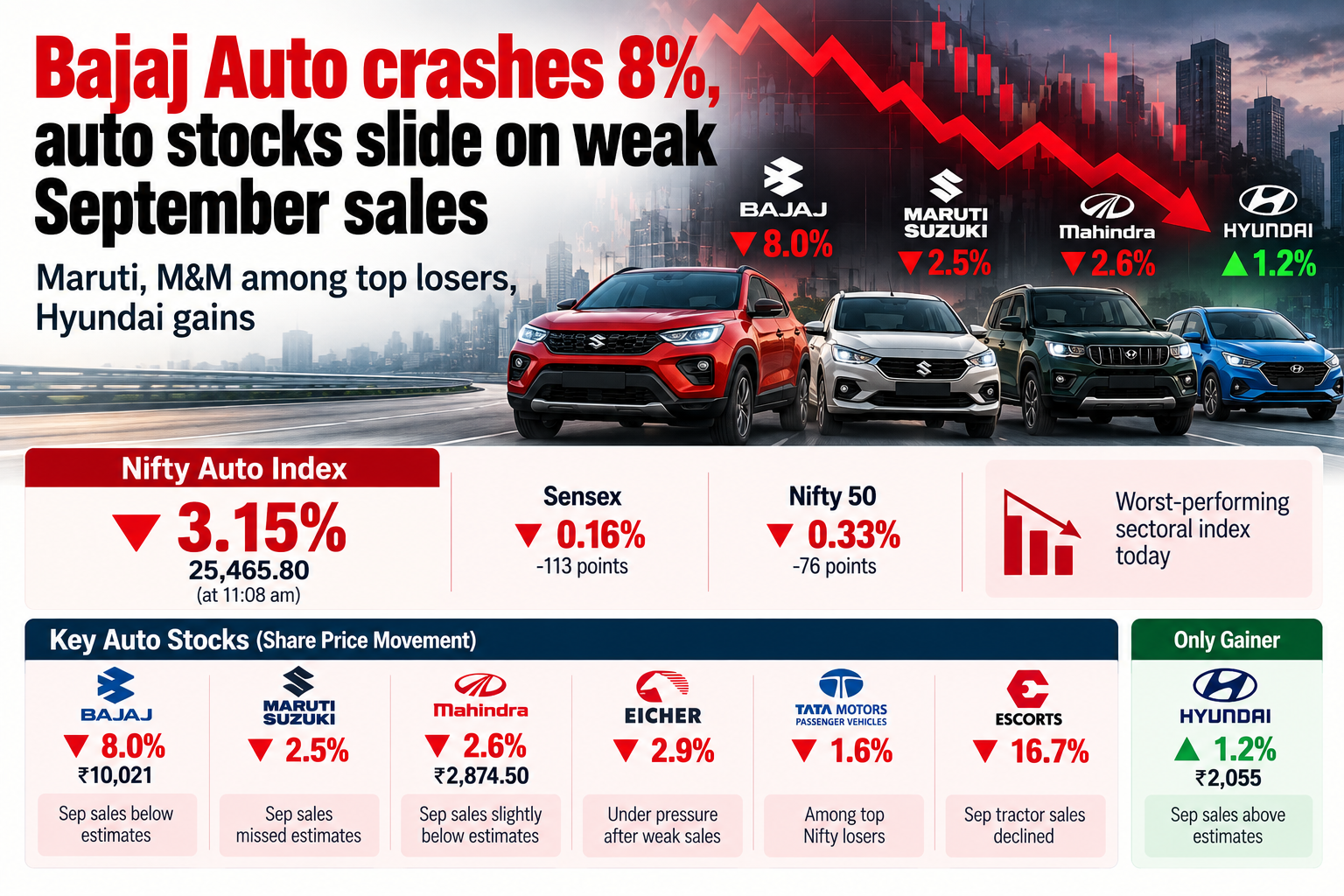
Auto stocks started October on the back foot, but the selling was sharper than many investors expected. Bajaj Auto shares crashed nearly 8%, while the Nifty Auto index became the worst-performing sector after September sales from several automakers missed estimates.
The key question for investors now is whether the weakness is limited to monthly sales numbers or signals a broader slowdown across parts of the auto market.
Track Live : NSE Option Chain — Live | BSE Option Chain — Live Sensex & Bankex Options Data Today
Auto Stocks Fall Sharply After September Sales Bajaj Auto Falls
The Nifty Auto index fell more than 3% on October 1, making it the weakest-performing sectoral index during the session. Around 11:08 am, the index was down 3.15% at 25,465.80, while the Nifty 50 and Sensex were down only 0.33% and 0.16%, respectively.
The selling was concentrated in automakers whose September volumes either missed analyst expectations or showed weakness in key segments, particularly domestic two-wheelers and tractors.
Bajaj Auto: biggest pressure point
Bajaj Auto shares plunged nearly 8%, making the stock the biggest Nifty 50 loser at the time.
The company reported:
- Total sales: 5,38,443 units
- YoY growth: 5%
- Domestic sales: 2,94,456 units, down 9%
- Exports: 2,43,987 units, up 32%
- Two-wheeler sales: 4,51,494 units, up 5%
- Commercial vehicles: 86,949 units, up 9%
The key concern was the sharp fall in domestic sales. Total sales also came below the CNBC-TV18 poll estimate of around 5.79 lakh units.
Bajaj Auto shares tumble as September sales miss estimates
Bajaj Auto shares fell nearly 8% to ₹10,021, making the stock the biggest Nifty 50 loser. The company sold 5.38 lakh units in September, below the CNBC-TV18 poll estimate of 5.79 lakh units.
However, total sales still increased 5% year-on-year. The pressure came mainly from domestic sales, which declined 9% to 2.94 lakh units.
Exports offered some relief, rising 32% to 2.43 lakh units. Two-wheeler sales increased 5% to 4.51 lakh units, while commercial vehicle sales rose 9% to 86,949 units.
The sharp reaction suggests traders were focusing more on the sales miss and domestic weakness than on the overall year-on-year growth.
M&M falls as tractor sales add to investor concerns
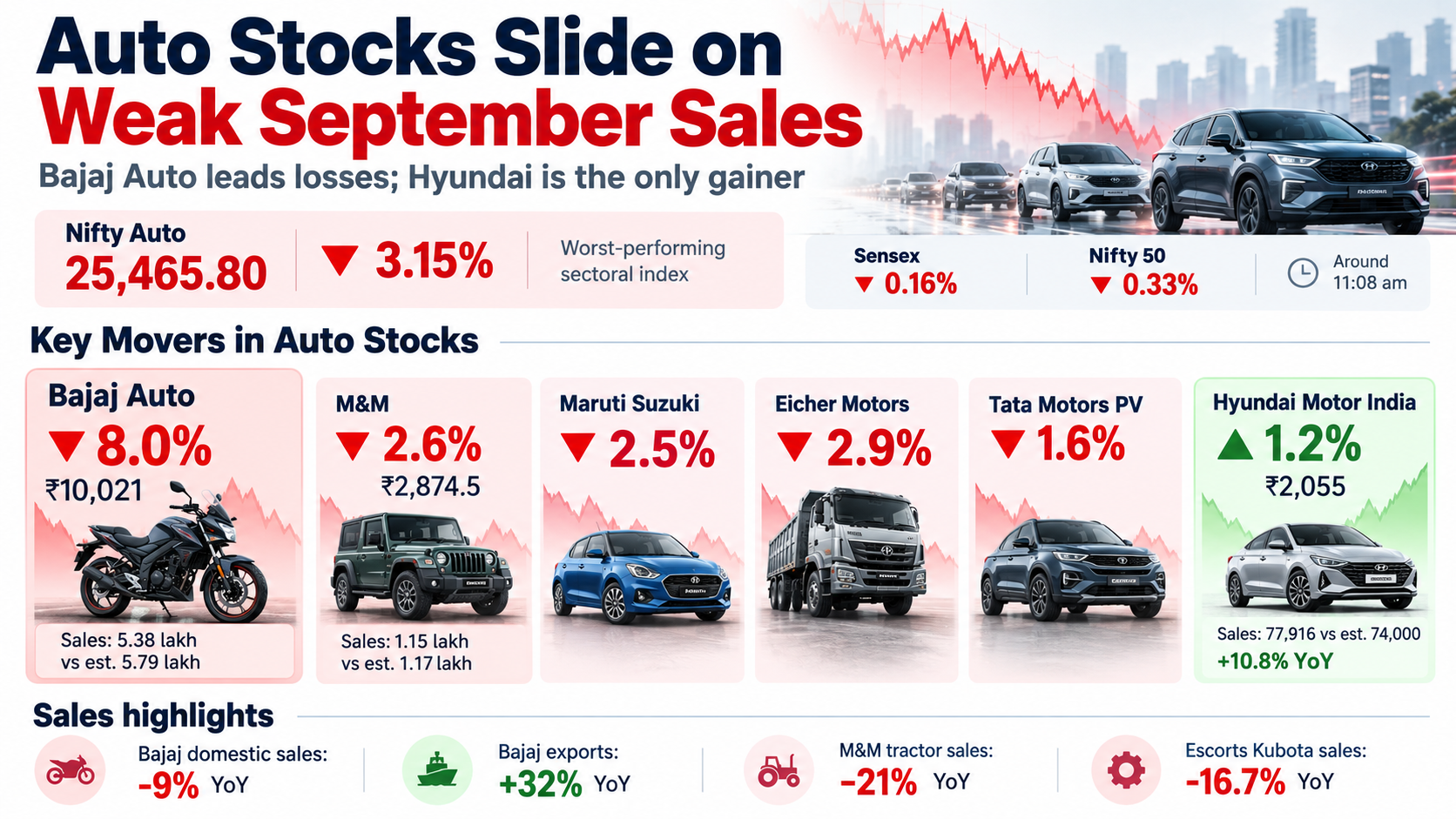
Mahindra & Mahindra shares declined 2.6% to ₹2,874.50 after September sales came in at 1.15 lakh units, slightly below the 1.17 lakh-unit estimate.
Overall sales still grew 15% year-on-year. Passenger vehicle sales rose 14% to 64,092 units, showing continued strength in that segment.
The bigger concern came from tractors. M&M’s tractor sales fell 21% year-on-year to 52,100 units, below the 58,667-unit estimate.
Track Live : Gap Up / Gap Down Stocks – Today’s NSE Opening Gaps
M&M reported:
- Total September sales: 1,14,874 units
- YoY growth: 15%
- Passenger vehicles: 64,092 units, up 14%
- Exports: 4,019 units, down 7%
- Total tractor sales: 52,100 units, down 21%
The tractor business was the major weak spot. The reported tractor figure was also below the CNBC-TV18 estimate of approximately 58,667 units.
However, M&M’s utility-vehicle business remained comparatively strong, with domestic passenger-vehicle sales rising 14%.
Maruti, Eicher Motors and other auto stocks also slide
Selling pressure spread across the sector. Eicher Motors fell 2.9%, Maruti Suzuki declined nearly 2.5%, and Tata Motors Passenger Vehicles dropped 1.6%.
Escorts Kubota also reported weaker numbers, with September sales falling 16.7% year-on-year to 15,214 units.
For investors, the broad-based decline means the market is currently looking beyond individual company performance and reassessing the overall September auto-sales picture.
Hyundai Motor India bucks the trend with stronger sales
Hyundai Motor India was the exception, rising 1.2% to ₹2,055 and emerging as the only gainer on the Nifty Auto index.
Hyundai reported September sales of 77,916 units, beating the 74,000-unit estimate and rising 10.8% from 70,347 units a year earlier.
Exports also increased 10.4%, significantly better than expectations of a 10% decline.
Read More : India’s Fiscal Deficit Is Already Rs 7.10 Lakh Crore by August: Which Two Subsidies Are Driving the Jump?
Hyundai reported its highest-ever monthly total sales:
- Total sales: 77,916 units
- YoY growth: 10.8%
- Domestic sales: 57,166 units, up 10.9%
- Exports: 20,750 units, up 10.4%
The total was above the CNBC-TV18 estimate of approximately 74,000 units.
Other auto stocks under pressure
The selling was broad-based across the sector:
| Stock | October 1 reaction |
|---|---|
| Bajaj Auto | Nearly -8% |
| M&M | Around -2.6% |
| Eicher Motors | Around -2.9% |
| Maruti Suzuki | Nearly -2.5% |
| Tata Motors Passenger Vehicles | Around -1.6% |
| Hyundai Motor India | Around +1.2% |
The Nifty Auto index subsequently touched an intraday low around 25,420.65, according to market data reported during the session.
Why are investors selling auto stocks?
There are three major factors behind the market reaction:
1. Sales missed expectations
The market was not simply looking at year-on-year growth. Investors were comparing September volumes with analyst expectations.
Bajaj Auto and M&M both delivered YoY growth in total sales, but their numbers were below estimates, triggering selling.
2. Domestic demand remains a concern
Bajaj Auto’s domestic sales declined 9%, while M&M’s tractor volumes fell sharply.
This has raised questions about demand across specific segments even though passenger-vehicle sales at some companies remain healthy.
3. Tractor weakness is significant
M&M’s 21% decline in total tractor sales was particularly important because tractor demand is closely watched as an indicator of rural consumption.
However, M&M said the timing of the festive season and a higher year-ago base also affected the comparison.
What investors should watch next
The September numbers provide an early indication, but they do not by themselves establish the full festive-season demand trend.
Investors should watch:
- October festive-season sales
- Domestic two-wheeler demand
- Tractor sales and rural demand
- Passenger-vehicle bookings
- Dealer inventory levels
- Export momentum
- Crude oil prices and their effect on costs
- Whether September sales weakness continues into October
The market’s reaction also shows that beating or missing expectations can matter as much as headline YoY growth.