
Nike Stock Drops 8.5% as It Cuts Jobs: Why the Sneaker Giant Is Struggling
Nike stock came under fresh pressure after the sportswear giant issued a weaker revenue outlook and announced another major restructuring push. The immediate question for investors is whether the latest cost cuts can revive growth—or simply highlight how much work remains.
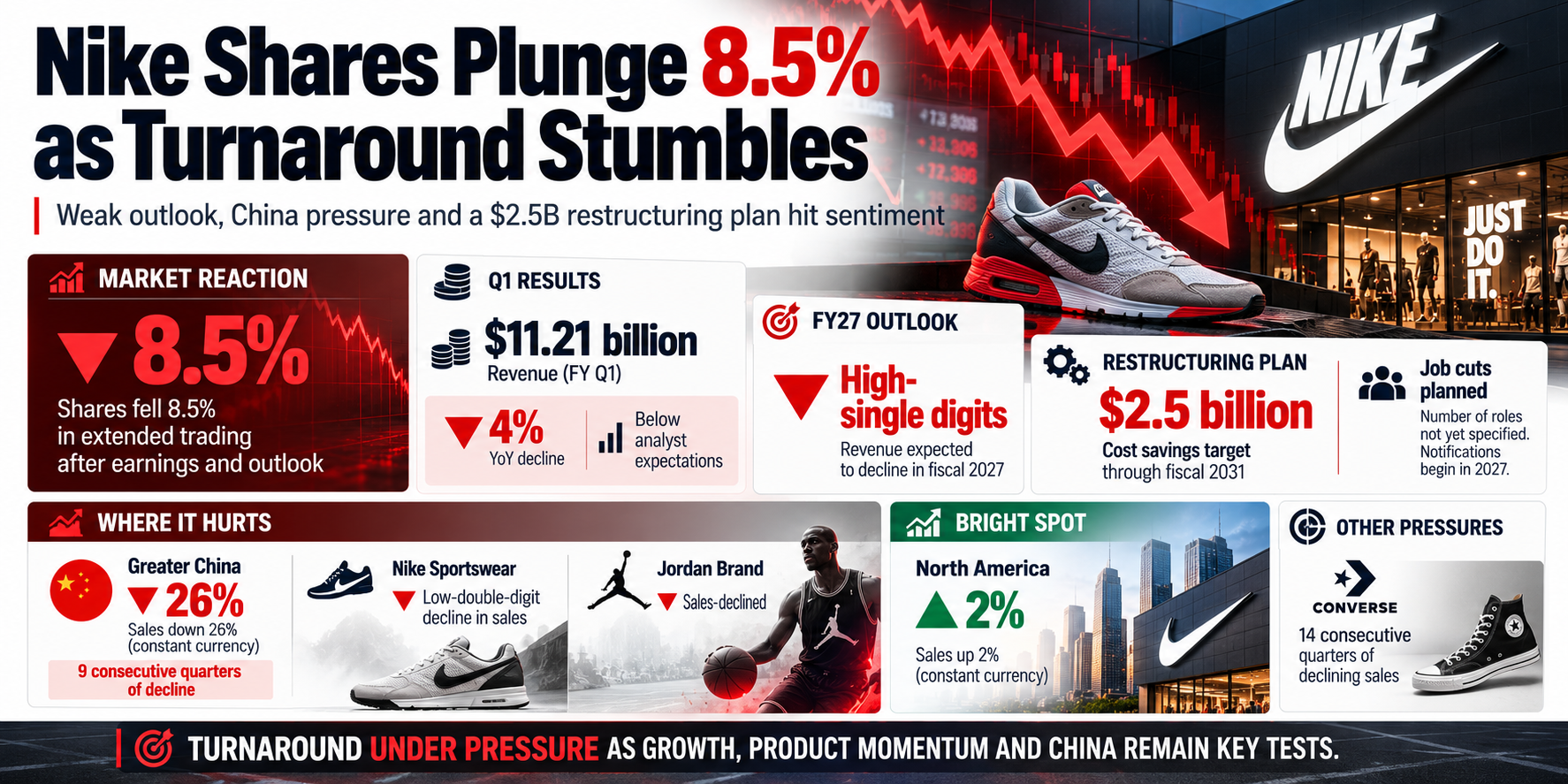
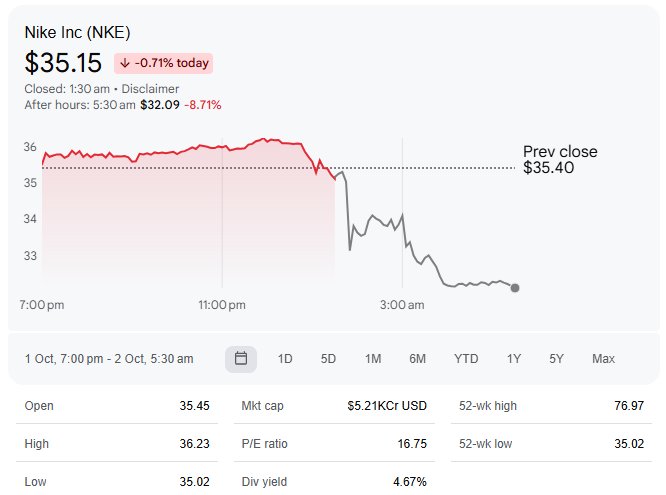
Nike shares fell 8.5% in extended trading on Thursday, adding to a decline of more than 40% this year. The latest sell-off came after Nike reported fiscal 2027 first-quarter results and warned that revenue could fall by a high-single-digit percentage in fiscal 2027.
Track Live : GIFT Nifty Live – Today Price, Chart, Timings and Nifty Opening Signal
Nike stock falls after revenue outlook disappoints investors
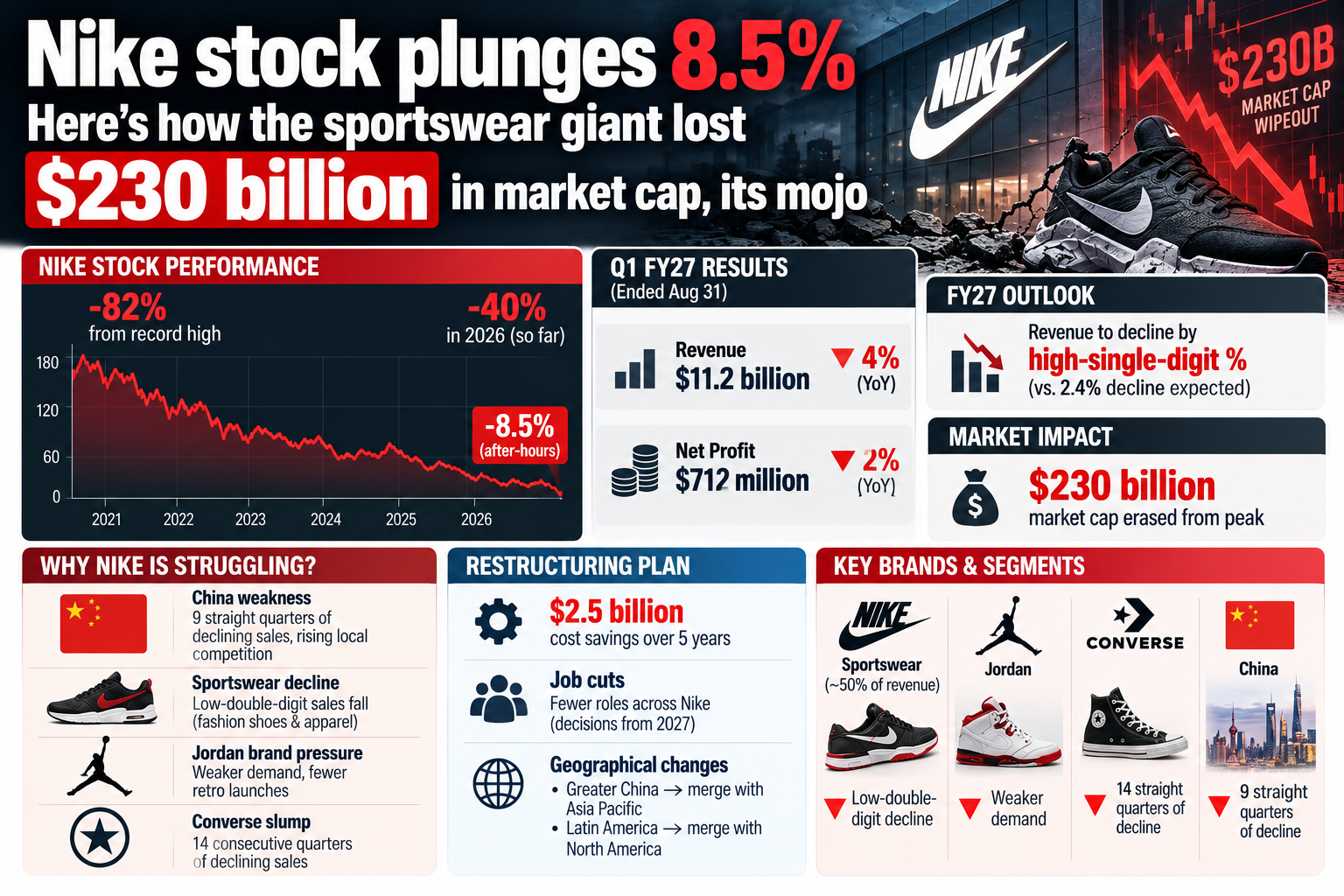
Nike reported first-quarter revenue of $11.2 billion, down 4% from a year earlier. Net income declined 2% to $712 million, while diluted earnings per share stood at $0.48.
The bigger concern was the outlook. Nike expects fiscal 2027 revenue to decline by a high-single-digit percentage, signaling that the turnaround under CEO Elliott Hill could take longer than investors had hoped.
The company also faces continued weakness across several important businesses.
Nike Q1 results: revenue falls 4%
For the quarter ended August 31, 2026, Nike reported:
| Metric | Q1 FY2027 |
|---|---|
| Revenue | $11.2 billion |
| Revenue growth | -4% |
| Currency-neutral revenue | -5% |
| Gross margin | 42.8% |
| Gross-margin change | +60 bps |
| Diluted EPS | $0.48 |
| Selling & administrative expenses | $3.9 billion |
Nike’s revenue declined 4% year over year, while Nike Brand revenue also fell 4%. The company said declines in Greater China and EMEA were partly offset by growth in North America.
Why is Nike cutting jobs?
Nike has introduced a new operating-model transformation called Pace.
The company expects Pace to deliver approximately $2.5 billion of cumulative savings through fiscal 2031. However, those savings come with approximately $1 billion of pretax charges, primarily related to employee costs.
Nike is also reorganising its geographic structure.
The company plans to operate around three geographic areas:
- Americas
- Asia Pacific and Greater China
- EMEA
The restructuring also includes further supply-chain optimisation, organisational streamlining and the establishment of a new campus in India.
Nike has not yet specified the total number of jobs that will be eliminated. Reuters reported that the company expects affected decisions to begin in 2027.
China, Sportswear and Converse remain major pressure points
Greater China continues to weigh heavily on Nike’s performance. Reuters reported that China sales fell 26% on a currency-neutral basis, marking the region’s ninth consecutive quarter of declining sales.
Nike’s direct business also remained weak, with Nike Brand Direct revenue falling 8%. Converse revenue dropped 28% to $263 million, extending its streak of declining sales.
The Sportswear and Jordan businesses are also being repositioned as Nike attempts to shift resources toward its strongest sports categories.
Nike announces $2.5 billion cost-saving restructuring plan
Nike is responding with a restructuring programme called Pace, designed to simplify its operating model and reduce costs.
The company expects Pace to generate approximately $2.5 billion in cumulative savings through fiscal 2031, while taking around $1 billion in pretax charges. Nike said the changes will include workforce reductions, supply-chain modernization and a realignment into three geographic regions.
CEO Elliott Hill told employees that the changes would result in “fewer roles across Nike”, with decisions on affected positions beginning in 2027 and beyond.
Nike has not yet disclosed the final number of jobs that could be eliminated.
Track Live : Opening Price Clues – What Pre-Market Data Says Today
Sportswear and Jordan are also under pressure
China isn’t the only issue.
Nike specifically identified Sportswear and Jordan Brand as businesses requiring repositioning. CEO Elliott Hill said the company still has “more work to do” in Sportswear, Jordan and Greater China.
The Sportswear business is particularly important because it contains many of Nike’s lifestyle products.
Jordan has also struggled, prompting Nike to rethink the frequency and volume of some retro product launches.
What happened to Nike’s $230 billion market value?
The $230 billion figure comes from the decline in Nike’s market capitalisation from its record valuation, rather than representing a cash loss during this week’s sell-off.
Nike reached an all-time closing/market peak around its 2021 high. Since then, the stock has fallen dramatically. Fortune India reported that Nike had lost roughly $230 billion in market capitalisation from its peak by September 2026.
That makes the latest decline part of a much longer deterioration rather than an isolated earnings reaction.
Nike was also removed from the S&P 100 in September 2026 after nearly 18 years, although it remains a member of the broader S&P 500.
Read More : Jio Built Its Own 5G From Scratch. What Does It Plan to Do With It?
What Nike stock means for investors now
For investors holding Nike stock, the next major catalyst will be the company’s Investor Day on November 16–17, when management is expected to provide more details about its growth strategy and financial plan.
The key signals to watch are sales in China, demand for Sportswear and Jordan products, digital sales, margins and evidence that the restructuring is translating into sustainable growth.
For traders, the immediate focus remains on whether the sharp sell-off continues or stabilizes after the earnings shock. For long-term investors, Nike’s ability to convert the $2.5 billion savings plan into stronger revenue growth will be central to the turnaround story.