
RBI Governor Reveals 5 Risks, Including AI, to the World’s Financial System
The global artificial intelligence boom has been one of the biggest drivers of equity markets in recent years. But the same AI investment cycle that has supported markets could also become a source of volatility if valuations or earnings begin to fall sharply.
RBI Governor Sanjay Malhotra on October 3 warned that a slowdown in AI investment could trigger a significant repricing of financial assets, particularly companies connected to the AI value chain. At the same time, he said India could benefit if global investors redirect capital towards the country.
Track Live : Gap Up / Gap Down Stocks – Today’s NSE Opening Gaps
AI valuation correction could redirect capital to India
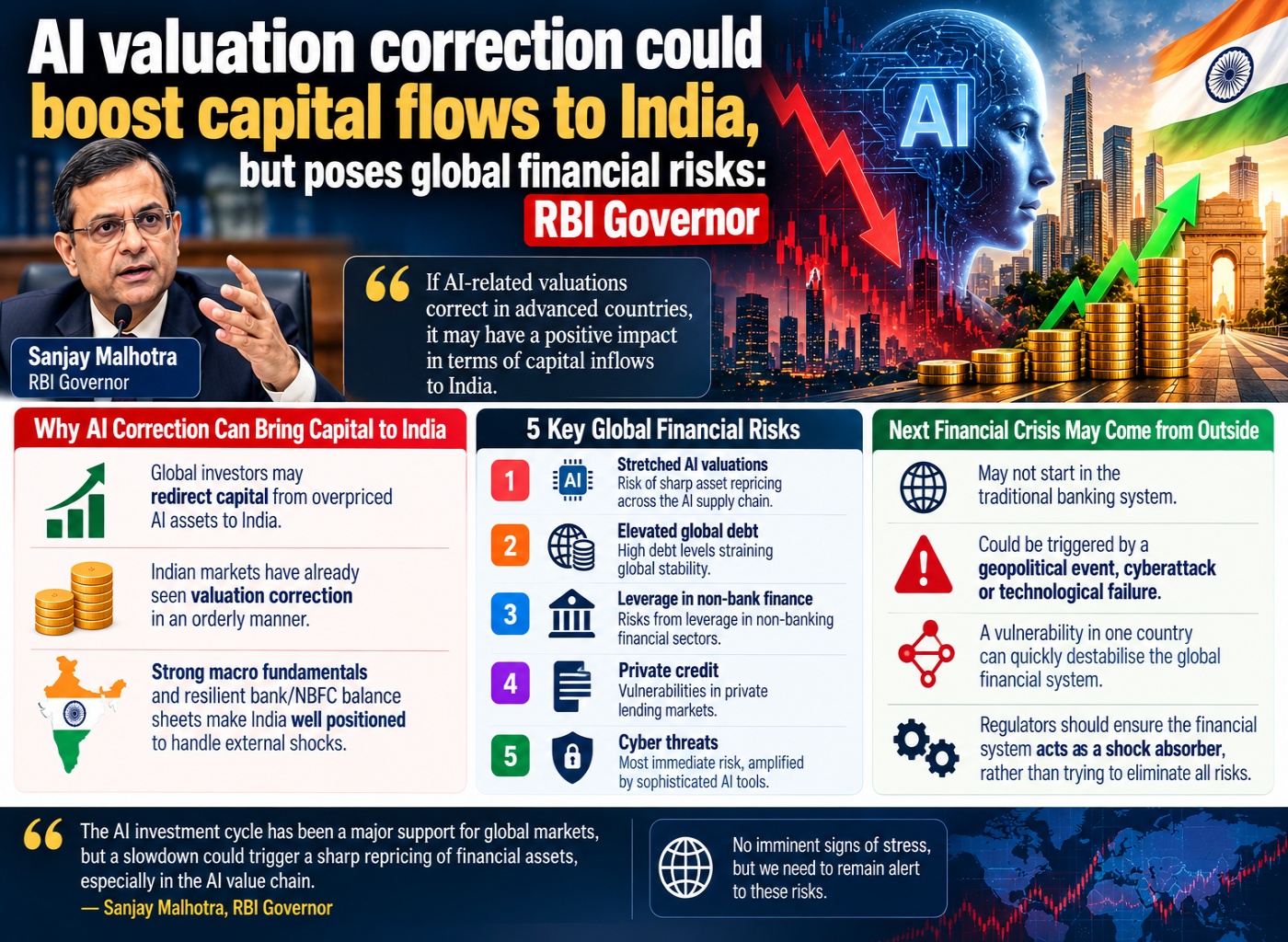
RBI Governor Sanjay Malhotra said a correction in elevated AI-related valuations in advanced economies could potentially redirect international capital towards India.
His argument is based on a possible reallocation of global investment. If investors reduce exposure to highly valued AI-linked assets in advanced markets, some of that capital could seek opportunities in other markets, including India. Malhotra specifically said such a correction “may have a positive impact in terms of capital inflows.”
However, this is not a prediction that India will automatically receive large inflows. Capital allocation would also depend on global risk appetite, valuations, economic conditions and India’s ability to attract foreign investment.
The AI Reallocation Opportunity for India
- Capital Inflow: A slowdown or correction in stretched AI valuations in advanced economies could cause global investors to redirect capital toward India.
- Orderly Adjustment: Indian equity markets have already seen some valuation corrections recently, but the transition has remained stable and orderly.
- Economic Strength: India is well-positioned to handle external shocks due to strong macroeconomic fundamentals and resilient bank/non-bank balance sheets.
Why an AI correction could bring more money to India
While an AI valuation correction could create turbulence in advanced economies, Malhotra pointed to a possible benefit for India.
He said a correction in AI-related valuations in advanced countries could encourage investors to move some of their money towards other markets.
“As for corrections in AI-related valuations, if they were to happen in advanced countries… it may have a positive impact in terms of capital inflows,” Malhotra said.
For Indian equities, stronger overseas inflows could provide support, particularly if global investors begin looking for markets with relatively resilient economic and financial fundamentals.
Indian markets have already seen some correction from elevated valuations in recent months, although Malhotra said the adjustment has remained orderly.
Global Financial System Risks
- Stretched AI Valuations: Risks of sharp asset repricing across the AI supply chain if earnings slow down.
- Elevated Global Debt: High debt levels straining global stability.
- Non-Bank Leverage: Risks associated with leverage in non-banking financial sectors.
- Private Credit: Vulnerabilities within private lending markets.
- Cyber Threats: The most immediate risk amplified by sophisticated AI tools.
RBI puts AI among key risks for financial stability
The RBI governor also highlighted the broader risks created by the rapid expansion of AI.
He listed stretched AI valuations alongside high global debt, leverage in non-bank finance, private credit and cyber threats as five important risks facing the global financial system.
Malhotra, however, stressed that he does not currently see signs of an immediate financial crisis.
“It is not that I see any imminent signs of stress,” he said. “But we need to remind ourselves that we need to remain alert to these risks.”
For investors, that means the AI story is no longer only about technology companies and earnings growth. Valuations, leverage and financial stability are becoming increasingly important parts of the discussion.
Track Live : NSE Option Chain — Live | BSE Option Chain — Live Sensex & Bankex Options Data Today
The Next Financial Crisis
- Origin: The next crisis may not start within the traditional banking system.
- Triggers: It is more likely to be sparked by a geopolitical event, cyberattack, or technological failure.
- Contagion: Cross-border gaps in cybersecurity mean a vulnerability in one country can quickly destabilise the global financial system.
- Regulatory Focus: Regulators must design the financial system to act as a shock absorber that protects the wider economy, rather than trying to eliminate risk entirely and killing innovation.
Why India may be better placed to absorb global shocks
Malhotra said India is entering the current period of global uncertainty from a “position of strength”.
He pointed to strong macroeconomic fundamentals and resilient balance sheets among banks and non-bank financial institutions as key supports.
“Strong macroeconomic fundamentals and the resilience of the financial system provide confidence in our ability to withstand these lingering shocks,” Malhotra said.
Still, India cannot remain completely insulated. Changes in commodity prices, global interest rates, foreign capital flows and international risk sentiment can all affect domestic markets.
Cyberattacks could create the next financial shock
One of Malhotra’s strongest warnings concerned cybersecurity.
“With the development of sophisticated AI tools… the most immediate concern is regarding cyber risk,” he said.
He noted that a future financial disruption may not necessarily begin inside a bank. A geopolitical event, cyberattack or technological failure could spread through highly interconnected financial systems.
“It may begin with a geopolitical event, a cyberattack or a technological failure that affects the financial system through multiple channels,” he said.
Read More : Nifty Falls 6.1% in September as Foreign Investors Pull Billions From Indian Equities
Why foreign flows matter for Indian markets
Investors should not read RBI Governor Sanjay Malhotra’s comments as meaning that a correction in global AI valuations will automatically send foreign money into India. A global correction could create an opportunity for India if international investors reallocate capital, but the actual outcome will depend on where global investors choose to deploy money, currency movements, interest-rate differentials, valuations and overall risk appetite.
Recent market data illustrates why this distinction matters. Foreign investors sold about ₹35,860 crore of Indian equities in September 2026, after buying in July and August. The selling continued into October, with CDSL data showing a net equity outflow of about ₹9,232 crore on October 1
What investors should actually watch
1. FPI equity flows
This is one of the clearest indicators of whether overseas investors are actually increasing exposure to Indian stocks.
If AI-related assets in developed markets correct but FPI equity flows into India remain negative, it would suggest that investors are either staying defensive or finding other destinations for their capital.
Conversely, sustained net buying would provide evidence that India is benefiting from a global reallocation.
2. FPI debt flows
Foreign capital does not have to enter through equities. Investors can also allocate money to Indian government securities and other debt instruments.
Therefore, equity and debt flows should be tracked separately. CDSL’s October data, for example, shows different movements across the General Limit, VRR and FAR debt routes.
This matters because a shift toward Indian bonds rather than equities could still represent increased foreign exposure to India without immediately creating a strong equity-market rally.
3. FDI
Foreign direct investment is different from FPI. FDI generally represents longer-term investment in businesses, projects and productive capacity rather than portfolio positions that can be changed relatively quickly.
So, if the thesis is that global capital is structurally being redirected toward India, investors should eventually look for evidence in FDI trends, not just daily FPI numbers.
4. USD/INR movement
The rupee provides another important signal.
Heavy foreign selling can increase demand for dollars and put pressure on the rupee, while stronger foreign inflows can support demand for Indian assets and the rupee, although many other factors also influence the exchange rate.
The relationship was visible recently: the rupee fell to around ₹96.32 per dollar on October 1, amid foreign outflows and higher US bond yields.
Therefore, if foreign capital begins returning after an international AI correction, investors can watch whether that coincides with reduced pressure on USD/INR.
5. Indian bond yields
Bond yields help investors understand the relative attractiveness of Indian debt versus global alternatives.
US Treasury yields are particularly important because global investors compare the returns available in India with dollar-denominated assets. Higher US yields can make US assets relatively more attractive and reduce the incentive to allocate money to emerging markets.
So, an AI correction alone is not enough. Investors would want to see whether global yields and the dollar are also becoming more supportive of emerging-market flows.
6. Foreign ownership of Indian equities
This is a useful medium-term indicator.
If foreign ownership has fallen significantly because of sustained selling, a subsequent recovery in ownership could provide evidence that international investors are rebuilding positions in Indian companies.
It is different from simply looking at one day’s or one month’s FPI flow because ownership shows the stock of foreign investment, rather than just the latest flow.
7. Sector-wise institutional buying
This can reveal where foreign money is actually going.
For example, investors can track whether institutional buying is concentrated in:
- Financial services
- IT
- Industrials
- Energy
- Consumer companies
- Healthcare
- Telecom
- Capital goods
This distinction is important because even if aggregate FPI flows turn positive, foreign investors may not be buying the entire Indian market. They could be selectively increasing exposure to particular sectors.