Fed Rate Hike Bets Fall to 30%: Will September Jobs Data Change the Picture?
Wall Street is heading into Friday’s session with investors watching two things closely: the September U.S. payrolls report and continued swings in the government bond market.
U.S. stock futures moved higher in early trading, suggesting a cautious start for equities as traders assess the latest signals on the labour market, interest rates and Treasury yields.
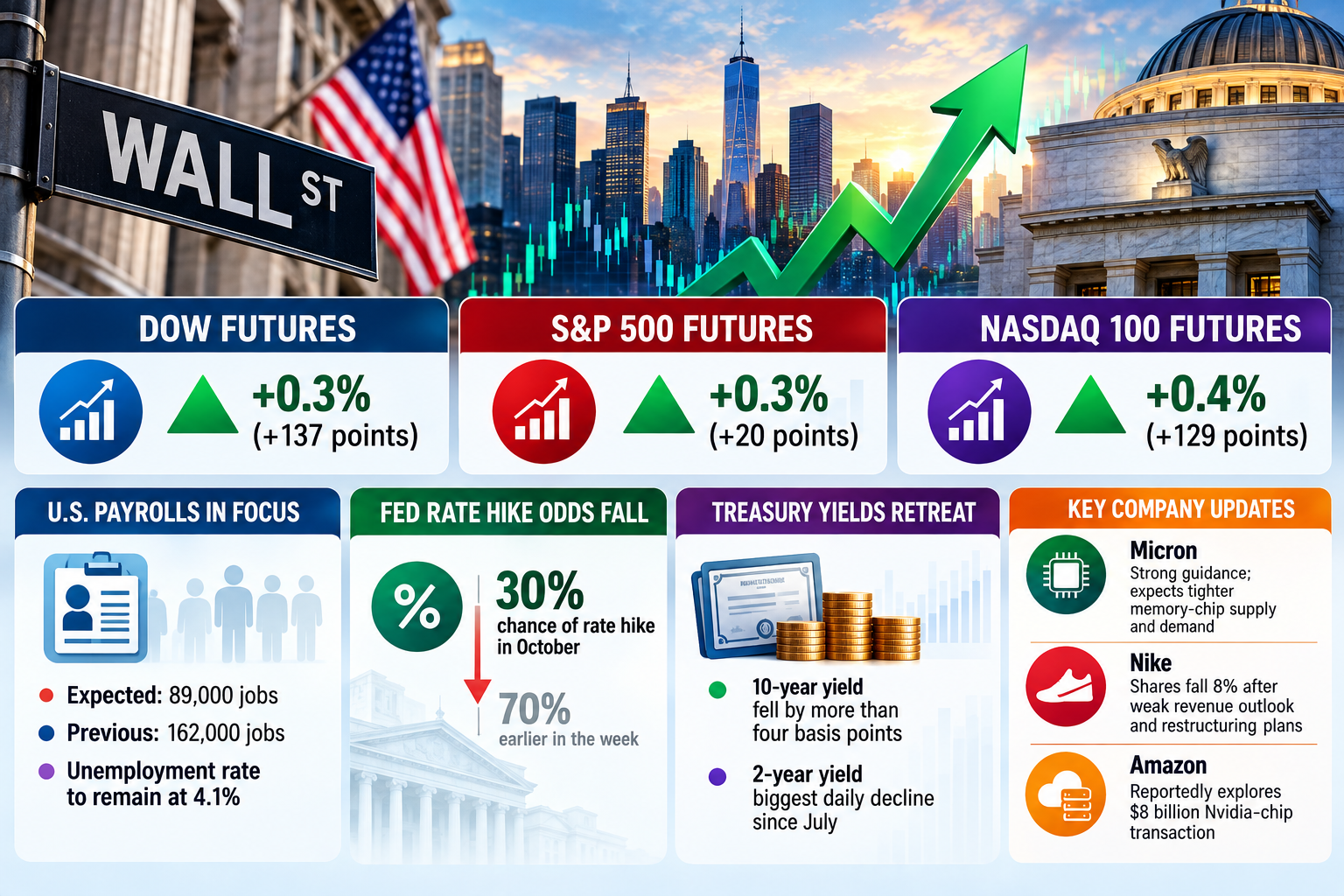
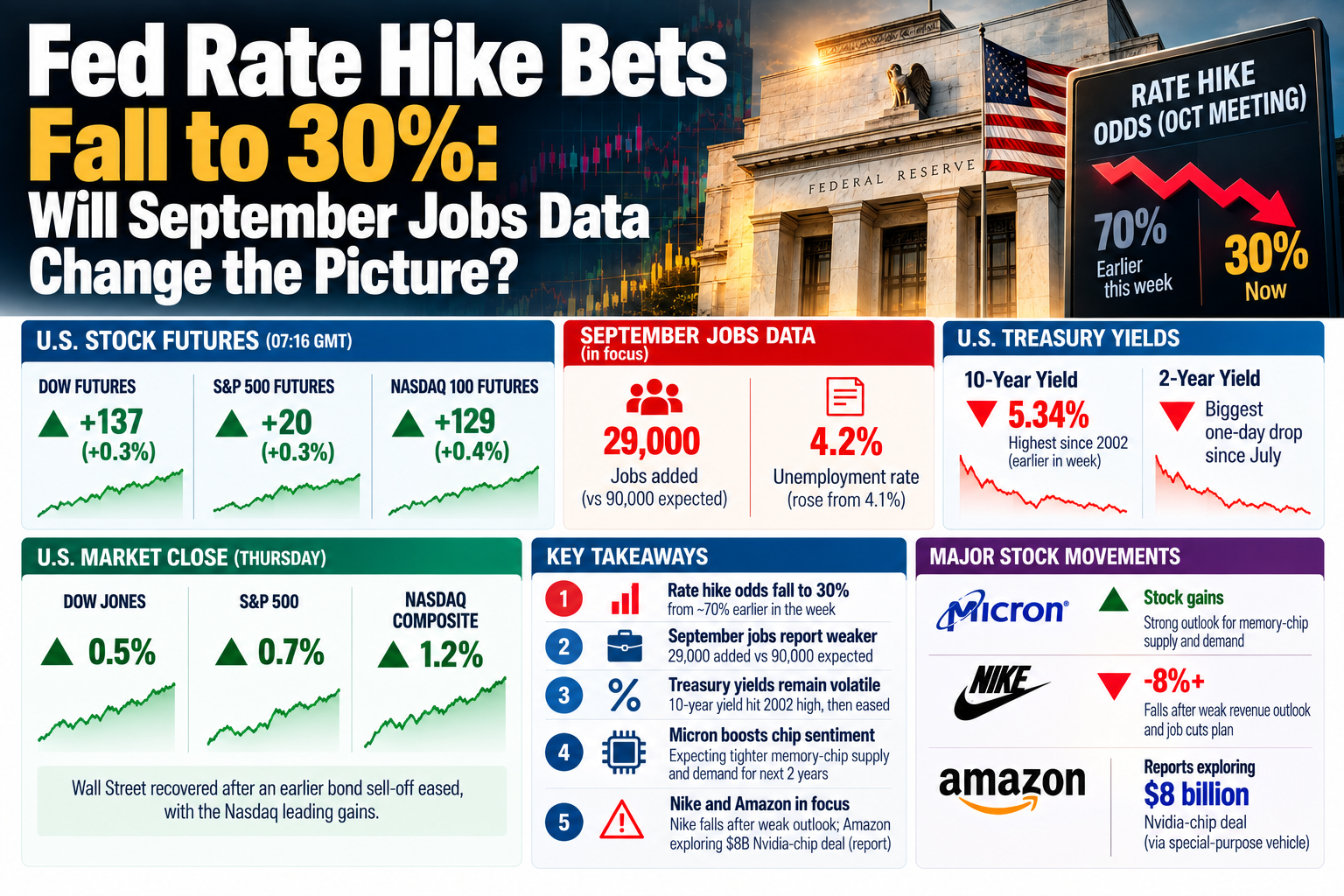
At 07:16 GMT, Dow futures gained 137 points, or 0.3%, while S&P 500 futures rose 20 points, or 0.3%. Nasdaq 100 futures added 129 points, or 0.4%.
The gains followed a modestly positive session on Thursday, when Wall Street recovered after an earlier sell-off in government bonds eased.
Track Live : GIFT Nifty Live – Today Price, Chart, Timings and Nifty Opening Signal
Fed Rate Hike Bets Fall : Treasury yields remain a key signal for Wall Street
The bond market remains another major driver of sentiment.
Expectations of another near-term rate increase have eased significantly. Markets were pricing around a 30% chance of a rate hike at the October Fed meeting, compared with roughly 70% earlier in the week, based on the supplied information.
Treasury yields also pulled back after the benchmark 10-year yield briefly reached its highest intraday level since 2002.
The 10-year yield eventually fell by more than four basis points, while the two-year yield recorded its biggest one-day decline since July.
However, bond-market volatility remains a concern. Inflation, Fed policy, Middle East developments and rising spending on artificial intelligence infrastructure are among the factors investors are watching.
How Wall Street reacted
By Friday’s close:
| Index | Friday move |
|---|---|
| Dow Jones | +0.5% |
| S&P 500 | +0.7% |
| Nasdaq Composite | +1.2% |
The Nasdaq outperformed as lower-rate expectations supported technology and semiconductor stocks.
U.S. Market Snapshot: 7 Key Points
- Dow futures: Up 137 points, or 0.3%, indicating a modestly positive start expected for Wall Street.
- S&P 500 futures: Up 0.3%, as investors remained focused on the U.S. economic outlook and interest-rate expectations.
- Nasdaq 100 futures: Up 0.4%, with technology and semiconductor stocks providing support.
- September jobs report in focus: Investors were awaiting the nonfarm payrolls report for clues about the labour market and the Federal Reserve’s next policy move. The subsequent report showed only 29,000 jobs added, versus expectations of 90,000, while unemployment rose to 4.2%.
- Treasury-market volatility: U.S. equities remained sensitive to movements in Treasury yields. Earlier in the week, 10-year and 30-year Treasury yields had reached their highest levels since 2002, making bond-market movements a major driver of equity sentiment.
- Micron supports chip sentiment: Micron’s strong outlook for memory-chip supply and demand helped reinforce optimism around the semiconductor and AI-infrastructure investment cycle.
- Nike and Amazon add company-specific signals: Nike came under pressure after forecasting a sharp revenue decline and announcing restructuring measures, while Amazon was reportedly exploring an approximately $8 billion Nvidia-chip transaction involving a special-purpose vehicle and leaseback structure.
Micron results give semiconductor stocks another boost
Micron’s quarterly results provided another positive signal for technology stocks.
The chipmaker said it expects memory-chip supply and demand conditions to remain considerably tighter over the next two fiscal years than during fiscal 2026.
The update could keep attention on semiconductor stocks and the broader AI investment theme, particularly as investors continue to assess whether heavy spending on AI infrastructure can translate into sustainable earnings growth.
Track Live : Opening Price Clues – What Pre-Market Data Says Today
Nike shares tumble after weak revenue outlook
Corporate news is creating a mixed picture beneath the broader gains in U.S. stock futures.
Nike shares fell more than 8% in after-hours trading after the company forecast a high-single-digit percentage decline in fiscal 2027 revenue. Analysts had expected a decline of about 2%.
Nike is also planning further job cuts and changes to its global business divisions under CEO Elliott Hill.
The company has not yet disclosed the number of positions affected but expects employees to be informed in 2027.
Major Stock Movements & AI Supply Chain Deals
| Company | Stock Performance / Market Impact | Key Catalyst |
|---|---|---|
| Amazon (NASDAQ: AMZN) | Closed at $251.52 | Amazon was reportedly exploring an approximately $8 billion transaction involving Nvidia Grace Blackwell chips. Under the proposed structure, the chips would move into a special-purpose vehicle backed by outside investors, with Amazon leasing them back. |
| Nvidia (NASDAQ: NVDA) | Closed at $233.95 | Nvidia remains central to the AI infrastructure buildout, with hyperscalers continuing to invest heavily in GPUs and data centres. Nvidia said AWS was deploying an additional 2 million GPUs beginning in the current quarter through fiscal Q2 2029. |
| Nike (NYSE: NKE) | Closed at $33.87 | Nike forecast fiscal 2027 revenue to decline by a high-single-digit percentage and announced its “Pace” operating-model transformation. The company expects approximately $2.5 billion in cumulative savings through fiscal 2031, alongside restructuring costs. |
| Micron Technology (NASDAQ: MU) | Supported broader semiconductor sentiment | Micron’s outlook pointed to tight memory supply-demand conditions as AI infrastructure demand remains strong, reinforcing the importance of memory chips in the broader AI hardware supply chain. |
Amazon and Nvidia deal report puts AI spending back in focus
Amazon is reportedly considering an approximately $8 billion transaction involving Nvidia AI chips, according to a Financial Times report cited in the supplied information.
The proposed structure would involve thousands of Nvidia Grace Blackwell chips being transferred to a special purpose vehicle. Amazon could then lease the chips for use in its U.S. data centres, with the vehicle potentially raising financing through debt.
The reported transaction highlights the enormous financing needs behind the AI infrastructure boom.
Read More : RBI Governor Reveals 5 Risks, Including AI, to the World’s Financial System
Macro Environment & Fed Rate Odds
- Bond-market volatility remains central: The U.S. 10-year Treasury yield had climbed to its highest intraday level since 2002 before retreating, while the two-year yield recorded its sharpest one-day decline since July. The move reflected changing expectations around the Federal Reserve and the U.S. economy.
- Fed hike expectations have fallen sharply: Earlier in the week, markets had been pricing roughly a 70% probability of an October rate hike. After comments from Fed officials and the weaker jobs data, that probability fell toward 20% or below.
- September payrolls were much weaker than expected: The U.S. economy added just 29,000 jobs in September, versus expectations of roughly 90,000. August payroll growth was also revised down from 162,000 to 133,000. The unemployment rate increased to 4.2% from 4.1%.
- The market’s rate outlook has therefore changed: The weaker labour-market report reduced the immediate pressure on the Fed to raise rates at its October 27–28 meeting. However, the December policy decision remains dependent on upcoming inflation data and other economic developments.
Here’s what happened today and why traders reacted
The focus has quickly shifted towards the U.S. jobs report, which could influence expectations for the Federal Reserve’s next interest-rate move.
Markets expect the U.S. economy to have added 89,000 jobs in September, down sharply from 162,000 in August. The unemployment rate is expected to remain at 4.1%.
“Clearly, the monthly jobs reports are always a macro highlight, but this is an important one, as the continued data resilience has been a huge factor supporting U.S. risk assets,” Deutsche Bank analysts said.
For traders, a stronger-than-expected jobs number could reinforce expectations for tighter monetary policy, while weaker employment data could strengthen expectations for a more cautious Fed.
What investors should watch next
The September payrolls report will be the immediate market catalyst. Investors will be watching job creation, unemployment and wage-related signals for clues about the Fed’s next move.
At the same time, Treasury yields remain crucial for technology and growth stocks because changes in borrowing costs can quickly affect valuations.
For traders and investors, the combination of U.S. futures, payrolls, Treasury yields, Fed expectations and AI-related spending could determine whether Wall Street extends its recent gains or sees another bout of volatility.