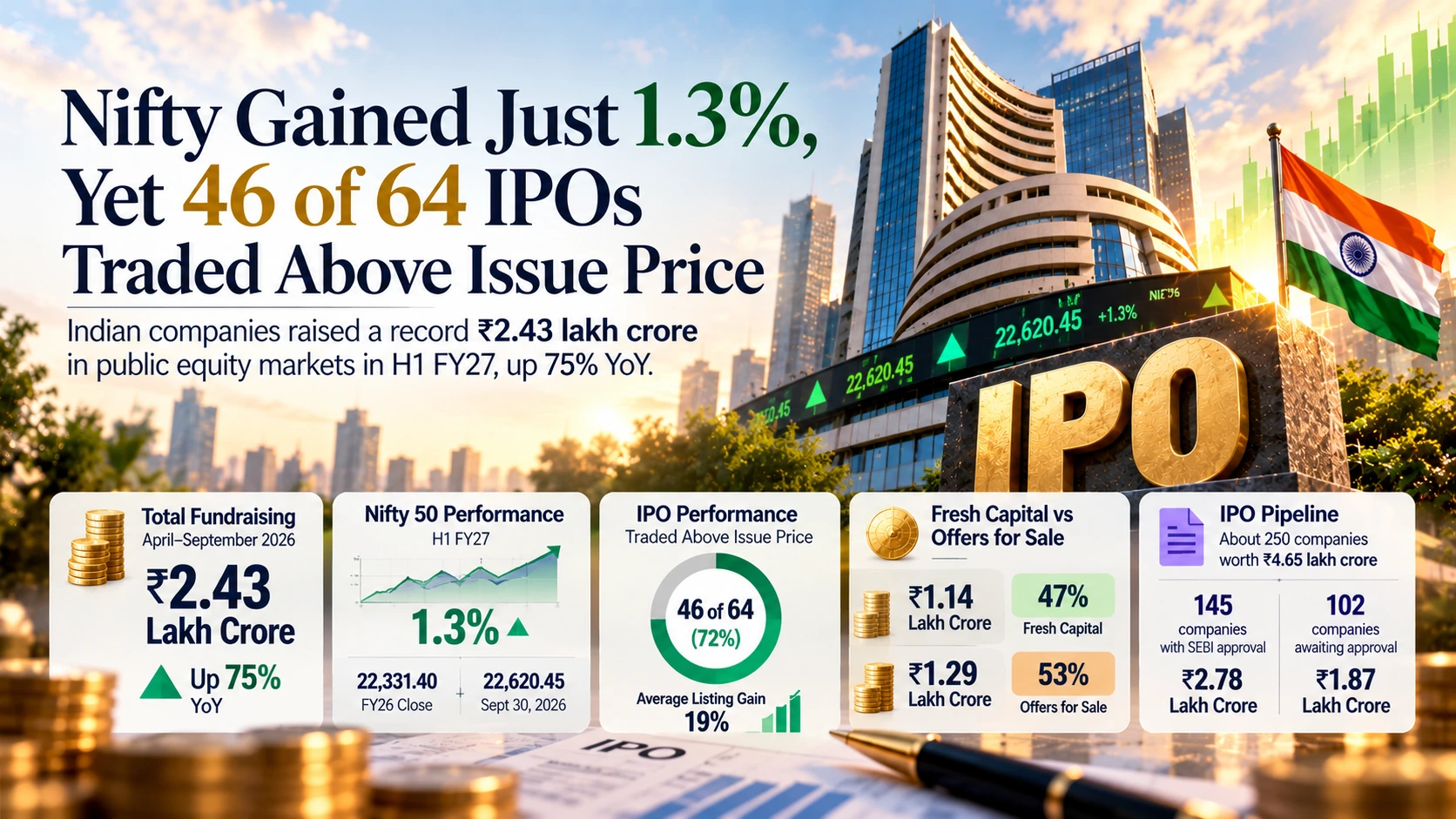
Indian issuers raised a record ₹2.43 lakh crore ($25.27 billion) from public equity markets in April–September 2026, up 75% year-on-year, PRIME Database Group data reported by Reuters on October 1 showed. The Nifty 50 gained just 1.3% during H1 FY27.
For investors, the more useful numbers sit underneath that headline. Of 64 IPOs with response data, 46 were trading above their issue price on September 29, according to PRIME. Meanwhile, ₹1.29 lakh crore, about 53% of the total, came through offers for sale rather than fresh capital.
Need to Know
- Public equity fundraising hit a record ₹2.43 lakh crore, up 75%.
- The Nifty 50 gained 1.3% during H1 FY27, ending September at 22,620.45.
- 46 of 64 IPOs with response data (72%) traded above issue price on September 29.
- Average IPO listing gains rose to 19% from 7%.
- Fresh capital was ₹1.14 lakh crore (47%); offers for sale accounted for ₹1.29 lakh crore (53%).
- About 250 companies are lined up for IPOs worth roughly ₹4.65 lakh crore.
Track Live: Latest IPOs 2026 | Recently Listed IPOs, Check Subscription & Listing Updates
Where the Money Went
- Mainboard IPOs: a record ₹94,205 crore across 78 issues, 35% above the previous first-half high. The largest deals were NSE at ₹22,563 crore (India’s second-largest IPO on record), SBI Funds Management at ₹9,795 crore and Manipal Health Enterprises at ₹9,275 crore.
- QIPs: up 36% to ₹61,553 crore, led by Adani Enterprises.
- OFS through stock exchanges: up more than fivefold to ₹55,337 crore, mainly due to government divestments in companies such as LIC and Coal India. LIC’s 6.5% stake sale alone raised about ₹31,400 crore.
The ₹2.43 lakh crore total also includes SME issues and InvIT/REIT fundraising.
IPO Scorecard
According to PRIME data, 42 of the 64 IPOs with response data (66%) were subscribed more than 10 times. PRIME’s 19% average listing gain compares each issue price with the closing price on the listing date, so it measures debut performance, not current returns. Check each issue’s current price before drawing conclusions.
Emkay Global’s Yatin Singh told Reuters that investors also sought niche exposure, with listings from sectors thinly represented on Indian bourses, including Rentomojo, LEAP India and Asset Reconstruction Company (India).
Fresh Capital’s Share Is Slipping
Fresh capital accounted for ₹1.14 lakh crore, or 47% of total equity mobilisation in H1 FY27, according to PRIME Database. The remaining ₹1.29 lakh crore, or 53%, came through offers for sale.
That share has been falling. PRIME put fresh capital at 63% in FY25 and 55% in FY26, both full-year figures. It was 51% in FY18, so 47% is not unprecedented, but it is the lowest of the past three years. A half-year compared with full years is not strictly like-for-like.
Money raised through an offer for sale goes to the selling shareholder, not the company. PRIME data shows OFS through stock exchanges rose more than fivefold to ₹55,337 crore, mainly due to government divestments such as LIC’s 6.5% stake sale. That is less than half of the ₹1.29 lakh crore total, so other offers for sale, including the selling-shareholder portions of IPOs, made up the rest.
Why the Index Isn’t Keeping Up
PRIME Database MD Pranav Haldea called the gap between primary and secondary markets “unusual” and cited a two-to-three-year IPO backlog and strong domestic liquidity. Reuters also reported that SEBI granted a one-time extension in April to IPOs deferred because of weak sentiment during the Middle East war, whose approvals were lapsing between April and September.
The flat index also hides a split market. An H1 FY27 market review found 16 Nifty stocks up more than 10% and seven down more than 10%. Adani Enterprises was the top gainer at 65%.
The IPO Pipeline
- 145 companies hold SEBI approval for about ₹2.78 lakh crore.
- 102 companies seeking about ₹1.87 lakh crore are awaiting approval.
The pipeline includes Jio Platforms’ $3.8 billion IPO, Carlsberg’s India business and Oyo’s parent Prism. Only part of it is cleared, so timing will depend on market conditions.
Check Live: Current IPOs 2026 – Ongoing SME & Mainboard IPOs in India
What to Watch in H2 FY27
Singh said the second-half picture is unlikely to change dramatically unless a major global or domestic factor shifts. Analysts quoted in the H1 market review name oil prices and bond yields as the key swing factors.
Analysis: the main risk is supply. If index returns stay muted while the pipeline keeps filling, investors may become more selective about which new issues they back.
Bottom Line
The ₹2.43 lakh crore headline reflects strong demand for new issues, but 53% of it came through offers for sale, not fresh capital. With ₹4.65 lakh crore of IPOs queued, the next two quarters will test whether domestic liquidity can keep absorbing supply.
Read Next: Nayara Fuel Price Hike: ₹5 Petrol, ₹3 Diesel Amid $100+ Brent Streak
FAQs
How much did Indian issuers raise in H1 FY27?
A record ₹2.43 lakh crore ($25.27 billion) in public equity in April–September 2026, up 75% year-on-year, per PRIME Database Group.
How much of it was fresh capital?
₹1.14 lakh crore (47%). The remaining ₹1.29 lakh crore (53%) came through offers for sale.
How are the new IPOs performing?
Of 64 IPOs with response data, 46 (72%) traded above issue price on September 29, and average listing gains were 19%.
How did the Nifty 50 perform?
It gained 1.3% during H1 FY27, ending at 22,620.45 on September 30, up from 22,331.40 at the close of FY26.
How big is the IPO pipeline?
About 250 companies are lined up to raise roughly ₹4.65 lakh crore. Of that, ₹2.78 lakh crore across 145 companies has SEBI approval.
Disclaimer: For information only, not investment advice. Sources: PRIME Database Group, Reuters, ANI, BW Businessworld.