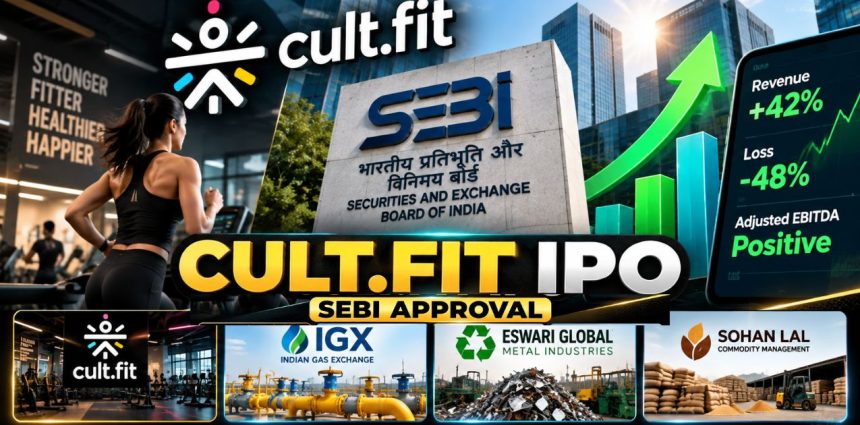
Cult.fit, Indian Gas Exchange, Eswari Global Metal Industries and Sohan Lal Commodity Management can now move towards launch, but the four offers could hardly look more different.
SEBI has issued observations on the draft IPO papers of all four companies, allowing them to proceed to the next stage of the listing process. According to CNBC-TV18, the regulator’s observations on Cult.fit and Indian Gas Exchange (IGX) came on October 12, followed by Eswari Global and Sohan Lal on October 13.
The headline numbers hide the real story. Across the three offers with public details, existing shareholders plan to sell more than 20.8 crore shares (NiftyTrader’s tally of DRHP figures), while only two companies are raising fresh capital: Cult.fit (₹950 crore) and Eswari Global (₹500 crore). IGX’s issue is a pure offer for sale (OFS), so none of the money reaches the company.
What SEBI’s Observations Mean, and What They Do Not
Observations are a go-ahead to proceed, not a launch. None of the four companies has announced an issue date, price band or lot size. According to CNBC-TV18, companies on the regular filing route generally have 12 months from receiving observations to launch, while those on the confidential route get 18 months. On NiftyTrader’s calculation, that puts the outer limit at around October 2027 for Cult.fit, IGX and Eswari, and around April 2028 for Sohan Lal.
The next formal step is a red herring prospectus (RHP) filed with the Registrar of Companies, which carries the final price band and dates.
Cult.fit: Revenue Nearly Doubled in Two Years, but the Loss Is Still About ₹252 Crore
Cult.fit, co-founded by Myntra founder Mukesh Bansal, plans a ₹950 crore fresh issue alongside an OFS of 17.86 crore shares. The selling shareholders include Temasek-backed MacRitchie Investments, Tata Digital, Accel India V (Mauritius), Schroders Capital, Chiratae Trust and Fitness First Luxembourg, according to CNBC-TV18.
The financial trajectory is the draw. According to DRHP figures reported by Kotak Neo and Outlook Money, revenue from operations rose to ₹1,720.6 crore in FY26 from ₹1,215.5 crore in FY25, a jump of roughly 42%. Net loss narrowed to about ₹252 crore from ₹480.8 crore. Against FY24, when revenue was ₹926.7 crore and the loss ₹888.5 crore, revenue is up about 86% in two years while the loss is about 72% smaller (NiftyTrader’s calculation).
Adjusted EBITDA also turned positive at ₹144.8 crore in FY26, against a loss of ₹33.5 crore in FY25, while the adjusted EBITDA margin improved to 8.41% from –2.76%.
| Cult.fit financial metric | FY25 | FY26 |
|---|---|---|
| Revenue from operations | ₹1,215.5 crore | ₹1,720.6 crore |
| Net loss | ₹480.8 crore | ₹251.9 crore |
| Adjusted EBITDA | –₹33.5 crore | ₹144.8 crore |
| Adjusted EBITDA margin | –2.76% | 8.41% |
Source: The Economic Times’ report on the company’s draft IPO filing. Figures are rounded.
The company still loses money, and the use of proceeds shows where the next bet goes. Kotak Neo reports that ₹276.6 crore, under 30% of the fresh issue, is earmarked for new Cult Elite and Cult Neo centres. A pre-IPO placement of up to ₹190 crore could also shrink the fresh issue. Cult.fit had 708 centres across 77 cities and more than 9.87 lakh paid members as of March 31, 2026, according to CNBC-TV18.
Outlook Money, citing a Reuters estimate, puts the total IPO size at ₹3,500 to ₹4,000 crore. If that holds, roughly three-quarters of the offer would be an OFS, meaning most of the money would go to selling investors rather than the company. That is NiftyTrader’s arithmetic on an estimate, not a DRHP figure.
The DRHP also flags risks, per Kotak Neo: continued losses, dependence on four cities for a majority of services revenue, reliance on franchise-operated centres, and pending litigation and statutory dues.
IGX: A High-Margin Exchange With a Seller That Has to Sell
IGX is the profit story of the group. Business Today reports FY26 revenue of ₹61 crore, up 25% from ₹48.8 crore, and profit of ₹42 crore, up 36.5% from ₹30.8 crore. Profit equals about 69% of operating revenue on NiftyTrader’s calculation. IPO Guru data show traded volumes of 76.79 million MMBtu in FY26 against 60.02 million a year earlier, about 28% higher.
The sale is also partly regulatory. Parent Indian Energy Exchange (IEX) holds 47.28% and plans to sell up to 1.67 crore shares, which would take its stake down to about 25%, the regulatory ceiling. NSE Investments, at 24.75%, already sits just below that line. ONGC, GAIL, Indian Oil, Adani Total Gas and Torrent Gas hold 4.92% each. Shares are proposed to list only on the BSE, and IGX would become India’s first listed gas exchange. Axis Capital and Motilal Oswal Investment Advisors are the lead managers.
IGX’s CEO had earlier targeted an IPO by December 2026, according to PTI. Observations arrived only this week, so that timeline now depends on RHP filing and market conditions.
Eswari Global: Profit Run-Rate Jumps Ahead of a Capex-and-Debt Raise
Coimbatore-based Eswari Global, incorporated in 1987, recycles non-ferrous metals, plastics and e-waste. PTI reports a ₹500 crore fresh issue and an OFS of up to 1.32 crore shares by promoters and another selling shareholder. Market sources estimate the full IPO at ₹1,100 to ₹1,300 crore, though that is not a DRHP figure.
About 80% of the fresh issue is earmarked: ₹150 crore for Phase-II expansion of its Mundra facility in Gujarat and ₹250 crore for debt repayment. A pre-IPO placement of up to ₹100 crore would reduce the fresh issue.
The numbers show a sharp step-up. In the nine months to December 2025, revenue was ₹1,401.5 crore and net profit ₹83.9 crore. For all of FY25, revenue was ₹1,407.6 crore and profit ₹30.2 crore, so nine-month profit is already about 2.8 times the full-year figure. DAM Capital, ICICI Securities and Motilal Oswal are the lead managers.
Sohan Lal: The Confidential Route Keeps the Numbers Hidden, for Now
New Delhi-based Sohan Lal Commodity Management, founded in 2009 by Sandeep Sabharwal, offers technology-driven post-harvest logistics, including warehousing, procurement and collateral management. It pre-filed through the confidential route in March 2026, so issue size, structure and financials are not public.
Confidential pre-filing lets companies take SEBI’s feedback without public disclosure, according to Outlook Business. Investors will see the company’s numbers only when it files an updated DRHP, which comes before the RHP.
Why the Timing Matters
India’s primary market is busy. The Free Press Journal reports that 96 IPOs have raised over ₹1.1 lakh crore in 2026 so far, including 35 issues in September. Jio Platforms’ issue of roughly $3.8 billion is expected to open on October 21, according to Reuters sources, and will dominate attention in the near term.
The 12- to 18-month windows mean none of the four need to rush. Daily institutional flows are one input into primary-market appetite, and you can follow them on NiftyTrader’s FII-DII Tracker at niftytrader.in/fii-dii-data.
What to Watch Next
Four things will matter most: whether Cult.fit completes its ₹190 crore pre-IPO placement and how that changes the fresh issue; the price band when it emerges, since valuation will decide how investors read the loss trajectory; whether IGX holds to its December target; and Sohan Lal’s first public financials.
Bottom Line
SEBI’s observations clear the path but not the price. Cult.fit offers growth with losses still on the books, IGX offers high margins with a parent that must sell, Eswari offers fast-rising profit with a debt-and-capex raise, and Sohan Lal remains an unknown until its numbers surface. The next disclosures will decide which of the four deserves the premium.
Read Next: ₹8,874 Crore IPO Rush: 4 Issues Open Today, but 68% Won’t Go to Companies
Disclaimer: This article is for informational purposes only and does not constitute investment advice, a recommendation, or an offer to buy or sell any security. IPO details are drawn from draft offer documents and media reports and may change in the final prospectus. Investments in securities markets are subject to market risks. Read all offer-related documents carefully before investing.