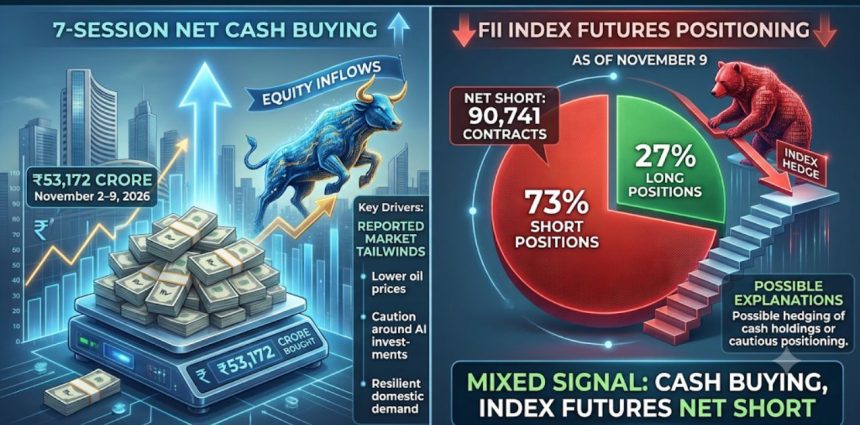
Foreign institutional investors bought about ₹56,771 crore of Indian equities between October 30 and November 9, helping the Nifty hit an eight-month high. But NSE derivatives data for November 9 shows 73.2% of their Nifty index-futures positions were still short. Is it hedging, or lingering caution?
Foreign money is flowing back into Indian shares, but the derivatives market is not fully convinced.
Foreign institutional investors (FIIs) were net buyers of about ₹56,771 crore across seven trading sessions from October 30 to November 9, according to NSE’s provisional FII/FPI and DII data. Yet on November 9, 73.2% of their Nifty index-futures contracts were on the short side, according to NSE participant-wise open-interest data.
That contrast matters because the Nifty 50 and Sensex have climbed to their highest levels since February 27. The question for traders is whether FIIs will start cutting those futures shorts or whether they are using them to protect a fast-growing cash-market portfolio.
Track Live: FII DII Data Today: NSE/BSE Cash & F&O Activity
FIIs Buy ₹56,771 Crore Across Seven Sessions
The buying is a sharp turnaround from the heavy foreign selling of September and October.
Provisional exchange data shows:
- October 30: net buying of ₹3,598.54 crore
- November 2–9: net buying of about ₹53,172 crore
Together, these flows come to roughly ₹56,771 crore.
Depository data, which is a separate series, shows foreign portfolio investors (FPIs) pulled out ₹35,861 crore in September and ₹34,843 crore in October. It also shows ₹53,739 crore of inflows during November 2–9, which should not be added to the exchange total. Even after the rebound, cumulative FPI outflows from Indian equities in 2026 still stood at about ₹2.41 lakh crore.
Reuters reported on November 11 that FPIs have bought $5.68 billion worth of Indian equities in November, the largest monthly inflow since September 2024.
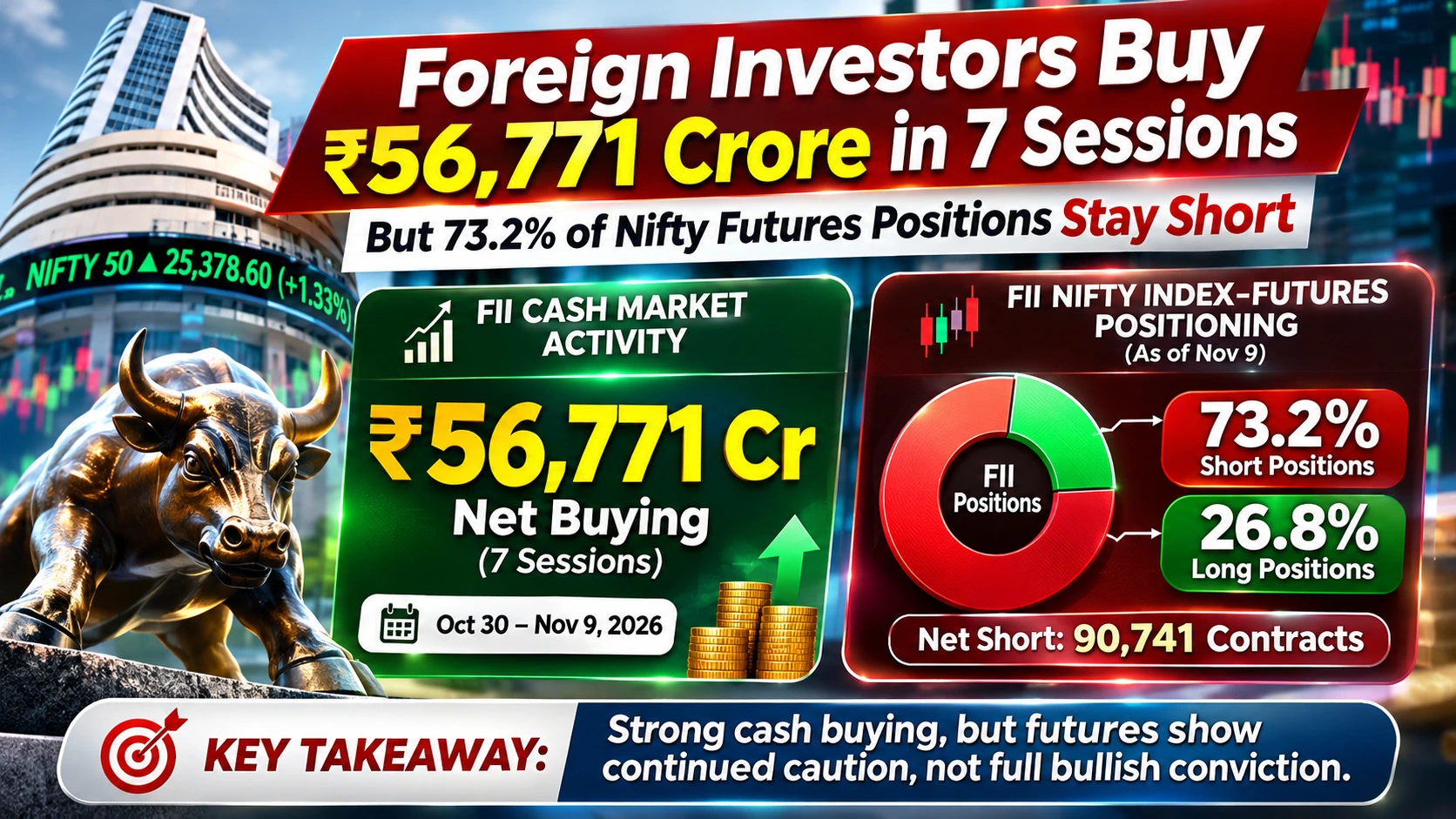
The Futures Signal: 73.2% of FII Positions Are Still Short
On November 9, NSE participant-wise data showed FIIs held:
- 52,382 long Nifty index-futures contracts
- 1,43,123 short contracts
- a net short position of 90,741 contracts
That works out to 73.2% short and 26.8% long, or about 2.73 short contracts for every long one.
The trend is improving, not worsening. According to reported NSE participant-positioning data, the 26.8% long share was the second-highest reading of 2026, and it stayed below 15% for much of the period after the Iran-US conflict. Foreign investors have become less bearish in futures, but fewer than three in every ten contracts are long.
Two cautions apply. First, futures positions are not a market forecast. FIIs can use index futures to hedge cash portfolios, manage exposure or run relative-value trades, so a net short does not mean they are bearish on Indian stocks. Second, these figures cover index futures only and exclude index options, where positioning can differ.
Track Live: Nifty Futures Live Price, OI, Chart & Expiry Today
FII Buying Almost Entirely Offsets DII Selling
Domestic institutional investors (DIIs) moved the other way on November 9, according to NSE’s provisional data.
- FIIs/FPIs: bought ₹20,310.99 crore, sold ₹13,098.77 crore, net buying of ₹7,212.22 crore
- DIIs: bought ₹12,764.97 crore, sold ₹19,937.50 crore, net selling of ₹7,172.53 crore
Combined, the two groups were net buyers of just ₹39.69 crore. Over November 2–9, DIIs were net sellers of about ₹32,069 crore.
With domestic institutions selling, the rally is leaning on overseas capital. A sudden reversal in foreign flows could therefore lift volatility.
Nifty Hits Eight-Month High as Crude Eases
At 11:00 a.m. IST on November 11, the Nifty 50 was at 25,378.60, up 1.33%, and the Sensex was at 82,363.95, up 1.55%. Both were at their highest levels since February 27.
At 10:07 a.m. IST, the Nifty and Sensex were up about 10% and 10.5%, respectively, for November, on track for their strongest monthly performance since November 2020. Fourteen of 16 major sectors were trading higher.
Brent crude touched a two-month low of $89.16 per barrel on November 10 before recovering to about $92.40 on November 11. Cheaper oil eases pressure on India’s import bill and currency. Reuters also pointed to a global correction in AI-related stocks, resilient corporate earnings and improved large-cap valuations as reasons for renewed foreign interest.
Market data timestamp: November 11, 2026, 11:00 a.m. IST. Index levels are intraday figures, not closing prices.
Also Check: NIFTY50 | SENSEX | NIFTYTRADER
What to Watch Next
- FII futures positioning: Does the 26.8% long share keep rising in the next participant-wise update? Further short-covering would signal growing comfort.
- Cash-market follow-through: Do foreign investors keep buying, or was this a one-off burst?
- DII behaviour: Continued domestic selling would make the market more dependent on foreign inflows.
- Crude and AI-stock sentiment: Brent near $90 and the global AI-stock correction are the two drivers cited for the foreign return, so a reversal in either could test it.
Bottom Line: Foreign Money Is Back, but Futures Haven’t Caught Up
Foreign investors have bought ₹56,771 crore of Indian equities in seven sessions, and the Nifty is at an eight-month high. But their Nifty futures positioning is still tilted short, even though it has improved.
If cash buying continues while the long share of index-futures positions climbs above 26.8%, the case for broader institutional conviction strengthens. If shorts rise while cash buying continues, the divergence widens. Until one of those happens, the foreign comeback is a clear cash-market positive, not yet a confirmed bullish turn in derivatives.
Read Next: Stocks in News Today: IIFL’s ₹5,000-Cr Bet, Jyothy’s 88% Profit Fall
Disclaimer: This article is for informational and educational purposes only and does not constitute investment advice or a recommendation to buy or sell any security. Derivatives positioning can reflect hedging as well as directional trading. Investors should independently verify market disclosures and consult a SEBI-registered investment adviser before making investment decisions.