Nvidia Stock Down Nearly 29% Stock Crash a Buying Opportunity?
Nvidia has become the centre of a market storm that goes well beyond a routine correction in technology stocks. The world’s most valuable chipmaker is still delivering extraordinary revenue growth, but concerns over artificial intelligence spending, future returns on data-centre investments and an unprecedented leadership crisis are challenging investor confidence.
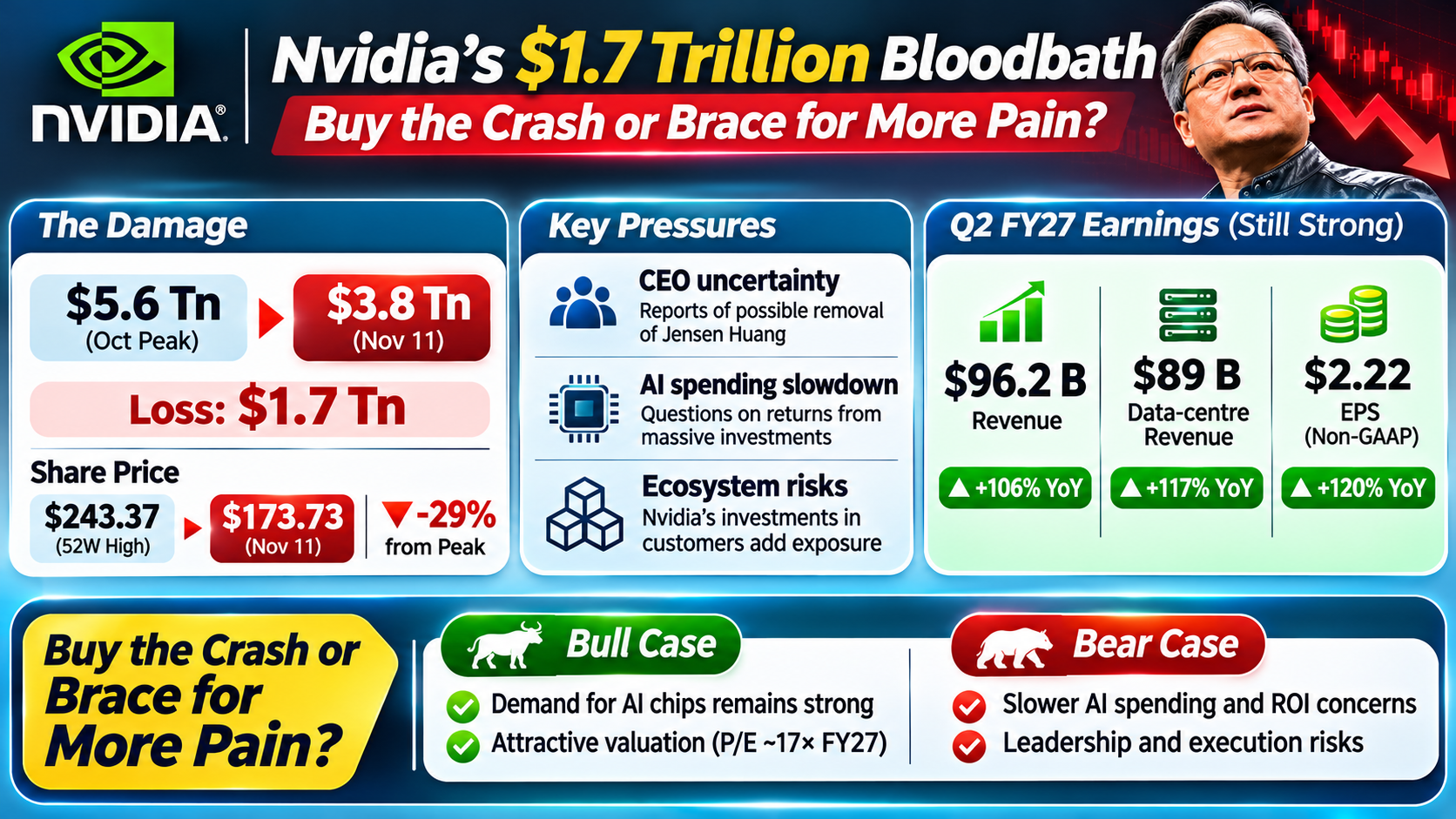
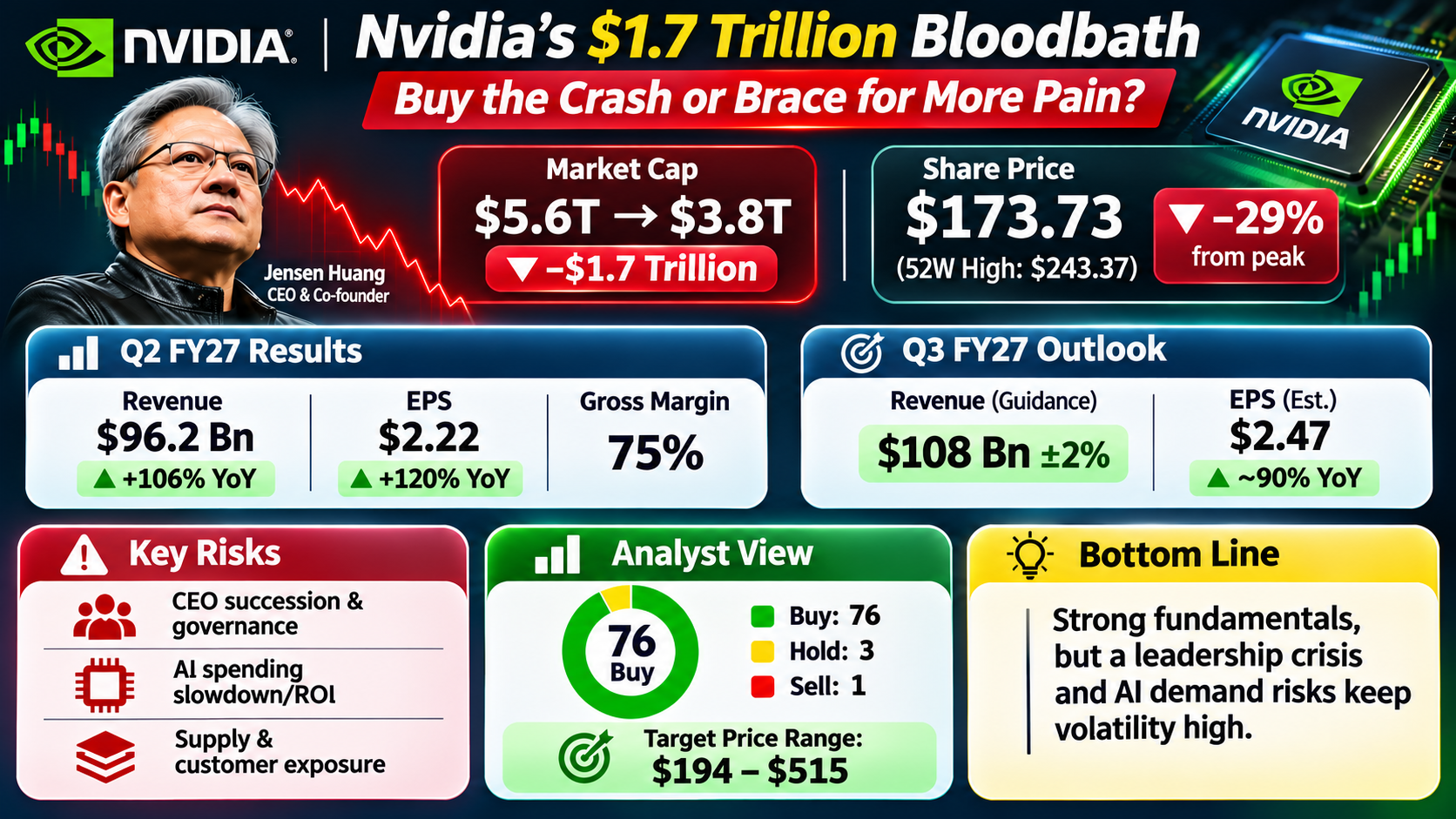
Nvidia shares closed at $173.73 on November 11, compared with their 52-week high of $243.37, representing a decline of nearly 29%. The sell-off has wiped out approximately $1.7 trillion in market value from the company’s October peak, reducing its valuation from around $5.6 trillion to roughly $3.8 trillion in after-hours trading.
The big question now is whether investors are looking at an attractive entry point or the beginning of a deeper correction.
Track Live : NSE Option Chain — Live | BSE Option Chain — Live Sensex & Bankex Options Data Today
Nvidia Stock Down : Nvidia’s Earnings Remain Strong, but Expectations Are Even Higher
Nvidia’s latest reported financial results underline the strength of its artificial intelligence business. Revenue in the second quarter of fiscal 2027, ended July 26, surged 106% year-on-year to $96.2 billion. Data-centre revenue, the company’s biggest growth engine, jumped 117% to $89 billion.
Non-GAAP earnings per share increased 120% to $2.22, while gross margin stood at 75%.
The company guided for third-quarter revenue of $108 billion, plus or minus 2%, and gross margin of approximately 74%. Market expectations are around $109 billion in revenue and adjusted earnings of $2.47 per share for the October quarter.
These numbers point to another exceptionally strong quarter. However, investors increasingly expect Nvidia to outperform already aggressive forecasts. A result that meets expectations but fails to deliver stronger guidance could struggle to reverse the share-price decline.
Nvidia’s November 17 earnings announcement will therefore be a critical test. Investors will focus on data-centre demand, the ramp-up of next-generation chips and systems, and the sustainability of gross margins.
Track Live : GIFT Nifty Live – Today Price, Chart, Timings and Nifty Opening Signal
Nvidia Shares Fall 29% From Peak as Market Value Shrinks
Nvidia shares closed at $173.73 on November 11, compared with their 52-week high of $243.37, representing a decline of approximately 28.6%.
The selloff accelerated following reports about the company’s leadership uncertainty.
| Market Indicator | Details |
|---|---|
| November 11 closing price | $173.73 |
| 52-week high | $243.37 |
| Decline from peak | Approximately 29% |
| After-hours decline | More than 8% |
| Market value at October peak | Approximately $5.6 trillion |
| Market value after-hours | Approximately $3.8 trillion |
| Estimated market value erosion | Approximately $1.7–$1.8 trillion |
Track Live : Nifty Levels Today | Sensex Levels Today
Nvidia’s Earnings Engine Remains Strong: Revenue Jumps 106%
Despite the share-price correction, Nvidia’s underlying financial performance remains exceptionally strong.
For the second quarter of fiscal 2027, ended July 26, 2026, the company reported revenue of $96.2 billion, representing 106% year-on-year growth.
Its data-centre business, which powers the global AI infrastructure expansion, generated $89 billion in revenue.
| Financial Metric | Q2 FY27 | Year-on-Year Growth |
|---|---|---|
| Total revenue | $96.2 billion | +106% |
| Data-centre revenue | $89 billion | +117% |
| Non-GAAP EPS | $2.22 | +120% |
| GAAP EPS | $2.46 | +128% |
| Gross margin | 75% | Improved |
The company’s third-quarter revenue guidance was $108 billion, plus or minus 2%, with expected gross margins of approximately 74%.
AI Spending and Customer Financing Present a Bigger Business Risk
Nvidia’s long-term earnings outlook remains attractive on paper. Bloomberg consensus estimates put earnings per share at $9.33 for FY27, $15.90 for FY28, $21.40 for FY29 and $25.30 for FY30.
At the current share price, those projections imply progressively lower forward valuation multiples, potentially making Nvidia appear inexpensive if earnings growth materialises.
However, consensus estimates assume earnings compound at approximately 32% annually through FY30. That is a demanding expectation.
One concern is Nvidia’s exposure to customers whose own AI investments require substantial funding. The company is not simply selling chips; it is also investing in and financing parts of the ecosystem buying its products. If customers face funding constraints or fail to generate sufficient returns from AI infrastructure, demand could weaken across the supply chain.
Read More : Nifty 50 Gainer SBI Retains Bullish Ratings From CLSA and Goldman After Investor Meet
Jensen Huang Leadership Crisis: Why Nvidia Investors Are Worried
The biggest immediate uncertainty is no longer just Nvidia’s financial performance. It is the future of its leadership.
Jensen Huang co-founded Nvidia in 1993 and has led the company for more than three decades. He has played a central role in developing its GPU technology, AI strategy and relationships with major technology companies.
Recent media reports have raised allegations concerning two extramarital relationships, including one involving Alice Huang, a former business executive suspected by US authorities of having links to Chinese intelligence activities.
These allegations remain subject to investigation and should not be treated as established wrongdoing.
On November 8, Nvidia’s board announced an independent investigation, stating that it had confidence in Huang and his leadership team. However, a subsequent Wall Street Journal report on November 11 said the board was preparing to remove him. Reuters also reported that directors were meeting to discuss his future.
Nvidia Valuation: Is the Stock Becoming Attractive After the Correction?
The correction has significantly reduced Nvidia’s market valuation, potentially creating an opportunity for long-term investors.
According to the analyst estimates provided in the original report, projected earnings per share are:
| Financial Year | Estimated EPS |
|---|---|
| FY26 | $4.77 |
| FY27 | $9.33 |
| FY28 | $15.90 |
| FY29 | $21.40 |
| FY30 | $25.30 |
These forecasts imply substantial earnings growth over the coming years.
However, the reported forward P/E multiples of 17 times for FY27, 10 times for FY28 and 6.2 times for FY30 should be treated cautiously. They depend on forecast earnings and the share-price reference used, rather than representing guaranteed future valuations.
Analyst sentiment also remains broadly positive despite the correction.
The supplied Bloomberg analyst survey indicated that 76 analysts maintained Buy recommendations as of November 11, while three had Hold recommendations.
Reported price targets ranged from $194 to $515.
Here’s What Happened Today and Why Traders Reacted
The latest pressure on Nvidia reflects a combination of business and governance concerns. Reports about a possible leadership change involving chief executive Jensen Huang intensified selling, with shares falling approximately 8% in after-hours trading.
The Wall Street Journal reportedly indicated that the board was preparing to remove Huang, while other media reports raised allegations concerning his personal relationships and possible governance issues. These claims remain subject to verification and should not be treated as confirmed findings or a completed board decision.
The uncertainty is significant because Huang co-founded Nvidia and has led the company for 33 years. He has shaped its technology roadmap, engineering culture and relationships across the AI ecosystem. Media reports put his ownership at approximately 3.6%.
A sudden departure could raise questions about succession, strategic continuity and the company’s ability to maintain its competitive advantage.
Buy Nvidia After the Crash or Wait for More Clarity?
Nvidia presents two contrasting investment arguments.
| Bullish Factors | Bearish Factors |
|---|---|
| Revenue growth remains strong | Leadership uncertainty |
| AI chip demand remains substantial | Potential slowdown in AI spending |
| Data-centre business expanding rapidly | Customer financing risks |
| Strong gross margins | Supply constraints |
| Long-term AI infrastructure opportunity | High earnings expectations |
Analyst Optimism Remains, but Investors Face a Difficult Choice
Analyst sentiment remains overwhelmingly positive. On October 6, Bloomberg data showed 79 Buy recommendations, two Hold calls and one Sell recommendation. By November 11, 76 analysts retained Buy ratings, while three had moved to Hold.
Reported price targets ranged from $194 at Zacks to $515 at Raymond James, reflecting substantial differences in expectations.
Warren Buffett’s observation that “when a management with a reputation for brilliance tackles a business with a reputation for bad economics, it is the reputation of the business that remains intact” offers a useful perspective.
For Nvidia investors, the central question is whether its technological leadership can outlast the uncertainty surrounding its CEO. The November 17 results may provide important clues, but investors must weigh exceptional growth potential against AI spending risks, valuation expectations and leadership uncertainty before treating the correction as a buying opportunity.